Aliens invaded the culture again this year. Southwest writers and contemporary artists had already made compassionate contact.
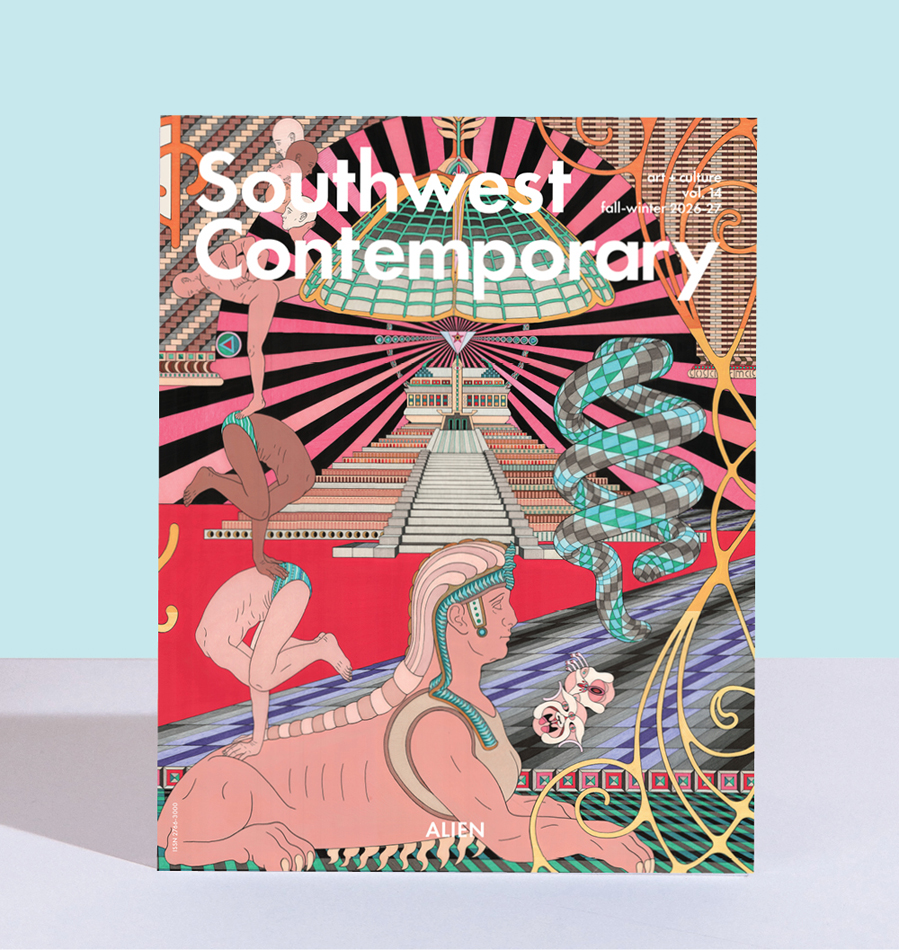
Welcome to Volume 14 of Southwest Contemporary: Alien.
Not since perhaps the 1950s or early ’80s have aliens—the skinny, gray-green, bug-eyed ones—stormed the culture as they did this year. The gravest example is the White House’s webpage aliens.gov, published in late May, which uses extraterrestrial disclosure aesthetics to reframe undocumented immigrants as invaders. “They weren’t little green men,” it blares. “Secure the border. Deport them all.”
This disgraceful entry in American discourse landed amid an internal government push to release records about extraterrestrial life, UFOs, and UAPs (Unidentified Anomalous Phenomena)—a sign of our conspiratorial times. In popular culture, Steven Spielberg attempted yet another UFO-themed blockbuster with Disclosure Day, and designer Thom Browne staged an alien encounter on a Paris runway. The contemporary art world has been so packed with references to cosmic visitors that Art in America ran the June headline “Why is Everyone Obsessed with UFOs Right Now?”
We selected “Alien” as the theme of Southwest Contemporary: Vol. 14 before the craze began. At the time, we were concerned with the term’s varied regional associations: could flying saucers and tense borderlands politics fit in the same issue? Would retro tales of Roswell and Area 51 eclipse a more layered discourse on a concept that has been politically weaponized and artistically reclaimed in equal measure?
The stories in this issue cover zany and serious angles on the theme, sometimes within the same piece, revealing a contiguous—and deeply human—conversation. In these pages, crop circles emerge from center-pivot irrigation and makeshift tools. Mysterious messages emanate from radios and automated phone lines, resolving into human voices. Strange projectiles abound, from SpaceX rockets to a glitter-encrusted frisbee, but they’re not exactly unidentified. The aliens aren’t among us, they are us.
Like any good cryptid, the space alien evokes real fears and desires, mirroring humanity despite its designation as the quintessential other. When a human labels another an alien—as a legal status, social pejorative, or celebratory cultural signifier—it ties both parties together, forming a shared destiny.
Long a mecca for true believers, the Southwest may be “out there,” but we are not alone. Thanks for exploring this exquisite corner of the universe with us.
—Jordan Eddy, editor-in-chief + Natalie Hegert, arts editor