Crop circles on the High Plains? Julian Francolino meditates on questions of alienness and human intervention in agriculture and art in Eastern New Mexico and West Texas.
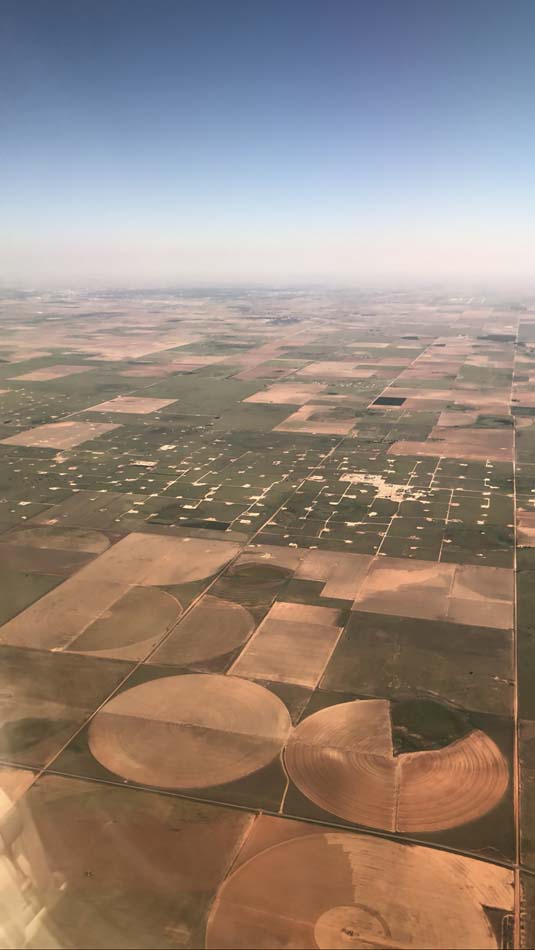
“Crop circles everywhere!” my friend exclaimed, describing his first descent into Clovis, New Mexico’s small airport. From the plane, he had gazed down at the semi-arid Llano Estacado, the High Plains tableland spanning Eastern New Mexico and West Texas. To him, the distinct circles below looked like imprints of flying saucers, apropos of the area’s paranormal history between the Roswell Incident and the Lubbock Lights. Yet, mundanely, this pattern is the result of a farming technique: center-pivot irrigation.
My friend joins a long human tradition of seeing this landscape as unearthly. Extraterrestrial translates to beyond earth, and that’s how early settler-colonists saw the Llano, comparing its grasslands to the ocean and likening their passage through it to seafaring. Today, amid the dwindling of the Ogallala Aquifer, the Llano’s vast underground water source, the center-pivots raise questions about human interactions with the land. What explains our impulse to engineer seemingly inhospitable places and make them seem less “alien”?
In his 1942 short story “Collision Orbit,” Eastern New Mexico–raised author and sci-fi legend Jack Williamson coined the term “terraforming.” Writing in the wake of the Dust Bowl, he understood agricultural struggles on the dry, windy Llano. The story alludes to anxieties of a hostile, capricious landscape as humans attempt to settle a distant asteroid and terraform it into an idealized Earth by “sinking a shaft to [a planet’s] heart” to generate water and oxygen. In essence, terraforming is land-making.
The technology that allowed farmers to tap the Ogallala Aquifer emerged in the mid-1940s, shortly after Williamson published his story. By 1976, a Scientific American article remarked on the dramatic visual change to the High Plains due to center-pivot irrigation, with clusters of the circles serving as orbital checkpoints for Skylab astronauts. The Llano’s perceived alienness had been extended by technologies of colonial expansion: industrial agriculture, extractive industries, and military experimentation in space and aviation.
What explains our impulse to engineer seemingly inhospitable places and make them seem less “alien”?
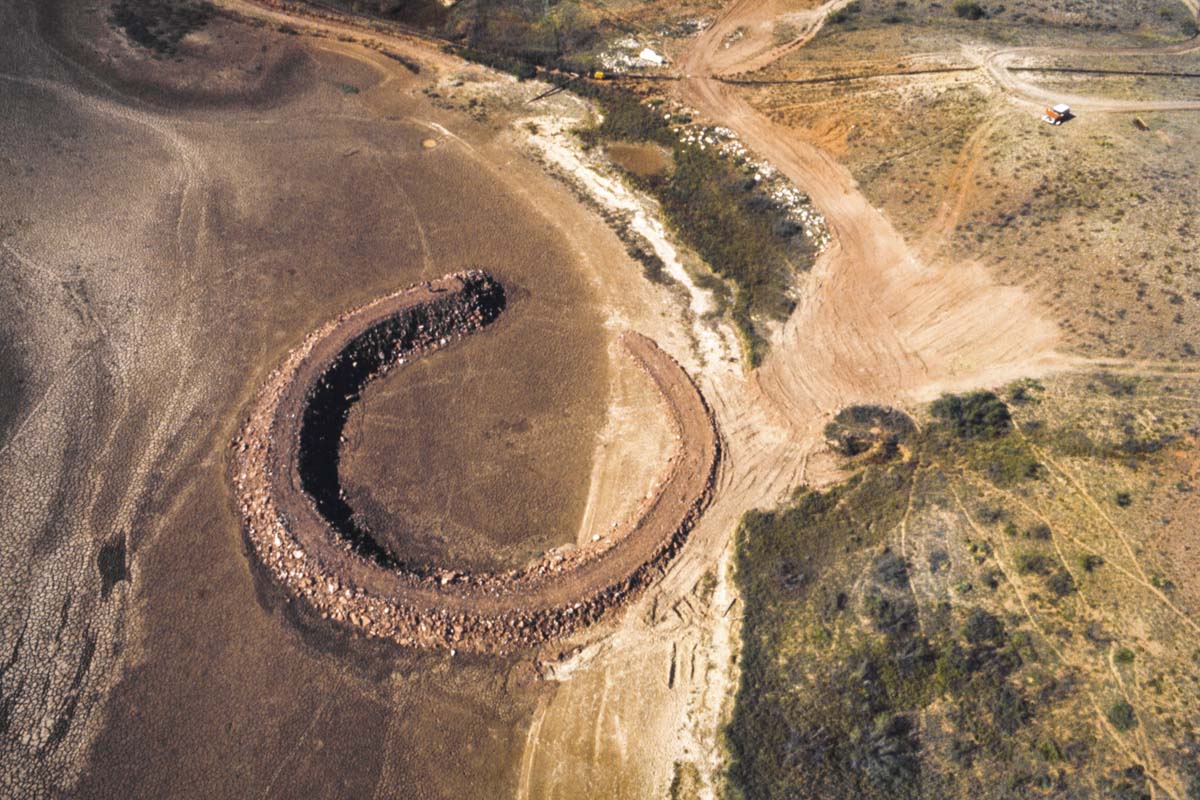
In the early 1970s, artists Robert Smithson and Nancy Holt engaged in a different kind of land-making here. Smithson chose the artificial Lake Tecovas for his earthwork Amarillo Ramp (1973) partly because of its seasonal changes and the presence of passive, gravity-fed irrigation. Following only four-fifths of a circle, Amarillo Ramp gradually tilts upward, then drops. Its seemingly unfinished shape challenges presumptions of completeness, progression, and usefulness. It’s a stranded architectural element that starts and leads nowhere.
As I climb up Amarillo Ramp, the land’s subtle undulations—its gentle dunes and sudden draws—swallow my perception. The earthwork makes its surroundings intimate, both “natural” geological features and “alien” interventions. “The new art is alien and distant, yet it is reflected in the familiar and common things of this planet,” Smithson wrote in 1966. Situated between geologic and human processes, Ramp links to both.
While distanced viewing was crucial to Smithson’s process, it led to tragedy. He died in a plane crash while surveying Amarillo Ramp, leaving Holt and other artists to complete the work.
As creatures who’ve been earthbound for only a fraction of our history, looking down on the land from above is inherently alienating. Yet changing vantages allows us to critique our own relationship to place, alien or familiar, hostile or terraformed, in collision orbit or landing with a gentle bump on the runway.