Poet Laura Neal discovers new roads in the collected works of Albuquerque-based artist Johannes Barfield exploring alternative states of being and imagining in Black culture.
“I would give almost anything to get that feeling of discovering everything for the first time.”
—Johannes Barfield, December 2025
Rediscovering the road
I’m a good traveler. I pack the bare minimum, a few clothes, and some snacks to save money. I check the weather, confirm my stops, and plan for alternatives. I enjoy the rhythm of travel. Plan. Hustle. Pause. Repeat.
Every summer as a child, my parents, two sisters, two brothers, and I piled into our family van, a 1995 Indigo Blue Chevrolet with the ladder and spare tire on the back. In it, we took the 500-mile, eight-hour trek to visit our extended family in the Carolinas.
We always took the same route, stopped at the same gas stations, and paused at the same rest stops. What I recall most is the sound of the road. The thrum-tha-thrum-tha-thrum of the tires, a harmony to my ears. The vibrations, the bridges, the speed, all of it marking a particular time and place. The road was like a record with the van’s tires needling the lanes.
In many ways, this sound has become a monumental part of my history. Road noise, I’ve discovered, roots my memory and invites the opportunity to listen deeply. However distant from the past, sound is revelatory. It becomes a matter of cultivating listening, of tethering our life experiences to the larger soundtrack of the world.
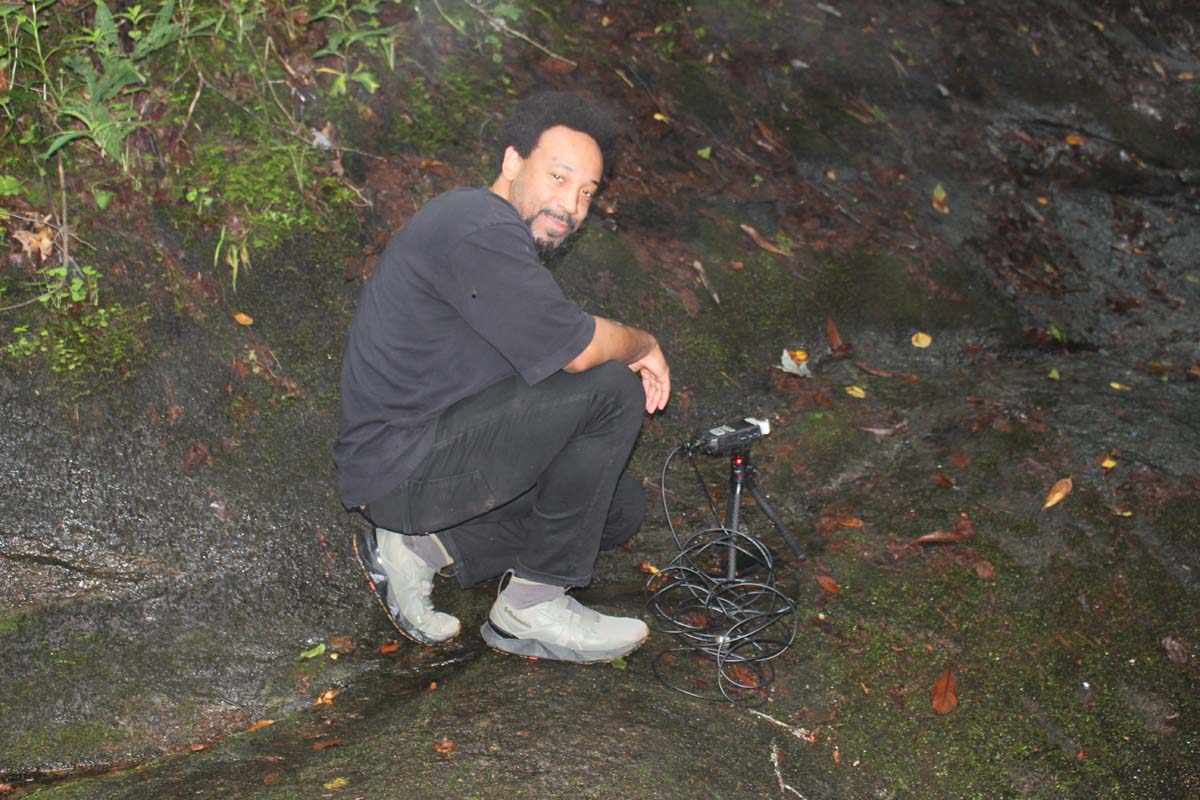
When I consider the road as a soundtrack, I’m reminded of the artist Johannes Barfield, who develops his practice around journeying, time, and sound. Barfield is an artist in New Mexico creating installation, photography, video, XR (extended reality), and collage. He also has a sample-based practice, recording sound fragments from various genres to create new compositions. Travel and geography foreground his work, particularly road materials such as asphalt and red clay, while navigating theories of time and Afrofuturism, broadening the idea of what a road can be.
Through Barfield’s material and conceptual work, I experience a new way to see and hear the road through a series of similes, where two seemingly unlike things are, in fact, deeply connected.
The road as a root system
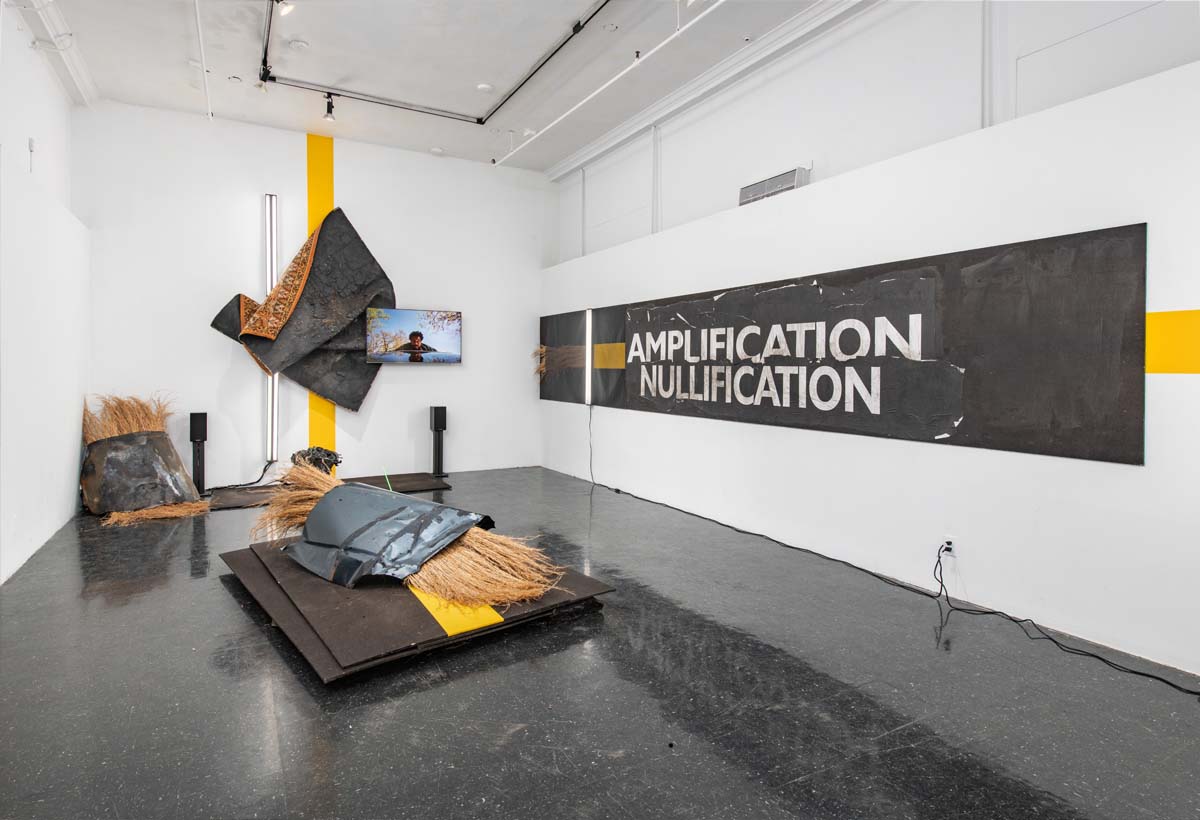
Barfield’s installation My Eyes Due See (2018) challenges us to reconsider the road as a necessity. In the center of the gallery is a pile of asphalt boards marked with yellow tape simulating a road. On top of that pile rests a bundle of broomsedge grass and a car hood, beneath which a small flashlight glows.
Running the length of the wall, Barfield constructs another road using the same materials bearing the words: “Amplification / Nullification.” Encountering a road in this way addresses our dependency on it. How asphalt will likely remain a permanent material in our lives. We rely on the road. It serves us, but it also controls us.
It’s time we start to imagine worlds we actually want to live in, with the most radical empathy we can summon.
Barfield’s representation of the road as a stack of man-made material—a tripping hazard in the gallery’s center—is an act of resistance, rendering the traditional road as we understand it, null.
He amplifies this resistance in a single-channel video also titled My Eyes Due See, showing him riding atop a car. In the video, Barfield adopts the image of either a superhero or escape artist. The rivulet reflections of trees that appear on the car along with the artist’s reflection stills the observer to listen. The accompanying sound carries its own narrative. At first it battles, next it marches reverent, and then it liberates displaying three bold words: “Objective / Reason / Ableness.”
The road as landmark
Sometimes, we don’t know where we’re going. When technology fails us during travel, we search for road names, look for a building, test our directional instinct. We look up and out for some beacon to guide us. But what if the landmark we’re searching for is the road itself?
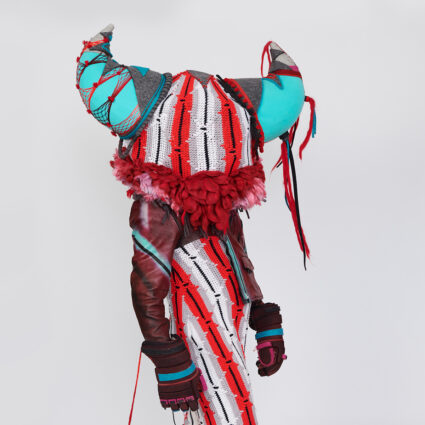
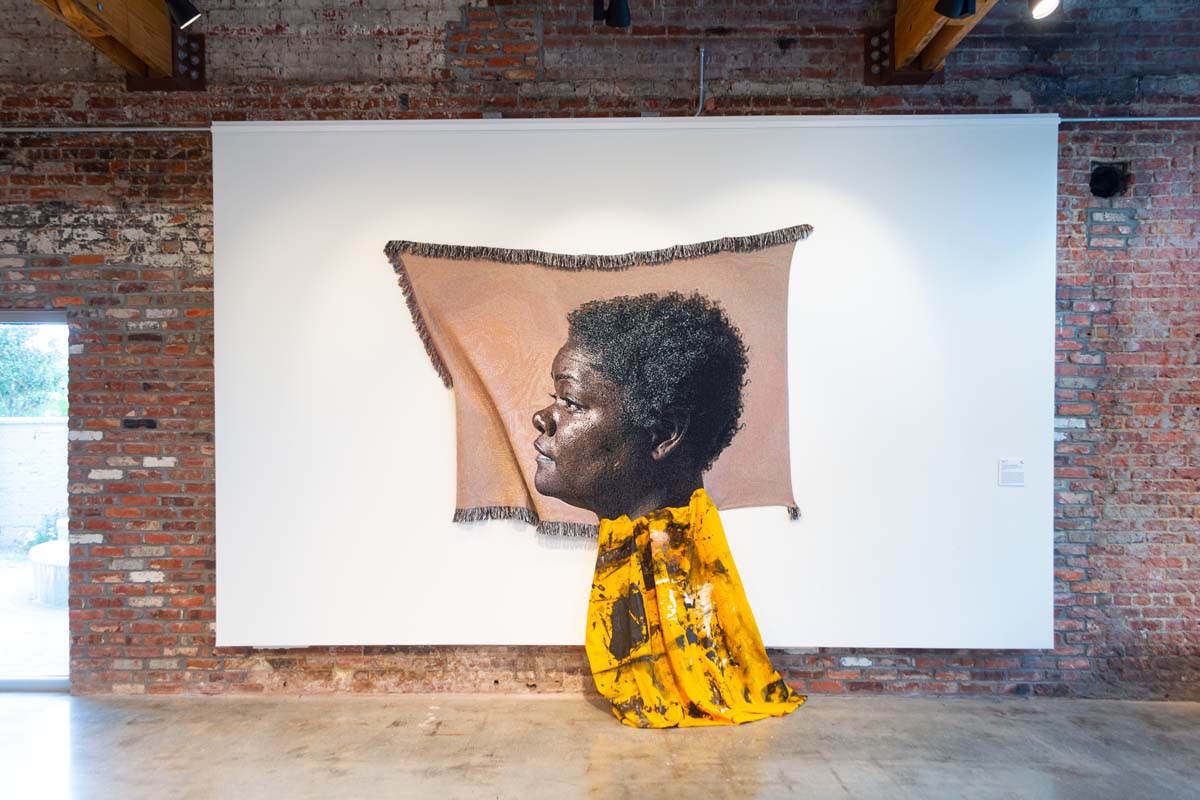
The portraits in The Green House on Cornell BLVD (2019), though printed on cotton textiles, frame themselves like statues, the kind you find patinaed in every major city. Beneath each image is a gathered yellow canvas covered in red clay. Barfield, raised in North Carolina, collects the red clay from its roads, carrying the land in homage. As a fellow Carolinian, I can attest that the land— whether you want it to or not—has a way of sticking to you.
The installation includes two images, one a self-portrait, the other of Barfield’s cousin, Nakesha, a semi-truck driver. Barfield’s father was also a truck driver, whom he accompanied on cross-country trips. The road’s sights and sounds remain pivotal to his life and practice. Like me, he’s lived with the road as his underlying soundtrack. It holds the family, their memories, their language, their labor.
Printing on textiles references African American quilts, utilitarian objects that hold stories and messages. The composition of the images, with their side-profile orientation, demands attention. The dichotomy between Nakesha’s occupation as a transporter and the historical lineage of being transported collapses time into a monument.
Barfield’s use of medium metaphorically travels across generations and yet grounds the work in a particular place. This recalls Katherine McKittrick’s assertion in “On Plantations, Prisons and a Black Sense of Place” (2011): “A Black sense of place draws attention to the longstanding links between Blackness and geography.” Barfield’s staining of the yellow canvas with North Carolina red clay is a sustaining marker for home.
The road as transcendental
Looter
leaping home / commentator / opera / egging applause / abruption and eruption / layers / harmonic / waiting + distraction / forgetting / nape + root / repeat yourself / thurty-sumtin / how long this plastic been on this chair?
choir / sass / spar / still / raid / boom + tsk / static or rain / interlude / railroad / chant / announce / arrive + exit / mock / braid / time / hey / clap / repeat yourself / lift / search / deaf from the bass of waiting and cymbal distraction
light / crowd / revolve / water / breathe / bless / dance / run / save some for me / jump / enter / fold everything / loot / meditate / remind + remain / sing / repeat yourself / listen / I will be gone by the time you get here
Barfield’s four works in the 2023 group exhibition MARAUDERS at the Greenville Museum of Art, which feature various roads including references to the Underground Railroad, inspired this list poem.
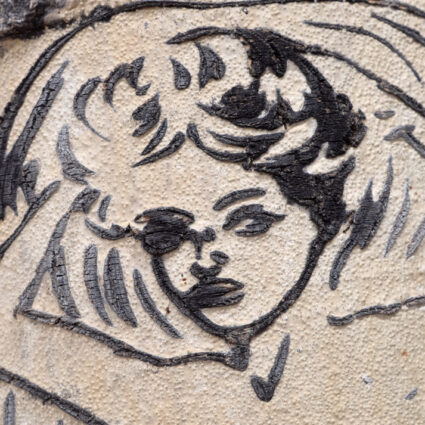
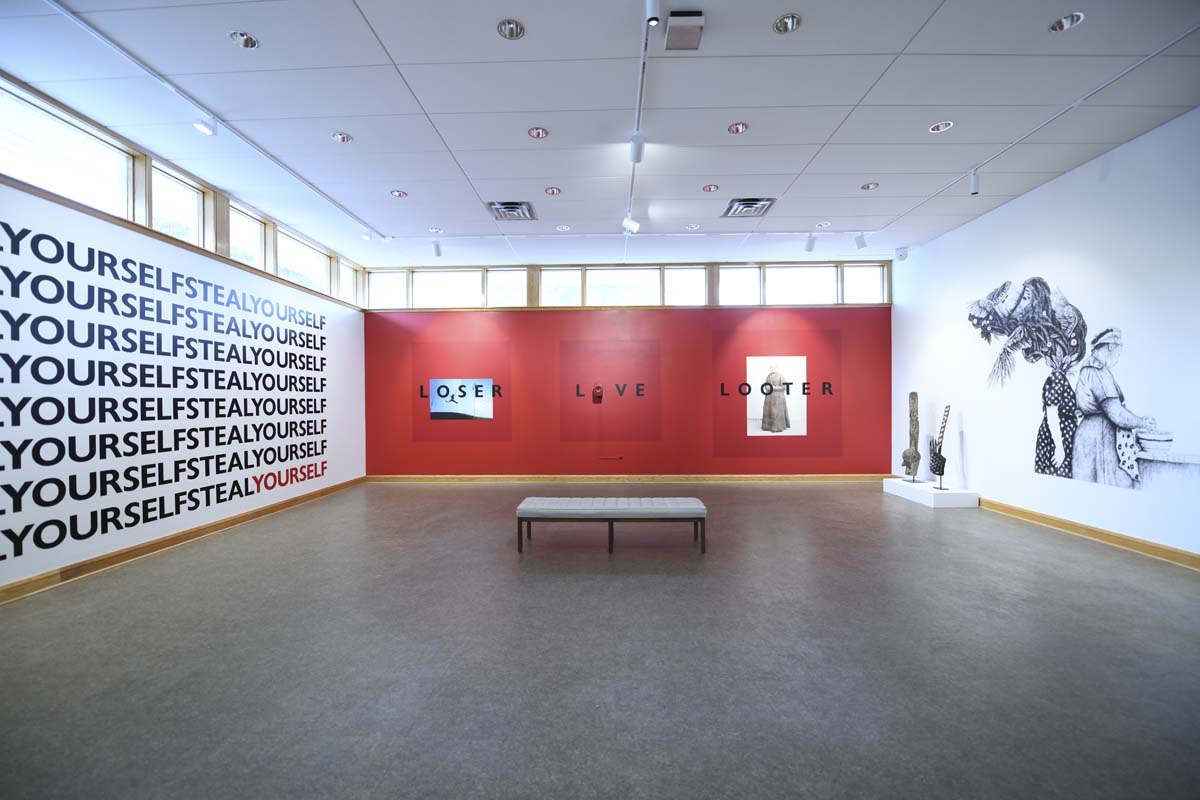
In the artwork Dividing Waters (2023), Barfield installs an image of Harriet Tubman on the wall, stamped with the word “Looter.” How could the respected abolitionist be considered such a name? For Barfield:
The word ‘looter’ is a part of the American fabric and how things started with colonialism—for example, stealing land from Indigenous peoples, kidnapping groups of people from Africa for forced labor, and stealing precious cultural artifacts from communities around the world. When a group of people are considered property, and an object for labor, and someone like Harriet Tubman comes along and steals you into freedom, then what would they call her?
Barfield’s STEALYOURSELF (2023), floor-to-ceiling vinyl text spanning the gallery wall, reads as manifesto. It urges people of the Black diaspora to liberate themselves and the language used to define them. To “steal yourself” is to not only repatriate what was taken, but a call to awareness of the cycle that exists.
The wall piece We Have All Lost Something Along Our Path (2023) depicts Michael Jordan in one of his most iconic dunk poses, labeled “Loser.” The word jars, because he is considered the greatest basketball player of all time. But early in his career, critics projected him as average. The work questions who holds authority to assign value, how we value ourselves, and the fault of placing value on others.
The fourth work, PLOY (2023), is a fifteen-minute sample-based score. The bass-heavy composition oscillates between a tone of restless determination, fury, and enlightenment. The sound of railroad tracks proliferates in the score. On the wall is the word “Love.” The speaker playing PLOY throughout the gallery replaces the letter “O” in the word love.
The road transcends in all four of these works. They become a road into the Black imaginary, inviting reflection instead of judgement. For Barfield, “It’s time we start to imagine worlds we actually want to live in, with the most radical empathy we can summon.”
The road as epistle
When we write letters to ourselves, we write toward our past or imagine our future. When we write toward others, we are building community.
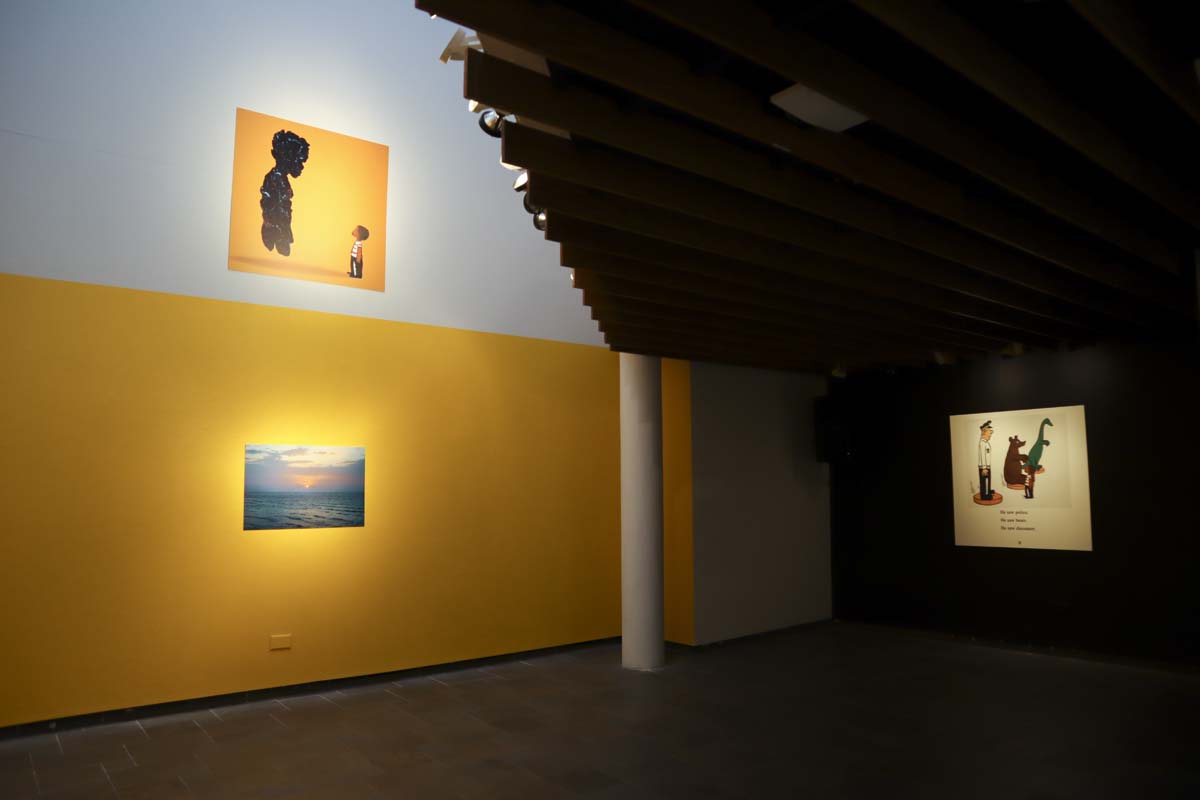
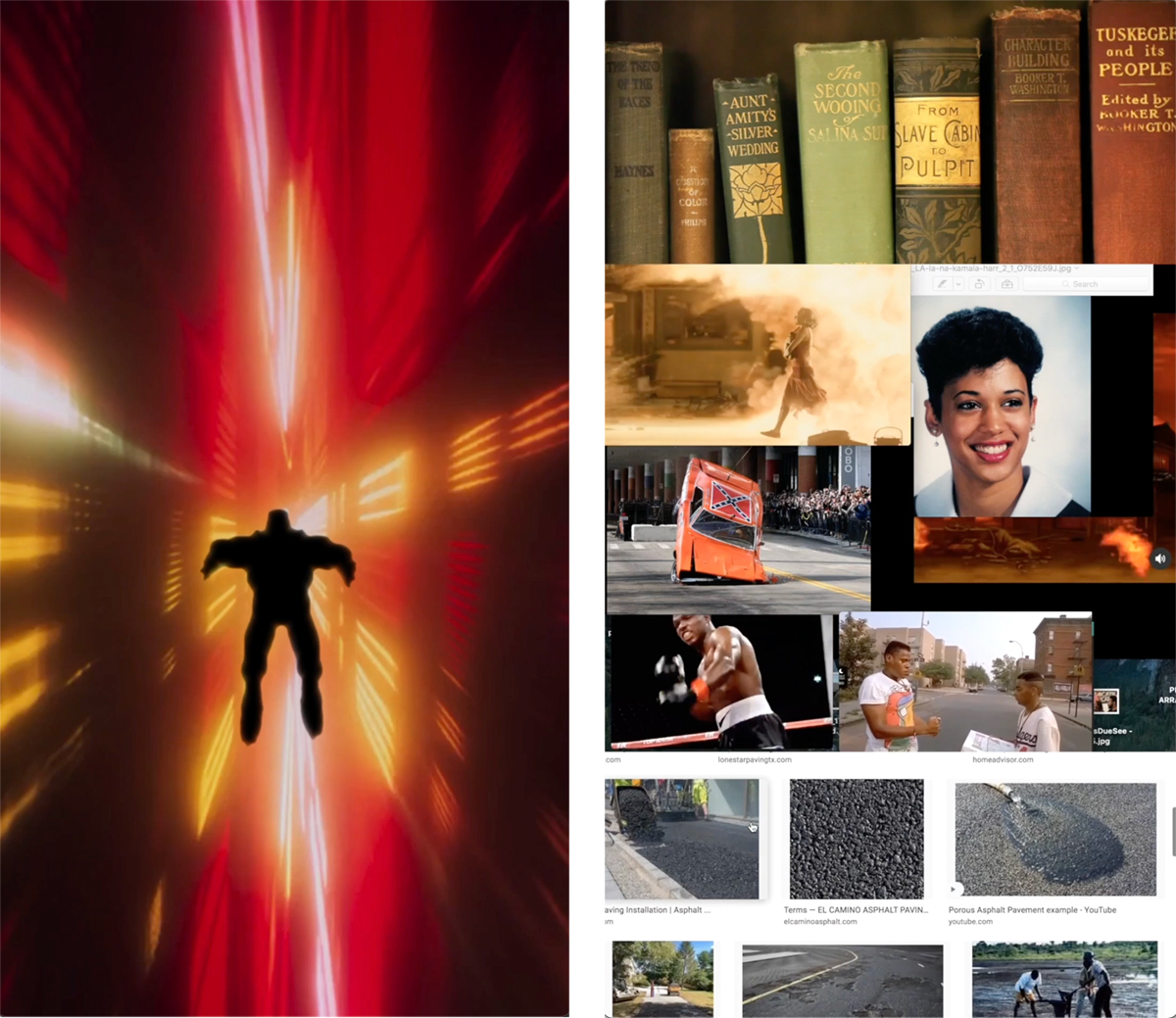
Consider time travel a love letter. In his XR film 19th Act (2022), Barfield travels forward with a portal-jumping figure named Yahya who, he writes, “is transported into the bodies of alternate versions of himself.” Yahya first appears in the exhibition my sun is black as the glowing sea by night (2022) as a storybook character wandering through an unusual museum “where he encounters a rip in the space-time continuum.”
The installation features a bass-heavy soundtrack influenced by science fiction films, Marvel comics, children’s books, and Griot storytelling.
To the artist:
Dear Johannes,
I think about traveling a lot. In fact, if I could choose a superpower, it would be teleportation. […] The trouble… is that I will no longer be available in the present. My desires, my thoughts, my values will all be tethered to other worlds.
I’ve been thinking about Yahya in your film, 19th Act. [In the] description [you write]: “The act of looking upward symbolizes a shift away from being the sole pilot of one’s destiny, allowing space for external guidance.” I have ideas about what “external guidance” intuits, but can you share what or who carries this responsibility of guidance? Or perhaps more simply, who is Yahya on this new road without that gaze and guidance?
My best, Laura
From the artist:
Dear Laura,
It’s funny you mentioned teleportation. I’ve been working on a story that centers around it, and I’ve been researching how it might actually work in the real world. There’s one theory that goes like this: if you step into a machine and then step out somewhere else, the person who emerges isn’t the original you but a perfect copy. The original doesn’t survive.
When I wrote, “The act of looking upward symbolizes a shift away from being the sole pilot of one’s destiny, allowing space for external guidance,” I was thinking about how we sometimes get trapped in our own narrow view of things. External guidance, to me, means letting another perspective, something beyond ourselves, take the wheel.
Yahya looks up constantly and doesn’t get lost in their immediate view. I wanted to create a character who observes the world with intention and openness.
Best, Johannes
Johannes Barfield’s collective portfolio explores the road both materially and conceptually. Each of his works travels through a metaphorical portal which is revelatory because they are daily artifacts. I recognize the clap and chant, the bass, the references. It’s a different way to see. Seeing not only through images, but through sound and through time. A remarkable world re-building. At once familiar, but also strange. Like a self-addressed letter that you didn’t write.
Like looking for future possibilities, wherever the road takes us.