On a road trip across the former rangelands of the American bison, Cannupa Hanska Luger envisions a new monument.
From his mountainside studio in Glorieta, a small community in the southern Sangre de Cristo Mountains in New Mexico, Cannupa Hanska Luger (Mandan/Hidatsa/Arikara/Lakota) is embarking on an epic road trip covering several states and multiple tribal nations.
It is an auspicious beginning point for a journey to honor bison. Just a few miles away sits Cicuye, once an economic center and cultural crossroads where Pueblo and Plains people came together to trade at the edge of the Rocky Mountains and the Great Plains. To the north of Cicuye is Glorieta Pass, a geographic feature that encouraged trade across the continent. The P’aékish/Pecos people settled Cicuye and acted as middlemen in this trade network, living there until 1838 when they joined the people of Walatowa/Jemez Pueblo in response to raiding from Plains tribes and diseases. Cicuye trade thrived, in part, because of bison; hides and meat brought in from the Plains were highly coveted by Indigenous people across regions, and for this reason, one could say that the bison brought about peace, if even momentarily.
Today, Pueblo communities still reenact these historical ties to the buffalo and the buffalo people of the Plains in our traditional dances. (Buffalo is the colloquial term for the American bison, both terms are used interchangeably in this article. Tribal nations have their own names for the animal.) In my village, every Christmas, in the early hours of the morning, two dancers dressed as buffalo shake the creaky wooden floors and pews of our old Spanish Catholic Church with each step they take.
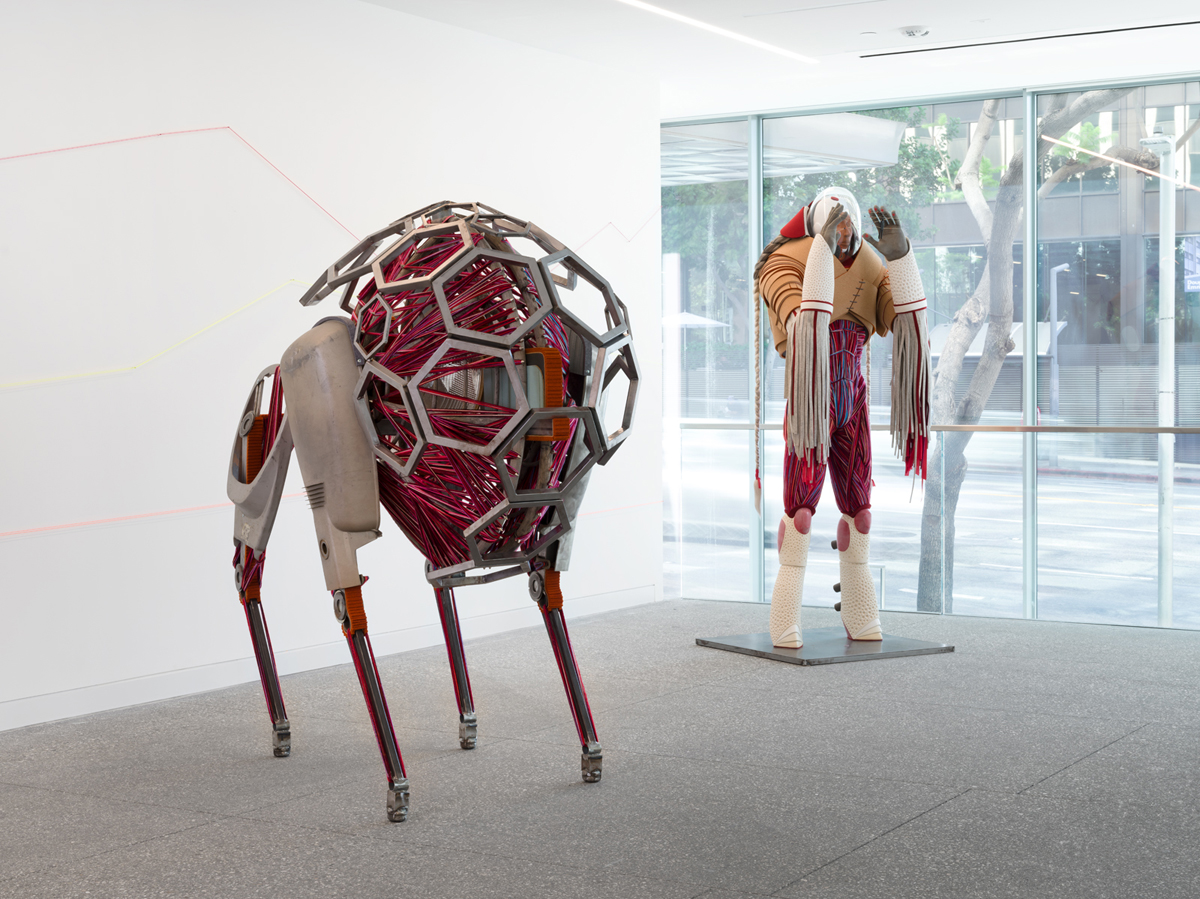
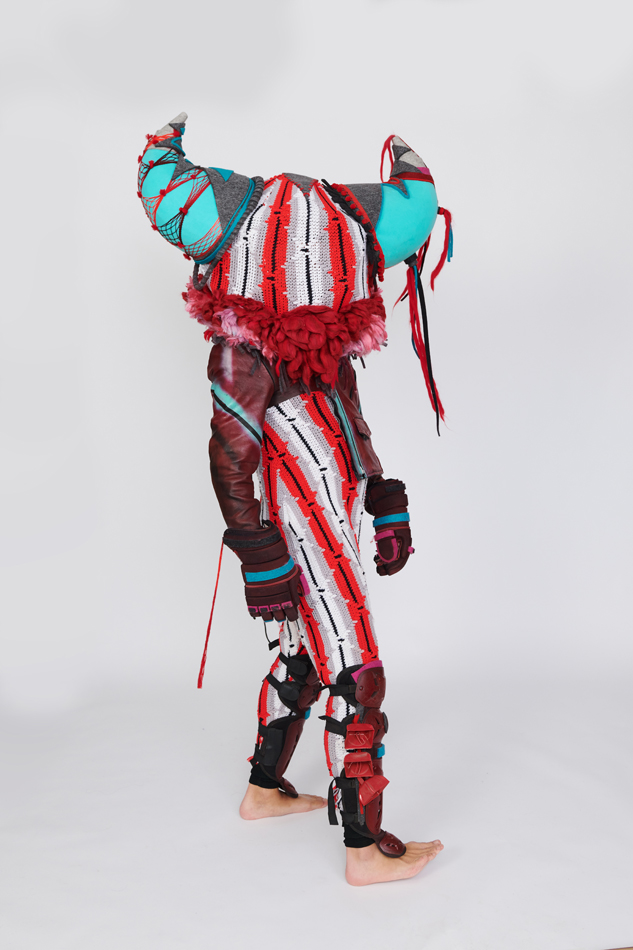
In April 2025, just before the stroke of midnight, a dancing Luger appeared across nearly 100 digital billboards for three minutes every night in the most far-flung place: Times Square in New York City. Dressed in regalia that he constructed from repurposed Afghan blankets—heirlooms he says were likely crafted by aunties, uncles, and grandmas in the same careful way that Indigenous people have, and continue to, tan buffalo hides—Luger encouraged the buffalo to return. On an episode of the podcast Fresh Art International, he explained:
Where I come from, to dance in the form of an animal is a show of reverence. It’s also a reinforcement of a very old pact, where we understood that we were dependent upon one another. To don the form of a buffalo, but dance in the shape of a human is a way to, every year, reassert and reassess that relationship. I want to present that as technology, as an anchor to our future and how we survive.

Technologies, or the knowledge, skills, and tools carried across time and specific to each Indigenous nation, are central in Luger’s work. These technologies are grounded in kinship between human and non-human life and are embedded in our collective memory; they define how our ancestors lived and thrived despite deliberate and unrelenting attempts to eradicate our cultures, and characterize how we continue to live.
In 1983, Luger’s grandfather reintroduced a ceremony honoring midéegaadi (Hidatsa for buffalo), inviting community members of the Mandan, Hidatsa, Arikara Nation (MHA Nation), also known as the Three Affiliated Tribes, on the Fort Berthold Indian Reservation in North Dakota, to participate. It had not been held there for around a hundred years, a result of U.S. policies banning such dances beginning in the 1880s until the American Indian Religious Freedom Act of 1978 lifted most prohibitions. A few years after the dance was revived, Luger says, “buffalo came back.” That is when the MHA Nation reestablished a herd that they still maintain today. The once prevalent buffalo, along with the dance honoring them, although absent, had never been forgotten.
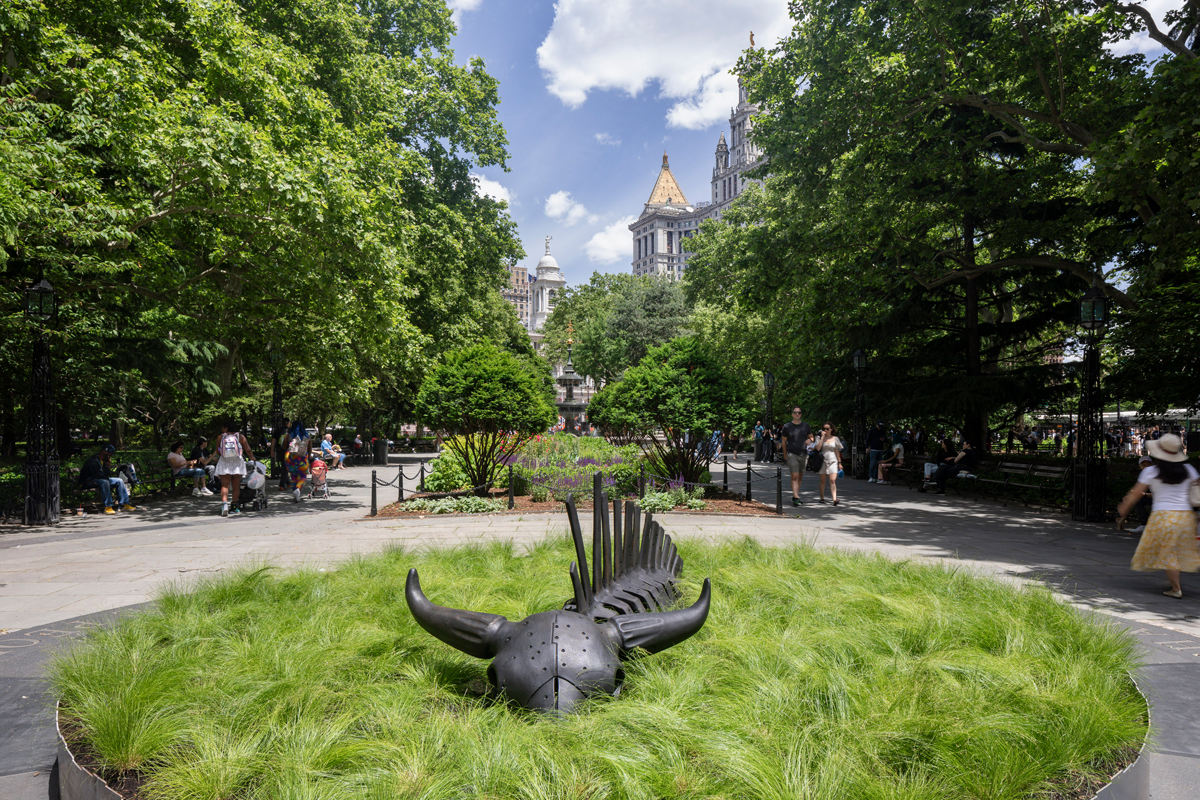
Exploration of these kinship ties between humans and buffalo have been an ongoing theme Luger’s body of work for at least the past decade. While doing research, he encountered a deeper story that did not live in victimhood, but rather in celebrating the contributions of buffalo even through their annihilation. This was the seed for his current project, Buffalo Nation, which “imagines a future monument that honors bison as kin, as casualties of American expansion, and as catalysts for Indigenous regeneration and connection.”
Luger’s original pitch for the monument was a war memorial. “The only time the United States sent out a military effort where the combatant was nonhuman was [at Palo Duro Canyon] in Amarillo, Texas,” he says, where “a small herd of buffalo, at the tail end of their annihilation” was killed. Comanche, Kiowa, and other tribes from the area, met the military in the canyon and fought back.“Everywhere that I’ve seen Native communities engage with buffalo, there is an understanding and a recollection about our relationship,” he states. “And we also see the suffering of buffalo as the suffering of ourselves, and a lot of us understand that buffalo were wiped out in order to control us, so they become collateral damage of the American Indian Wars.” He says that this attack on bison was done to destabilize the cultures of the Plains who were deemed barriers to U.S. expansion.
In his research, he also encountered a sepia photograph that he remembered seeing as a child: a towering pyramid of bison skulls taken in 1892 at Michigan Carbon Works, a manufacturing company in the Detroit area that processed bones into a number of products. In the photo, two men stand on or near the pile, dwarfed in comparison. He says that anytime the extinction of bison was addressed in public school, “the storyline of it was so weak compared to the visual that I was seeing.”
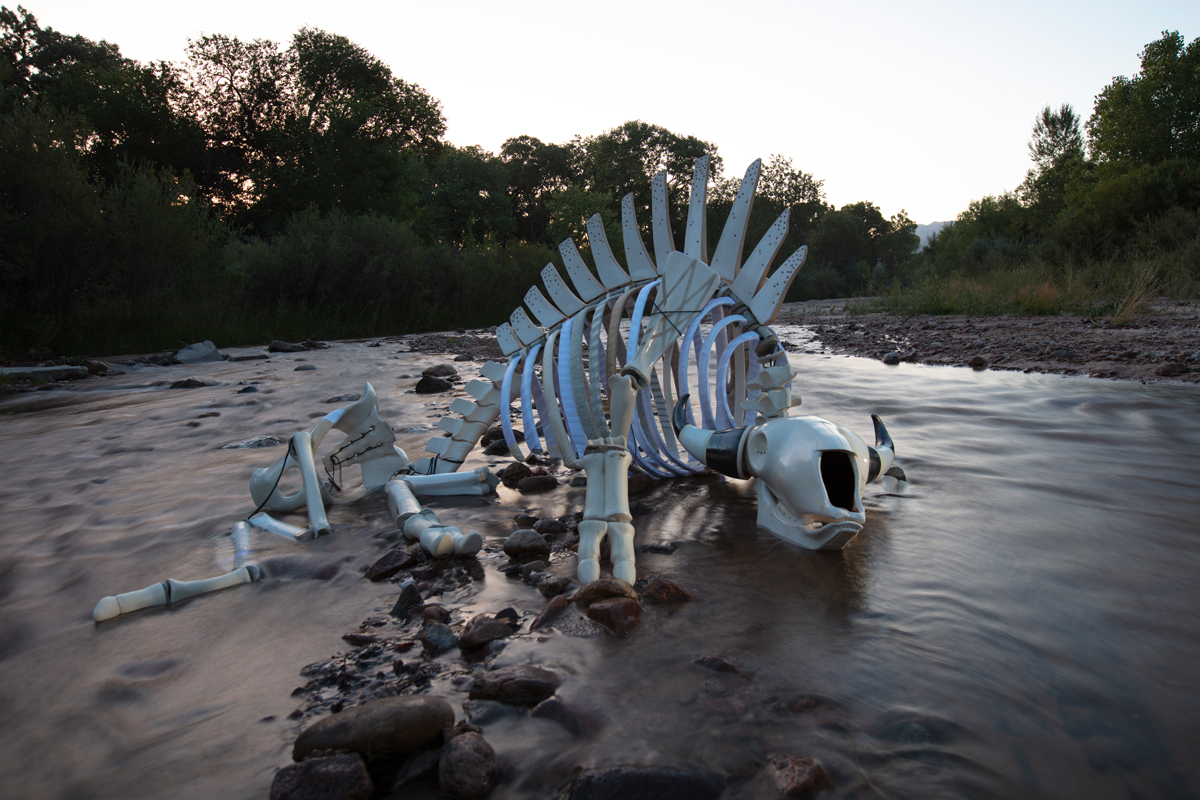
Bones like these were turned into fertilizer, pigments, glue, charcoal that was used to filter and purify sugar, and bone china; while hides were fashioned into coats popularized in the United States and Europe. Luger says, “I just started following the money… and that opened up a whole spectrum of the story of the annihilation of buffalo in North America.” Realizing that these market demands correlated with the dwindling population, he says, “buffalo gave, and they gave, and they gave…”
Indigenous cultures acknowledge qualities in animals that are typically reserved for humans and from their example we learn how to live. Luger talks about stories from his own culture in which bison offered themselves to strengthen humans, and they continued to do so even as they were being extinguished. “They kept their end of the deal,” he says. Buffalo Nation centers on how humans can keep ours. For Luger, that means stewardship of bison as well as the land and ecosystems they inhabited, and maintaining that pact across generations even through disruptions to culture caused by the massive loss.
The number associated with that staggering loss of bison in the 19th century is something that he still has to wrap his head around. Luger says that estimates range from 30 to 60 million, so he split the difference and settled on 45 million. In 1889, there were just 456 bison left.
How best to communicate the scale of loss and its impact in monument form is one of the questions on Luger’s mind as he begins the first phase of eighteen months of research and development for Buffalo Nation.
An undertaking this extensive requires a collective beyond the well-organized and intentionally small team Luger and his wife and studio director, Ginger Dunnill, have established. Luger will travel with a coalition of partners, including Paul Farber, director and cofounder of Monument Lab, a non-profit public art design studio; Amber Morning Star Byars (Choctaw Nation of Oklahoma), media specialist and founder of the media company Good Trade Productions; and a primarily Indigenous film and sound team, who will document and archive the process. Dunnill and the couple’s two children, and likely additional Monument Lab members, will accompany the group on some of these trips.
Byars will assist Luger in following proper protocols for engaging with Native communities, including presenting culturally significant offerings, so, according to Luger, “we arrive in a good way.” She has worked on several films including the Oscar-nominated documentary Sugarcane. “She’s developed a really consistent and respectful way to engage with community,” Luger says, which is why he invited her into the development phase of the project, to work closely with Indigenous communities and possible future collaborators in order to create tangible groundwork and alliances for future phases.
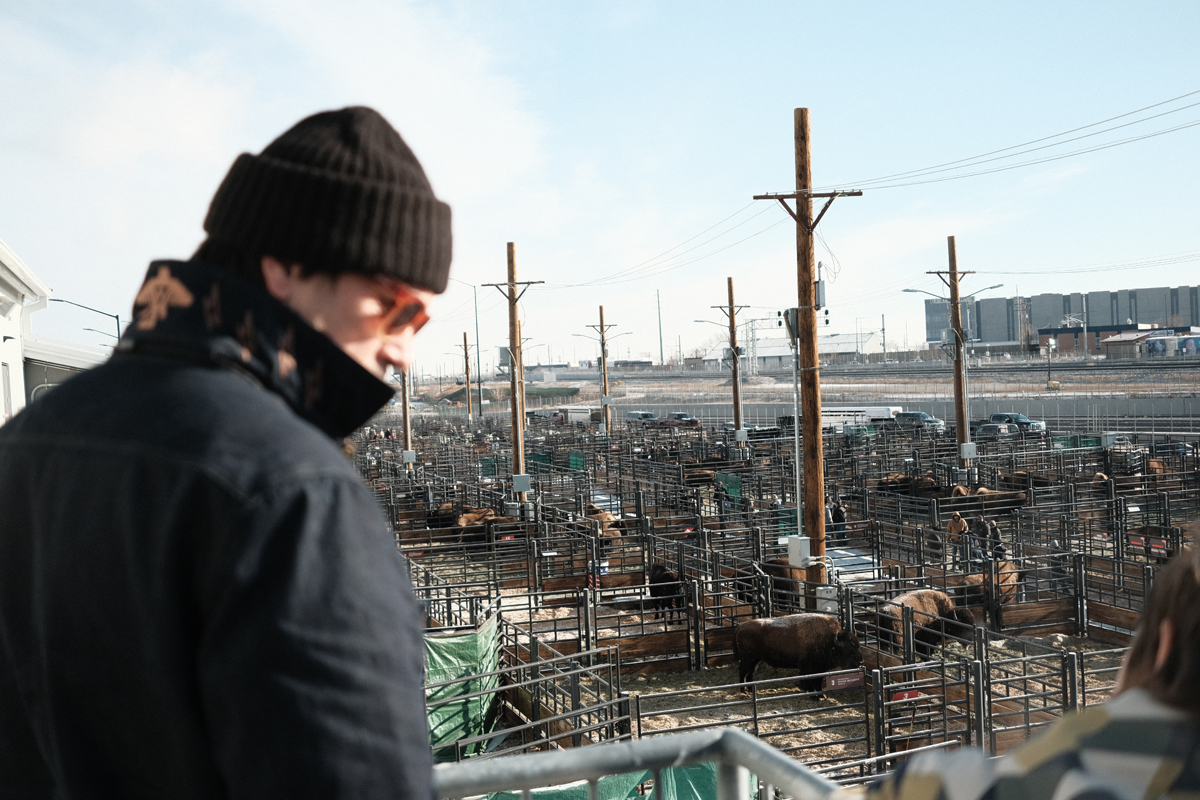
“[Luger] has a vision that [goes] beyond art,” remarks Farber, whose work with Monument Lab includes not only erecting new public art, but also reimagining monuments from underrepresented perspectives and conducting research, such as the consequential “National Monument Audit” of 2020-21, which came at a moment of national reckoning with the way history is told in public space. About Luger and this project, Farber says, “Buffalo Nation is a collaboration that is led by Cannupa, but enriched by every participant.” He continues, “[Luger has] made a pact with bison, to honor their presence and summon them back to the land. And his art is a vehicle to do that. But so are his relationships.”
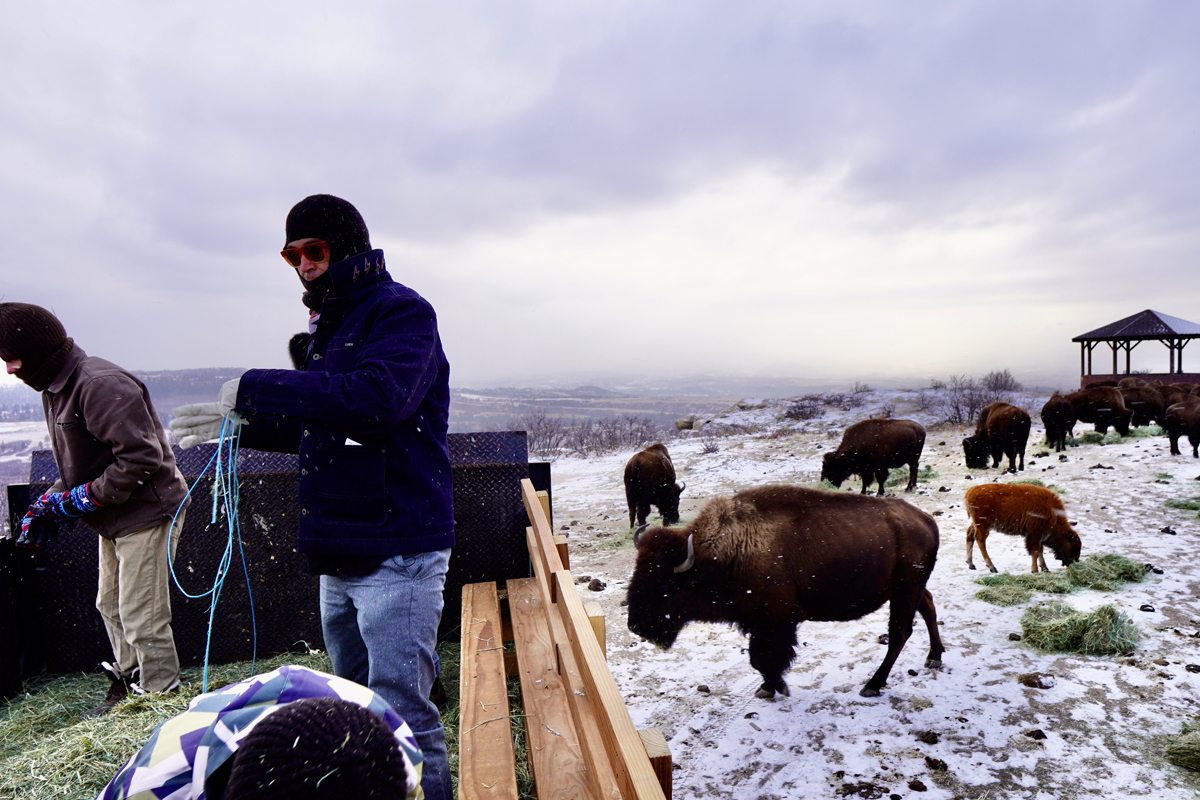
At the time of this writing, the group was attending the National Bison Association Conference in Denver and visiting other relevant sites in the area. Throughout the year, they will work across tribals lands and historical sites throughout Oklahoma, Wyoming, Montana, North Dakota, South Dakota, Michigan, and Alabama, where they plan to explore the history from various perspectives—cultural, ecological, social, and economic, as well as studying existing monuments of remembrance. One stop on the itinerary that holds particular significance for Luger is the site where that towering mountain of buffalo skulls sat over a hundred years ago.
The best monument for bison would be an easement, a way for them to roam again […] and the only way to get to that point is to educate the population to value their presence, too.
Luger is eager to reach out to community, certain that his voice alone should not dictate the best way to memorialize buffalo. He says, “I have a very narrow perspective on this story because it’s limited to my own personal research, and that takes place in this studio.” He wants to enter into this endeavor “open for adaptation, open for learning,” as he imagines the myriad ways the project could develop, saying that it should be “generative,” fostering communication between various entities, tribal and non-tribal, governmental and non-governmental, and contributing to the already existing efforts toward the renewal of bison.
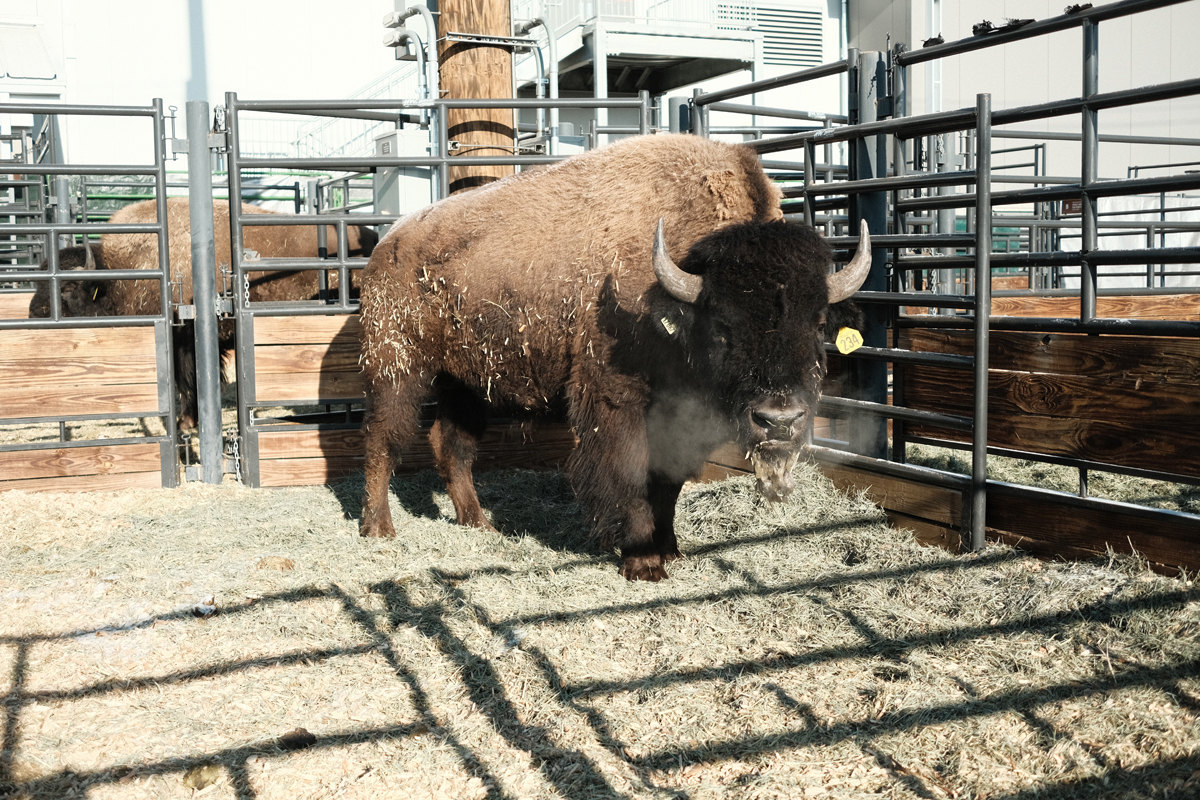
In his opinion, he says, “the best monument for bison would be an easement, a way for them to roam again, a way for them to move from Canada to Mexico freely and with their own agency. And the only way to get to that point is to educate the population to value their presence, too.” Unlike cattle, which are domesticated and dependent on humans, the bison’s particular biology and behavior make domestication a challenge. To truly thrive, they need vast swaths of land.
Near the end of our conversation, Luger and I return to the topic of ancient trails and trade routes, in particular those leading in and out of Cicuye; Luger points out that paths like these have existed since time immemorial, made by animals and followed by humans. “I think of buffalo as a technology. If we can look at buffalo the way my ancestors looked at them and understood that when you see a species at 45 million roaming across the Americas or North America, they’re obviously doing something right. So, how do we model ourselves after that? You know, whatever it is that they’re doing makes them successful, and in their success, there is inspiration.”