In the California desert, Angella d’Avignon traces a spiritual and extraterrestrial lineage in the works of Agnes Pelton, El Disco, and Esther Pearl Watson.
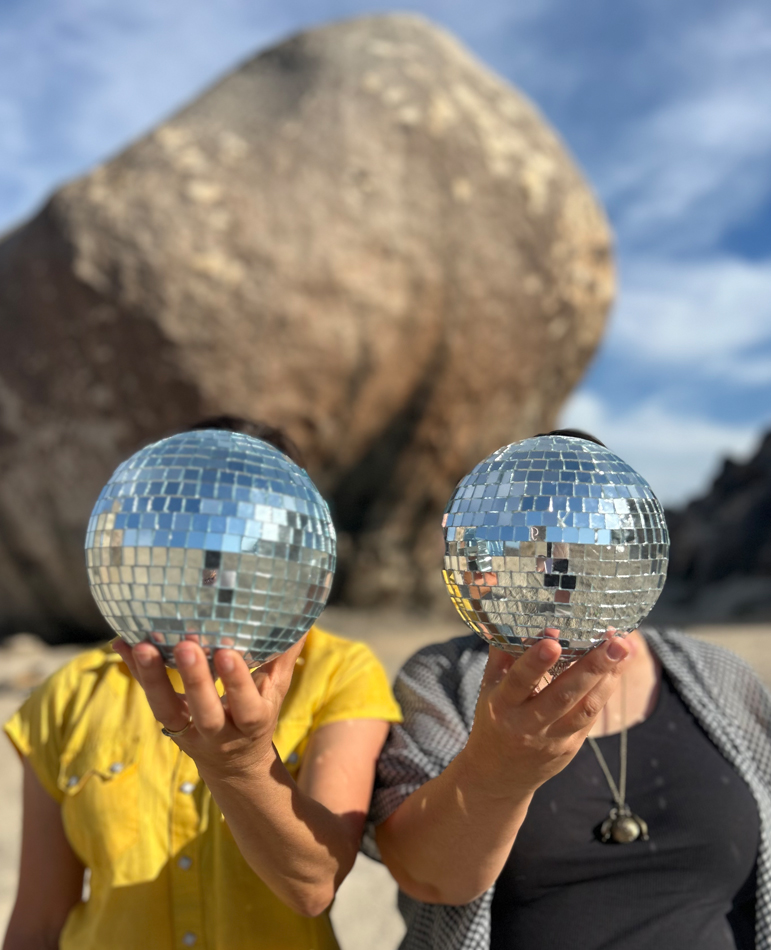
In the dry Mojave heat the artist Esther Pearl Watson counts down from three. A gust of wind rushes across the desert floor and sweeps the hair beneath her cowboy hat. Just outside the frame looms Giant Rock, a ninety-seven-foot-tall freestanding boulder in Landers, California, about fifteen miles north of Joshua Tree National Park. On three, her sister Teresa Watson tosses a shopworn but bedazzled pink UFO, made from two styrofoam bowls glued together, into the air while Esther snaps a picture.
The saucer tossing began with Esther’s daughter, Lily, on an alien-themed road trip in the mid-2000s when they visited alien sites across the Southwest. “If you can see powerlines in the photo, it’s a fake,” Esther tells me of early UFO documentation, but doesn’t explain why. Some of the first UFO photographs ever published—the Trent photos—feature wispy powerlines beneath a blobby orb over a farm in rural Oregon, captured in 1950. An earlier set was taken in 1947 and shows what may have been a detached side-view mirror of a vehicle, lobbed into the air over Phoenix, Arizona, by the inventor William Rhodes, not unlike the styrofoam bowls.
Both Watson sisters are artists. Teresa is a prolific cartoonist with a wicked sense of humor. Esther works in the vernacular often associated with folk or outsider art, her flattened compositions drawing on a deep well of memory to tell stories of a Texas childhood with an eccentric, self-taught inventor for a father.
While looking for suitable angles, the sisters take a stroll around Giant Rock and inspect it for what was once the entrance to Frank Critzer’s subterranean and, ultimately, ill-fated domicile, wherein the prospector, who faced FBI suspicion for being a German spy, was backed into a corner and allegedly blew himself up in 1942. Until then, he was a local curiosity known as “Straight Road Frank” because of the roads he graded throughout the area. He tinkered with radio technology, lived entirely off-grid, and built an airstrip on a nearby dry lakebed.
His friend George Van Tassel took up the mantle of Critzer’s eccentric lifestyle, transforming Giant Rock from a prospector’s outpost into one of the most famous UFO sites in the United States. He held meditation sessions in Critzer’s former underground rooms, claimed to receive communications from extraterrestrials there, and began construction of the Integratron nearby, which he described as a kind of electrostatic energy device informed by principles from Nikola Tesla, though there is no scientific evidence that it functioned as Van Tassel claimed.
Even without the alien lore, the rock itself, at almost seven stories tall, disorients a sense of scale in a landscape whose vastness already evokes geologic time. If not for the ovular shadow in the foreground, the Watson sisters’ UFO shot is almost believable, as if an alien tricked out her ride with pearly pink detailing and went cruising across the basin.

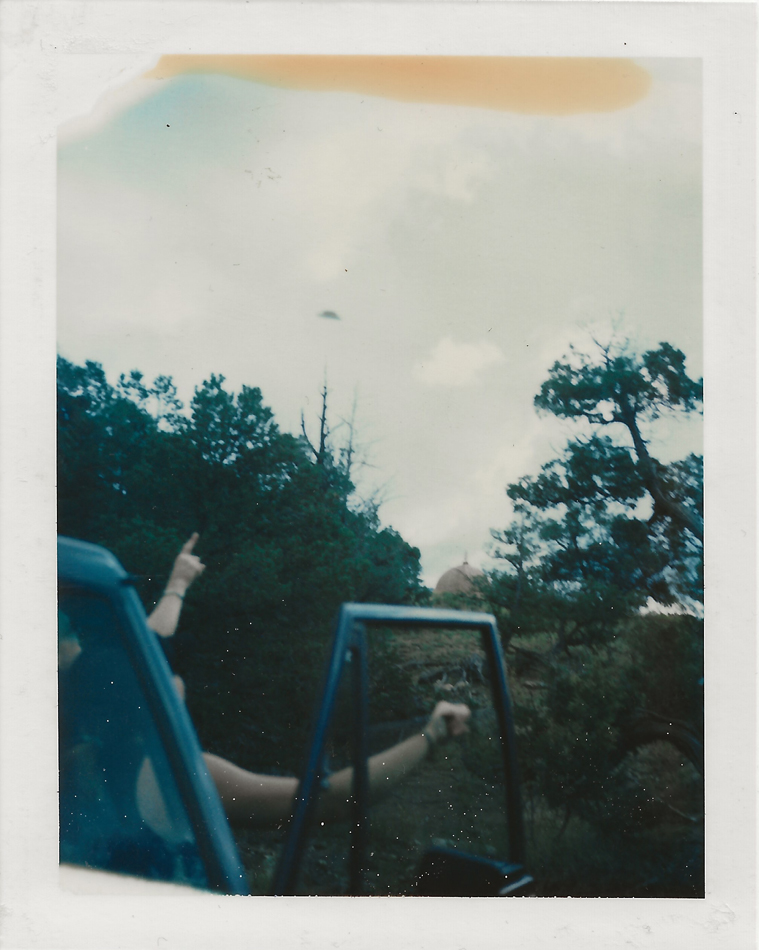
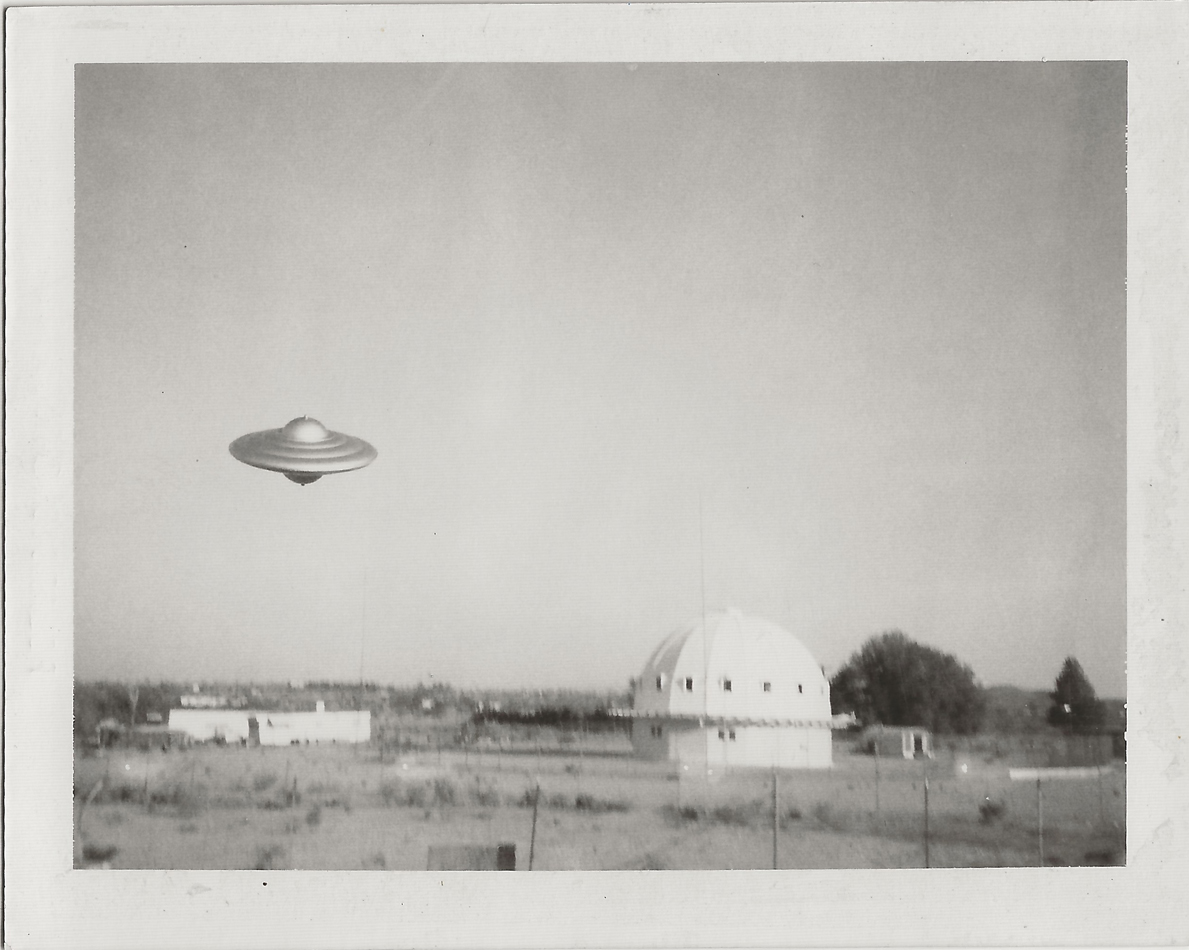
The artist collective El Disco (Joe Clower, Steve Thomsen, and Tennyson Woodbridge), founded in Los Angeles in 1987, spent decades assembling a UFO archive to rival the FBI’s, making similar photographs to the pink Watson spacecraft. They have fabricated anomalous events over and over—for example, a set of Polaroids taken between the late 1980s to the early 2000s features a silver, shadowless flying saucer floating over a mountain range with a long desert basin road or spinning over the ruins of Harmony Borax Works in Death Valley. One even features Van Tassel’s Integratron. Built in 1954 around the corner from Giant Rock, the domed building was constructed without nails and resembles a cross between an observatory, a revival-tent tabernacle, and a flying saucer. (I mistook it for a vaulted water tower at first glance.)
Each El Disco shot—like a punchline without the setup of a joke, but no less funny and deeply mischievous—constructs an archive of belief in the U.S. West. The series reflects a speculative and mystical search for belonging alongside a persistent cultural desire for a world that exceeds the limits of its denizens’ understanding.
The real desert weirdos nurtured relationships to the places around them, and were open to messages—from spirits or aliens or otherwise—when no one else was around to receive them.
These apocryphal images of UFOs—by El Disco, farmers, inventors, and the Watson sisters—and their dubious productions reveal a kind of longing for another world beyond the boundaries of our own, of something more numinous. Something that can be summoned out in a space like an ancient, omnipresent desert landscape.
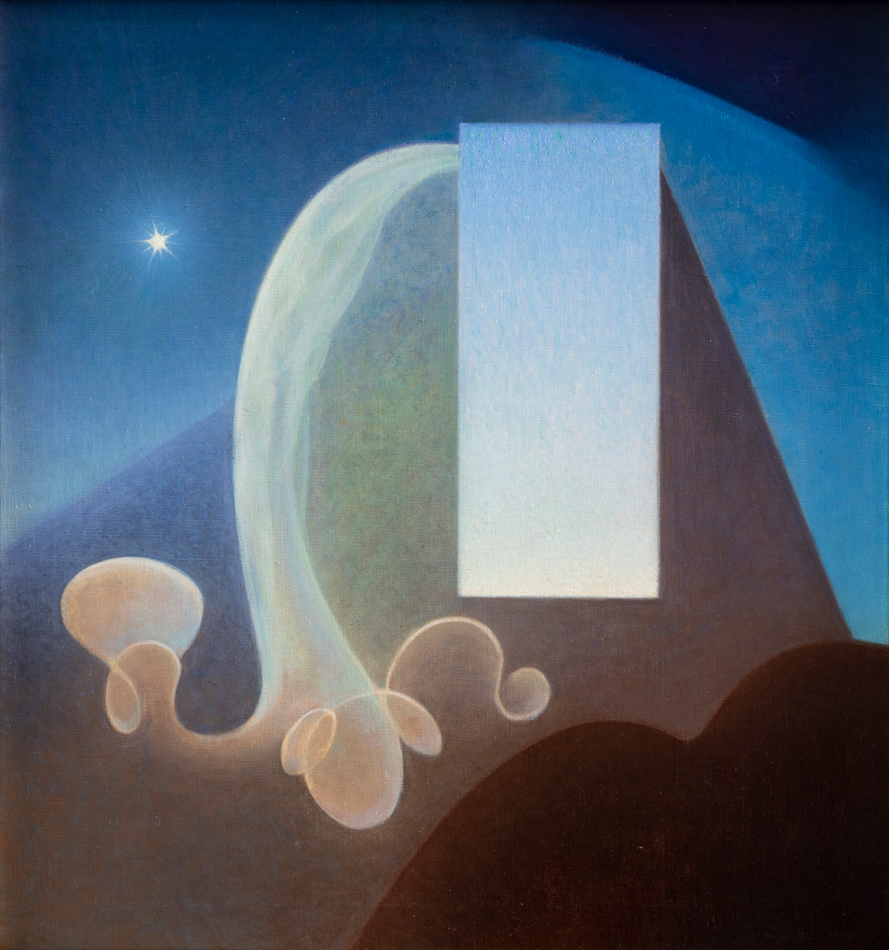
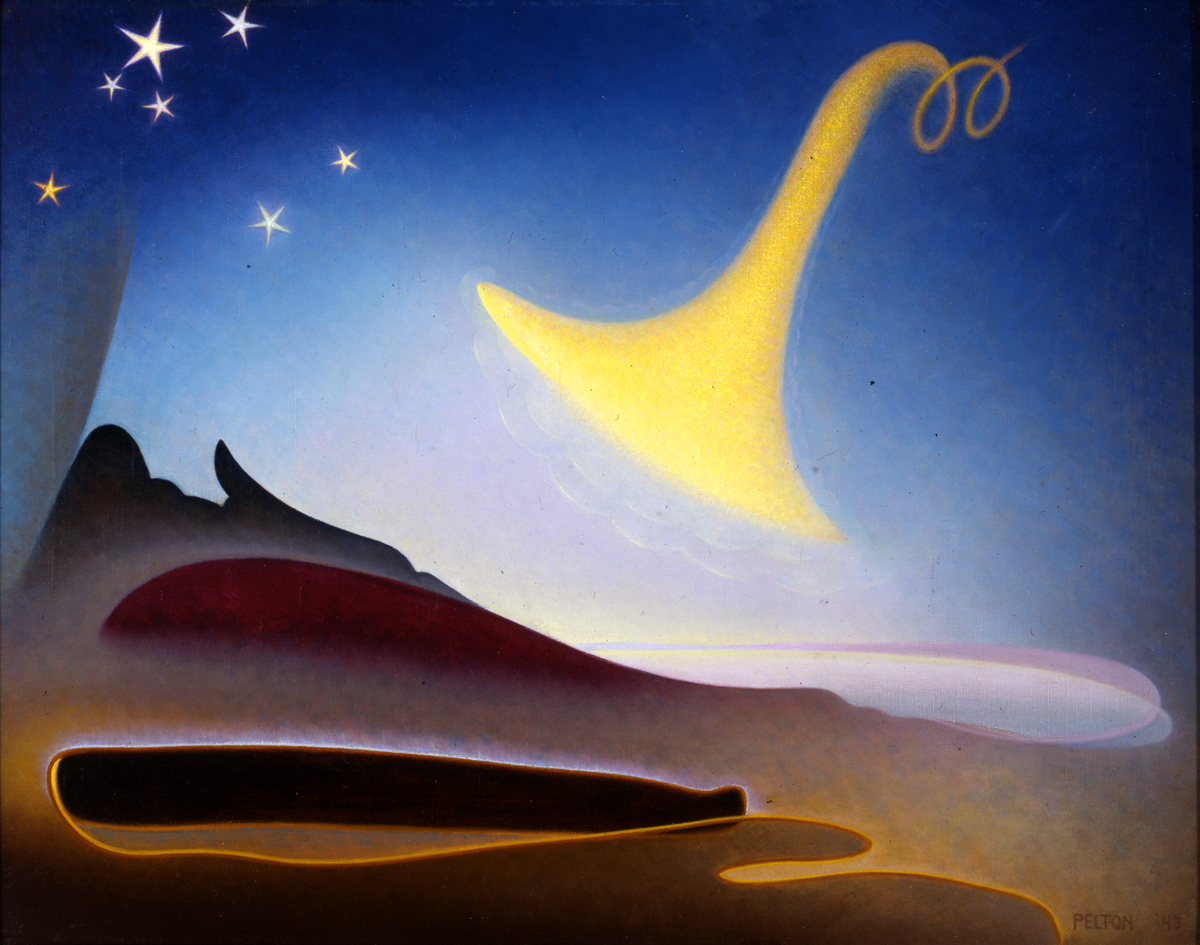
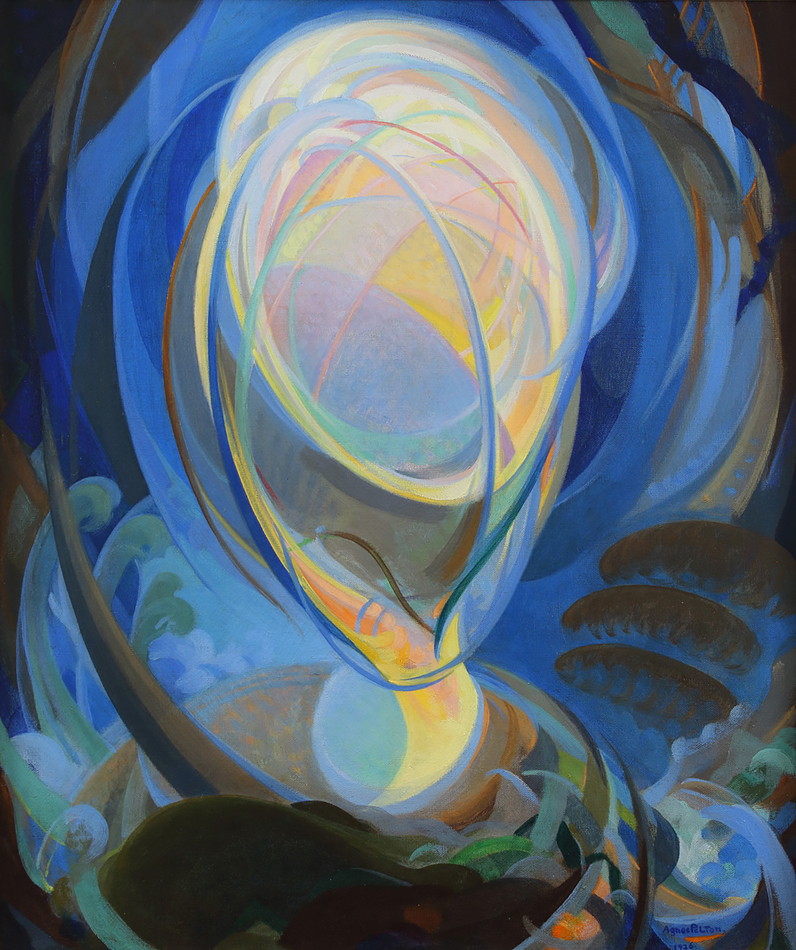
Between 1931 and 1932, painter Agnes Pelton left the New York City area for the low deserts of Palm Springs and settled in Cathedral City, some forty miles west of Giant Rock. A trained and celebrated painter in her time, it wasn’t until she began engaging with Theosophy and astrology in the Mojave that her abstractions came to resemble prismatic hallucinations overlaid on low desert landscapes. As her spirituality developed, so did her visions.
Pelton was part of the Transcendental Painting Group, which explored abstraction as a vehicle for spiritual or metaphysical experiences, and gathered mostly in Taos, New Mexico. Pelton was voted in as a member in absentia by a colleague who recognized her work in the California desert as being spiritually aligned. Often compared to her younger colleague Georgia O’Keeffe, Pelton looked to the cosmos, and O’Keeffe to the land; both plumbed the depths of solitude the desert provided them. Pelton’s move West was part of a larger movement in the 1920s and ’30s, when a litany of emerging alternative spiritualities and their practitioners took up residence across the Southwest. Seeking life outside the city was a means to break away from the strictures of society.
As an artist, Pelton saw the low desert as a place where she could work and get “away from the distractions of the modern world, in harmony with what [she] believed to be an ancient land,” as curator Elizabeth Armstrong put it in her 2019 catalogue essay “Agnes in the Desert.” Pelton’s was a desert before Airbnbs, before Flock cameras, detention centers, and nuclear testing, a desert without sagging powerlines and other failing infrastructure poorly managed by bloated power corporations.
Who the desert attracts is less interesting than who the desert keeps—while the desert welcomes anyone, very few can hack it out here. The art that is produced in these rarefied and so-called mystical locations is often the result of sustained and intense solitude: one that allows artists to dance out of step with society in larger cities; where artists can find their freak and choose to be outsiders.
The term “outsider,” in art, is an inadequate way of positioning artists beyond the limits of an amorphously defined “art world.” West of New York and east of Los Angeles, the Southwest contends with a lingering fixation on the idea that the desert is outside the center of the world itself.
The real desert weirdos like Van Tassel and Pelton nurtured relationships to the places around them, and were open to messages—from spirits or aliens or otherwise—when no one else was around to receive them. Such communiqués are gifts given to those who find silence generative rather than intimidating—to emanative beings attuned to their speck-like position in the span of time and space. After all, visions are sent to those fearless enough to engage with their uncertainty without demanding resolution.

Every bit of history I read about Giant Rock includes a vague land acknowledgment about the rock being central to Indigenous people, but fails to mention a specific tribal community or a ceremony or ritual purpose for the rock.
In old images, the rock is whole, but in the auspicious year of 2000, a craggy slice cleaved from the igneous quartz monzonite boulder. The break sent a sonic boom across the mesa, leaving neighbors to assume something had gone awry at the nearby marine base. Had aliens finally come to visit? Or had the marines blown themselves up?
Someone has installed a tire swing, dangling off the side of Giant Rock, that used to be the entrance to Critzer’s house. Esther wraps herself in a sheet of sequined fabric and tries it out. The sequins refract glittering light all over the backside of the boulder.
The Watson sisters’ dad shared affinities with Van Tassel and Critzer. An Italian adoptee, Gene Watson spent his fathering years in pursuit of researching, designing, and building what he felt was the vehicle of the future. Though quite serious, he earned the nickname The UFO Man by people in town when he worked on building his “future-ships” with stuff pulled from the junkyard; Esther has binders filled with his notes and drawings in her studio. Gene seemed to receive visions from beyond, like Tesla or Pelton, to build “the future of transportation,” a vehicle to take Americans into a parallel dimension, away from earthly limitations, drudgery, and the overall indignities of capitalism. Even Van Tassel believed aliens spoke through him, another outsider—or maybe, a visionary—who assigned himself a very important position, speaking to the world on behalf of the extraterrestrial.
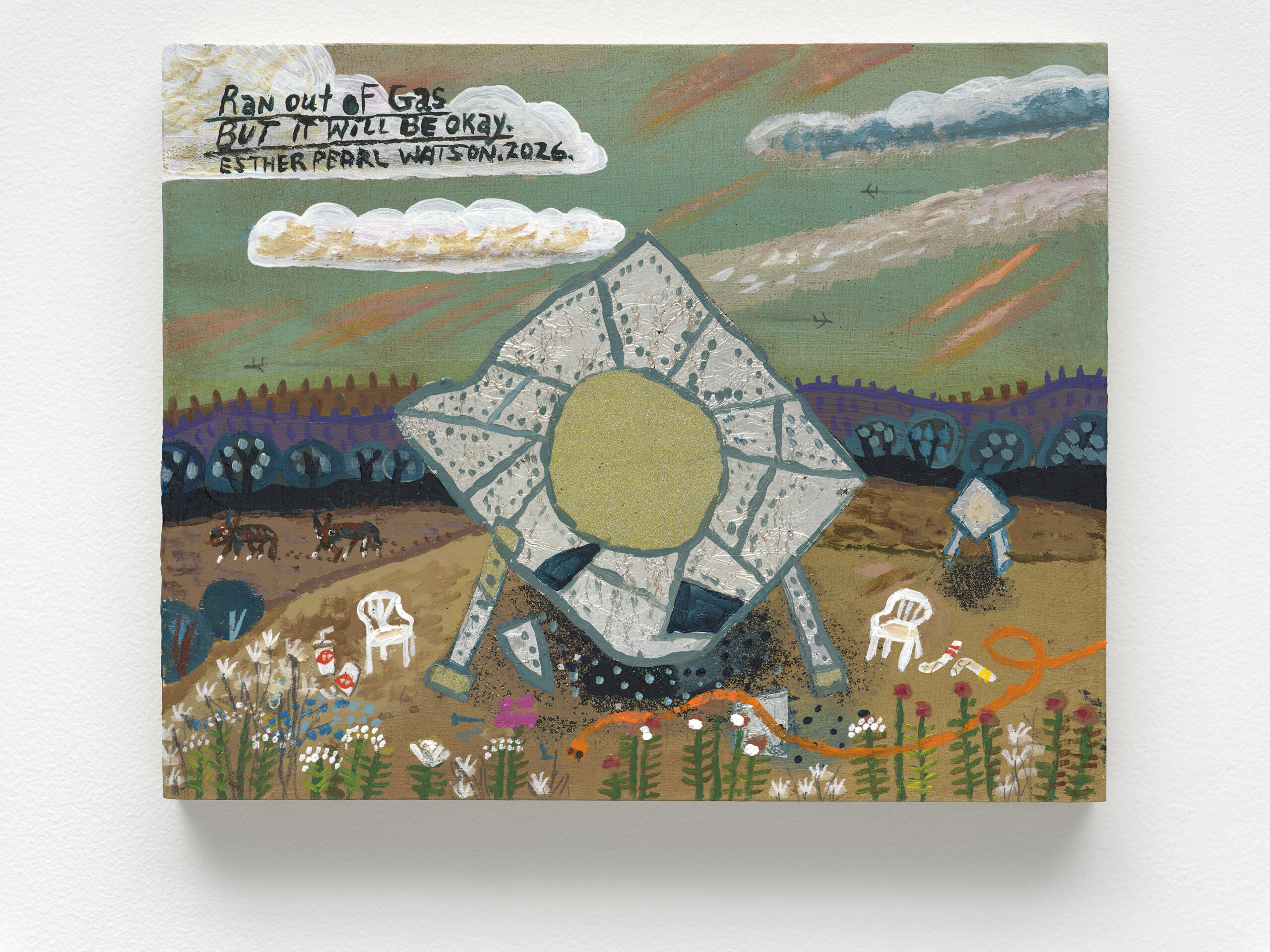
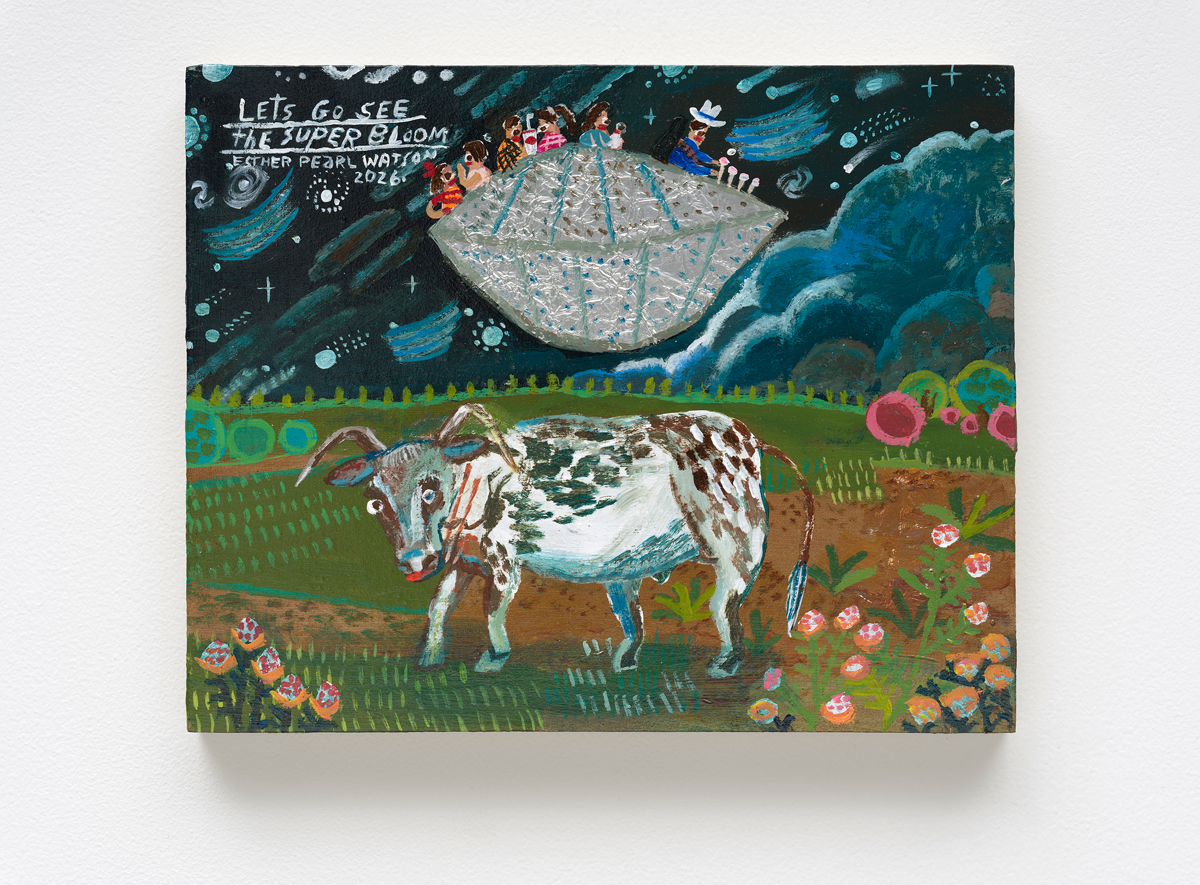
In dozens of Esther’s paintings, UFOs hover over each scene like an omniscient, cosmic eye, like Rene Magritte’s The False Mirror (1929), witnessing moments from her Texas girlhood. In later work, the UFOs maintain their presence, overlaid with images from Esther’s adult life in Yucca Valley and memories from her girlhood. Across these paintings, encounters cascade through the Watson family mythology: a sparkly pink UFO hovers over a field with a cow and her calf, while angels clasp Reese’s Peanut Butter Cups, recalling a week when Esther and her siblings had to subsist on the candy while their father tinkered.
As far as the designation of “outsider” goes—Esther finds it pejorative and outdated. “Some of us can be called by a strong vision and make work using our living environment as an exhibition space; some of us can choose to bypass the gallery system altogether,” she tells me. Desert artists in particular, she notes, divine ideas from the world around them—from animals, plants, and yes, even the local “desert rats.”
“There are many creative people out here and most of us are doers. We get ideas to manifest,” she says.
After the 2025 Eaton Fires, Esther and her family moved to the desert full time. In her newest paintings, Texas flatlands are swapped for the desert floor of Joshua Tree, though the compositions remain similar.
The form of each UFO emits immediate emotion. As subjects, they act as intergalactic babysitters and protectors, observers and bearers of omens. In The Fleet is Supportive (2022), a patchy silver UFO hovers while Esther and her family walk in a line through a field with rolled haybales, each with a popsicle in hand. An acrid peach and lemon sunset melts behind grayish clouds.
Back at Giant Rock, Esther has placed a freestanding painting of E.T.’s mother, made by Teresa, in the tire swing, and kneels to photograph it before the wind blows again. While I watch, I think about how I never considered E.T.’s mother, how she must have been worried about him.