Native artist James Luna bequeathed his most famous performance to protégé Erica Lord. On the eve of a rare reprise in Santa Fe, she recounts its fraught evolution.
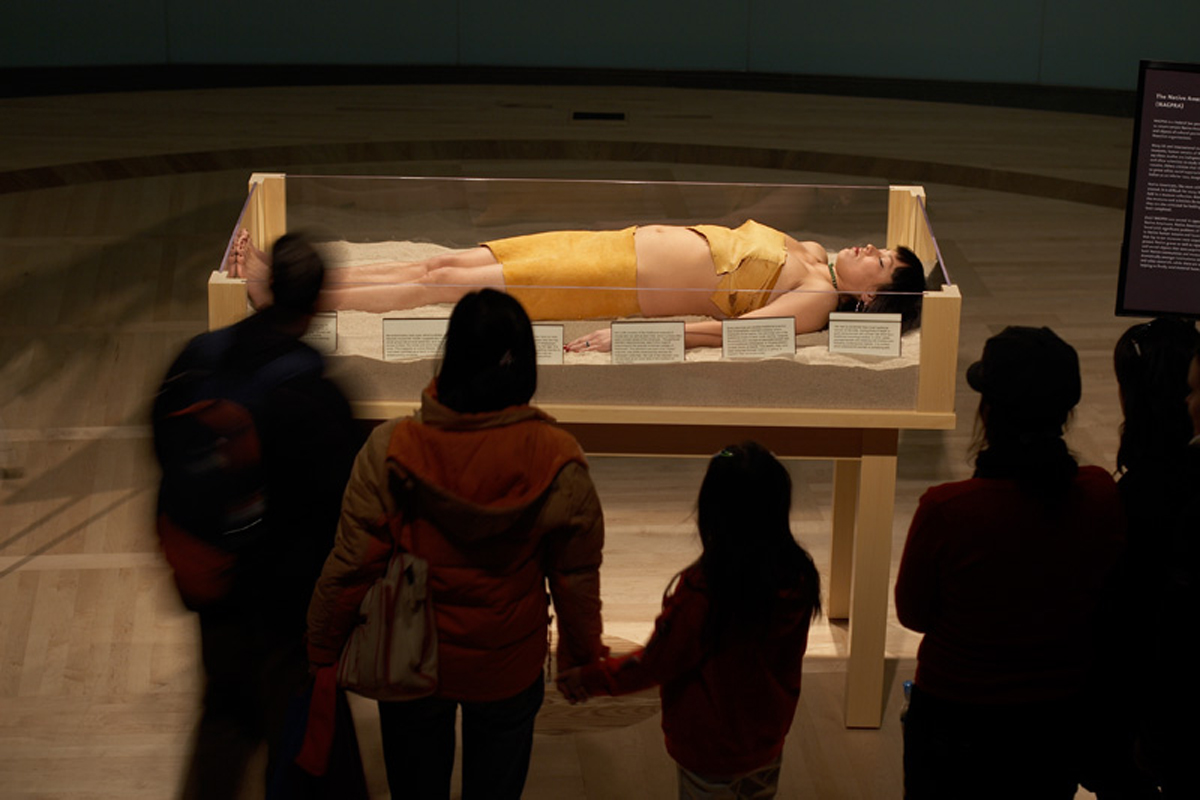
On her lunch break from lying in a museum display case, Erica Lord was on a mission. It was 2008 in New York City, and the artist had just spent hours trying not to shiver in the air-conditioned National Museum of the American Indian. She was determined to lie motionless in an open-topped Plexiglas box for her performance Artifact Piece, Revisited, and she had about three hours to go.
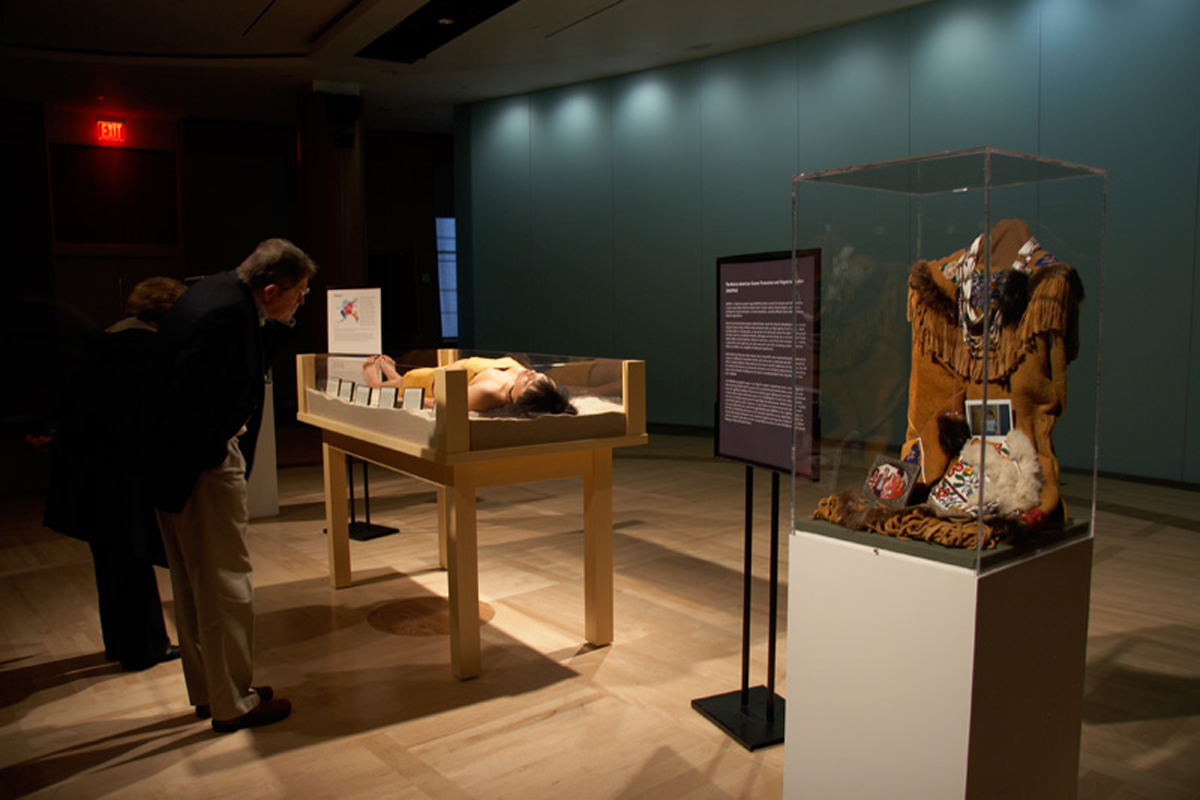
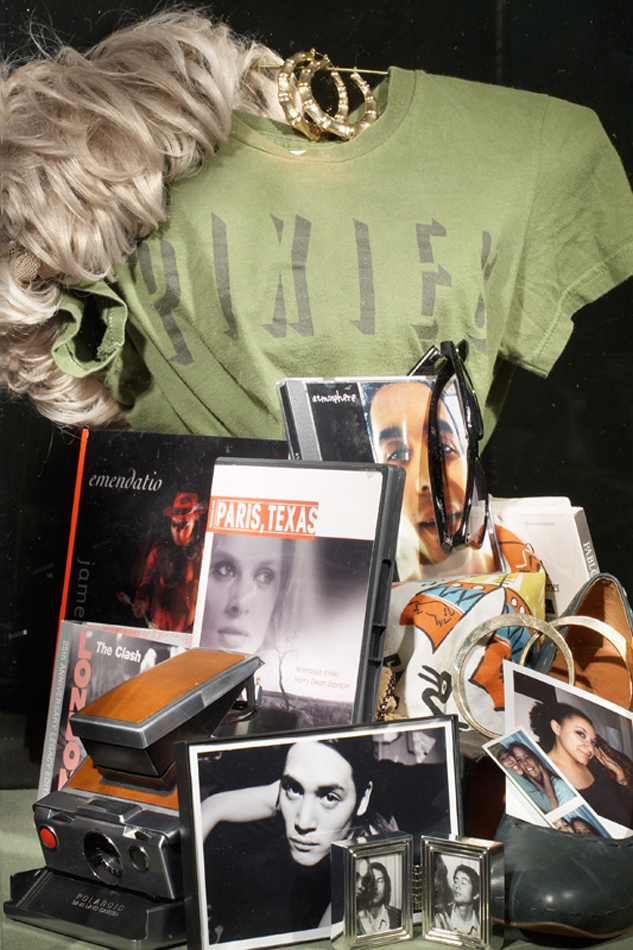
“We sent out all of the interns and they bought out every pharmacy of those heat patches,” says the Native and multiracial artist. “We took a picture of my back, and it looks like I’m covered in maxi pads.” She was much cozier when she climbed back into the sand-lined case, but to Lara Evans (Cherokee Nation), her body still looked cold. The art historian and longtime interlocutor of Lord’s work witnessed the full piece, writing later in an essay that two smaller displays of Lord’s personal possessions and some rows of chairs “made the installation… closely resemble a wake.”
Late last month, Lord and I met in her Santa Fe studio to discuss two forthcoming renditions of Artifact Piece, Revisited at Site Santa Fe, part of the traveling show Indian Theater: Native Performance, Art, and Self-Determination since 1969. The work is a sanctioned reinterpretation of the late James Luna’s The Artifact Piece—one of the most iconic Native American performance artworks of all time.
In their ten-year friendship, Lord came to call Luna her “art uncle.” Ahead of her first staging of the tribute piece since Luna’s death in 2018, Lord was thinking about what it means to place her body back in the box.
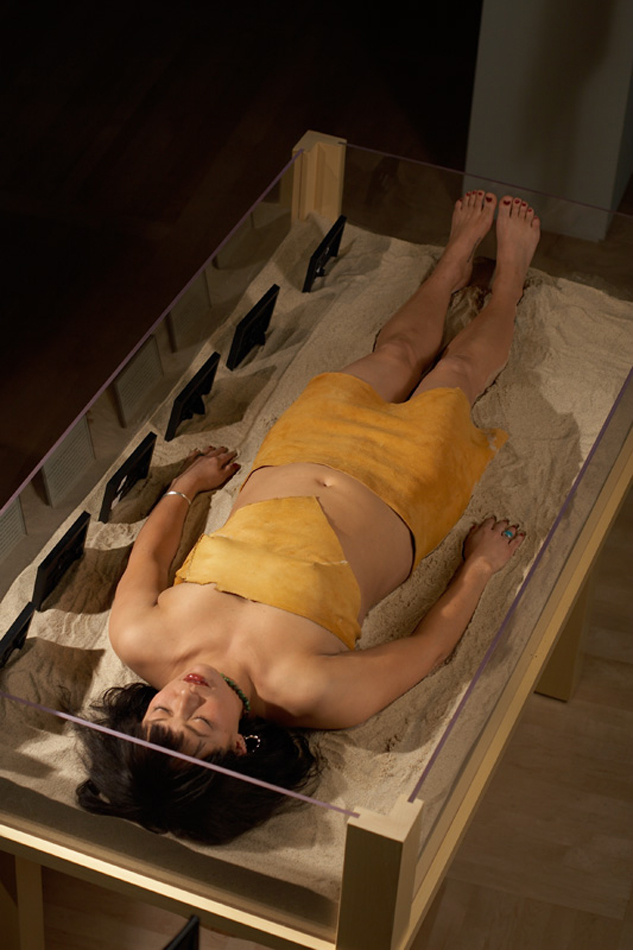
Lord’s New York performances of Artifact Piece, Revisited lasted three days and totaled more than fifteen hours. She says, “Afterwards, when I talked to James, I was like, ‘Do you remember how long you [did it]?’ He said, ‘Hour, hour and a half.’ I was like, ‘That performance made your career!’”
Luna debuted The Artifact Piece in 1987 at San Diego’s Museum of Man (now the Museum of Us), and it featured many of the same elements as Lord’s iteration. He lay in repose in a loincloth, surrounded by an elaborate display featuring cases of personal artifacts (Luna’s divorce papers, his college diploma) and didactic panels (noting things like the callus on his ring finger “with assorted painful and happy memories”). The work critiqued anthropological museum practices and turned visitors’ gazes back on themselves. People would lean close to examine Luna’s body, then pull back when they saw his chest rise. Sometimes he would yawn or stretch.
The Artifact Piece landed amid—and helped shape—a fierce debate about the possession and display of Native remains.
The Artifact Piece landed amid—and helped shape—a fierce debate about the possession and display of Native remains by American museums, leading to the passage of the Native American Graves Protection and Repatriation Act of 1990. The law requires federal agencies and institutions to return Native ancestral remains and objects to lineal descendants.
Before meeting Luna, Lord staged a tribute to the piece as a graduate student at the School of the Art Institute of Chicago. Born in Alaska and raised between there and Michigan, she describes herself as “circumpolar”: she is Alaska Native, both Athabaskan and Iñupiat, and Finnish, Swedish, Japanese, and English. She related to Luna’s multiracial identity—he was Puyukitchum, Ipai, and Mexican American—and the ways he played with that in subsequent works like Take a Picture With a Real Indian (1991/2001/2010).
In art school, Lord focused on photographic self-portraits in which she shifted her appearance using costumes and tanning beds, exploring versions of herself as a multiracial woman. “People are always like, ‘Well, you don’t really look Indian,’ [but] my blood doesn’t change from image to image,” she says. “I remember looking for people to identify with… just searching for this conversation.”
Lord met Luna in 2007 in Seattle, through Evans. “I had this little flipbook of all these questions I had written down,” she says. “After a handful of them, he’s like, ‘Erica, just calm down, listen, I’m done with this project, this is your project now… you can do whatever you want with it.’ That felt like freedom.”
Lord’s performance at NMAI in New York opened the following spring. NMAI is a Smithsonian institution, which is subject to the NAGPRA law, and in 2001, Lord had visited its storage facilities to view Native remains awaiting repatriation.
“I was shocked at how it’s just like football-field-size rooms with these giant stacks of boxes of skulls [and] femurs,” she says. Some bones were set out on a table, and Lord remembers Smithsonian staff “really manhandling” them. “A lot of the Native interns, they’re from other tribes that have different relationships to bodies or death, and they were up against the wall, trying to get away.”
Lord’s presence sparked a ‘very subtle’ shift in visitor behavior, causing them to reexamine objects that they’d previously breezed past.
In New York, Lord was suddenly the body on the table, wearing a deerskin bikini that had once been her Halloween costume—a reference to the idea of “playing Indian.” A few visitors were pushy, attempting to touch her or snap photos despite multiple warnings. The museum had arranged for one guard to protect her, but brought in a second. (In an earlier attempt at the performance, at a gallery in Canada, staff support and crowd control had gone so poorly that she doesn’t consider it part of the work’s history.)
From the audience, Evans absorbed the differences between Luna and Lord’s works, and the audience’s reactions. She wrote later, “A long-haired brown man in a loincloth is recognizable as an ‘Indian.’ Female Indian-ness is much less recognizable. […] Cultural specificity is erased in the face of sexualization.” Lord had fortified her text panels in anticipation of this, grappling directly with her mixed-race identity. Her personal artifacts included Riot Grrrl paraphernalia and a copy of Barack Obama’s Dreams From My Father (1995).
Evans reported that Lord’s presence sparked a “very subtle” shift in the behavior of some visitors, causing them to reexamine objects that they’d previously breezed past. “Strangely, the dehumanizing display of the body of the artist as an object had the effect of humanizing [other, inanimate] objects.” The dynamic also flipped in the other direction: visitors openly critiqued Lord like an object, especially for her decision to wear makeup.
Nearly twenty years since her New York performance, Lord is again taking stock of her life. The forty-eight-year-old has been scribbling clinical details in a notebook to update the text panels for Artifact Piece, Revisited. They note things like “fat deposits around her middle” and “multiple scars [from] biking and skateboarding accidents.”
Soon after her NMAI performances, Lord began planning another rendition in Fairbanks, but canceled after she was sexually assaulted in Michigan. She reported it, but the police declined to press charges. “I was just like, I can’t make sense of this, I can’t go and lie in this box,” she says. For years, she left the piece alone.
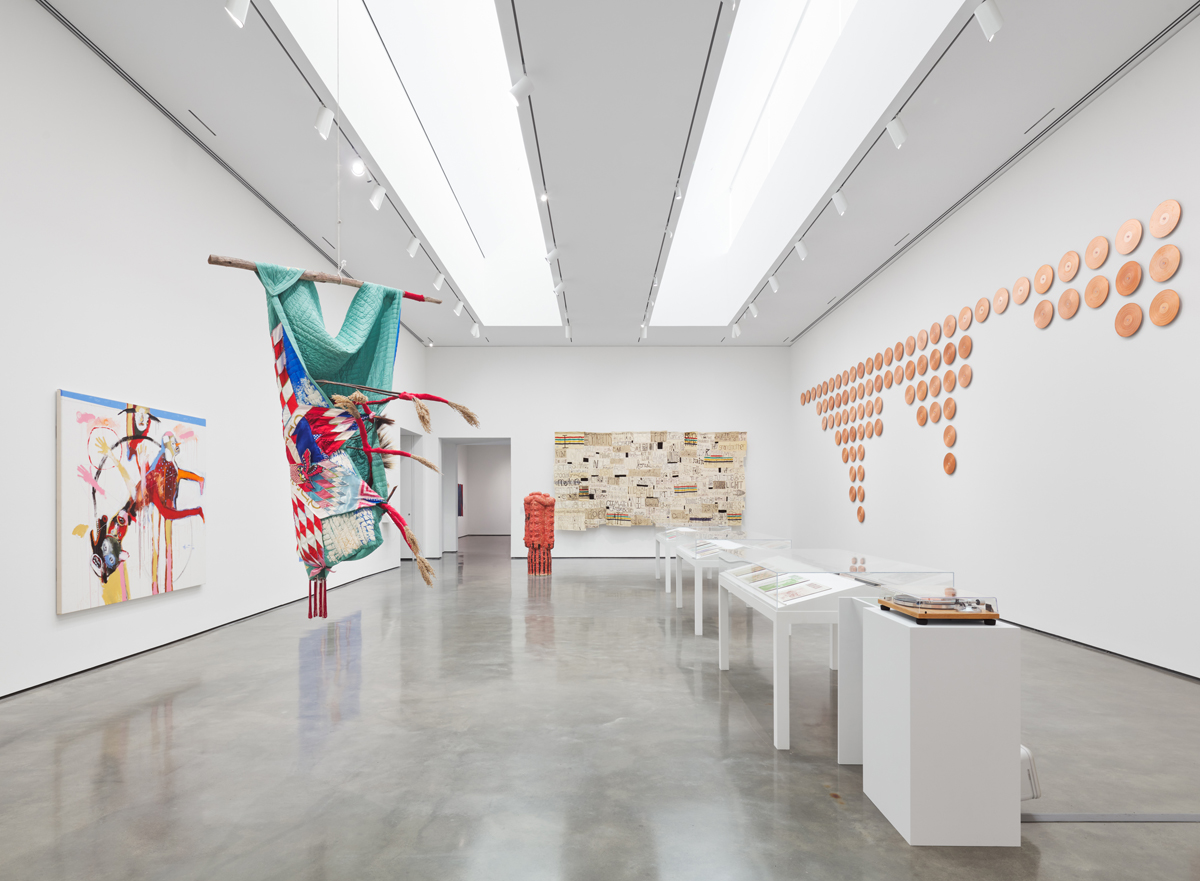
Recently, Lord ran into Site Santa Fe curator Brandee Caoba, and they started talking about finally reviving Artifact Piece, Revisited. Caoba was preparing to host Indian Theater, a traveling exhibition that is making its final stop in Santa Fe. Curated by Candice Hopkins (Carcross/Tagish First Nation), the show draws a direct line from late-20th-century Native performance art and activism—with Santa Fe’s Institute of American Indian Arts as a key incubator—to the current contemporary Native art moment.
I was just like, I can’t make sense of this, I can’t go and lie in this box.
“I see this performance as carrying forward this intergenerational conversation on Indigenous presence and self‑determination,” says Caoba. “Erica’s revisitation isn’t fixed—it’s repositioning that critique in a different generation and a different institution, and in the context of a female body.”
Lord is treating her body carefully for the Site rendition. Echoing Luna’s approach, she will perform for about an hour rather than six. One new text panel describes “a large surgical scar from a spinal fusion surgery on her lumbar vertebrae.” She was hit by a car and then driven over by a truck in 2018. Luna called her up soon after, inviting her to the La Jolla Indian Reservation in California so he could support her recovery. He died of a heart attack two days later. Amid Lord’s pain and grief, her community in Santa Fe came together to support her.
“It meant a lot to have James take me under his wing and reach out,” Lord says. “I swear, every Native artist I know… has some experience where we’ve had someone we really looked up to that crushed us. To have them not crush you—to have them support you and push you to keep going—that’s huge.”
Lord will perform Artifact Piece, Revisited on June 6 and August 15 at Site Santa Fe, and her display elements will remain on view through Indian Theater‘s run from June 5 to September 7. Lord and Evans will speak about the piece at Site on June 20. Portions of the show also appear at IAIA Museum of Contemporary Native Arts in Santa Fe.