Invoking the shifting lineage of void aesthetics, Jerónimo Reyes-Retana’s installations confront colonial practices of erasure by examining what he terms the “Playa Bagdad/SpaceX Conundrum.”
Immediately south of the Mexico-U.S. border lies El Campo Pesquero de Playa Bagdad, a stretch of windswept beach cradled by sand dunes and shallow, lapping waves, where a community of oyster farmers has been cultivating an oyster field for decades. A mere two miles north of the border is Starbase, the rapidly developing gated city created solely to service the Texas headquarters of SpaceX. These two populations represent opposite ends of the techno-industrial spectrum, separated by a political and economic power imbalance of epic proportions, but their futures are inexorably intertwined.
Jerónimo Reyes-Retana has been researching the effects of SpaceX’s operations on the easternmost edge of the North Mexican borderlands since 2021. As SpaceX endeavors to fulfill its core mission—the colonization of Mars—its rocket launches (and landings) have assaulted the Playa Bagdad population with deafening noise, which Reyes-Retana refers to as “transboundary sonic violence.” The oyster farmers and the fragile ecosystem on which their livelihoods depend are powerless against these acoustic invasions, all of which are being carried out in the name of space colonization—a project that, as recently proposed, includes sending data centers into orbit.
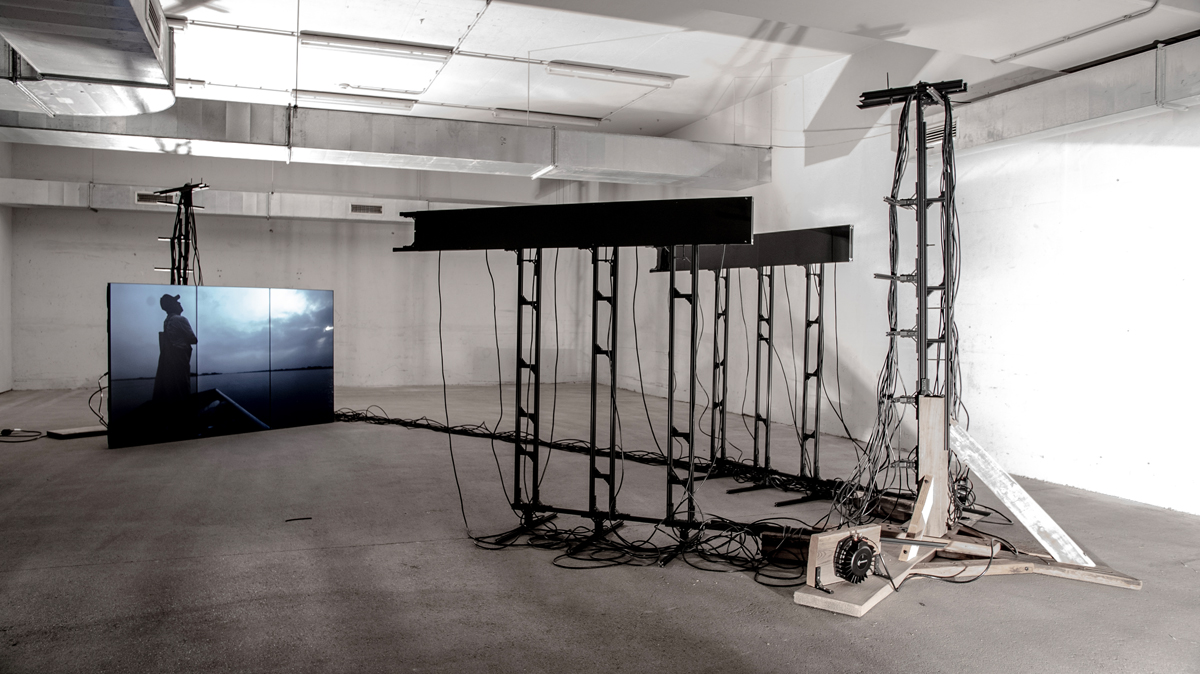
Reyes-Retana is an aesthetic practitioner, researcher, and community organizer based in Denver and pursuing a PhD in Critical Media Practices at the University of Colorado Boulder. His 2025 film installation Void in Resonance, winner of a CIFO-Ars Electronica Award, examines what he calls the “Playa Bagdad/SpaceX Conundrum”—a seemingly irreconcilable dynamic between two disparate populations co-existing in close proximity.
Composed of a custom-made sixteen-channel sound-reproducing device and an array of video screens arranged in a kind of techno-brutalist constellation with exposed tangled wires and crude, salvaged wood supports, Void in Resonance feels intentionally sinister. The installation’s components are situated in a manner that’s both sophisticatedly engineered and rudimentary—summoning a kind of cognitive dissonance and the duality embodied by the Playa Bagdad/SpaceX Conundrum. “I wanted to create an atmosphere in which the viewer would be exposed to this radically asymmetrical reality that overwhelms,” Reyes-Retana explains.
While filming Void in Resonance, Reyes-Retana closed his camera’s aperture, cloaking his protagonists and the scenery in darkness. This darkness conveys the deleterious effects of neoliberal industrialization and corporate profiteering, especially in relation to local and/or marginalized communities. “The consolidation of these sorts of infrastructure projects is often enabled by colonial practices of erasure,” Reyes-Retana explains. “I refer to the communities that are erased by these practices as colonial voids.” His intentional underexposure of the film’s visuals anonymizes the subjects by obscuring their faces, a prelude to the impending erasure threatened by SpaceX’s increasingly domineering presence.
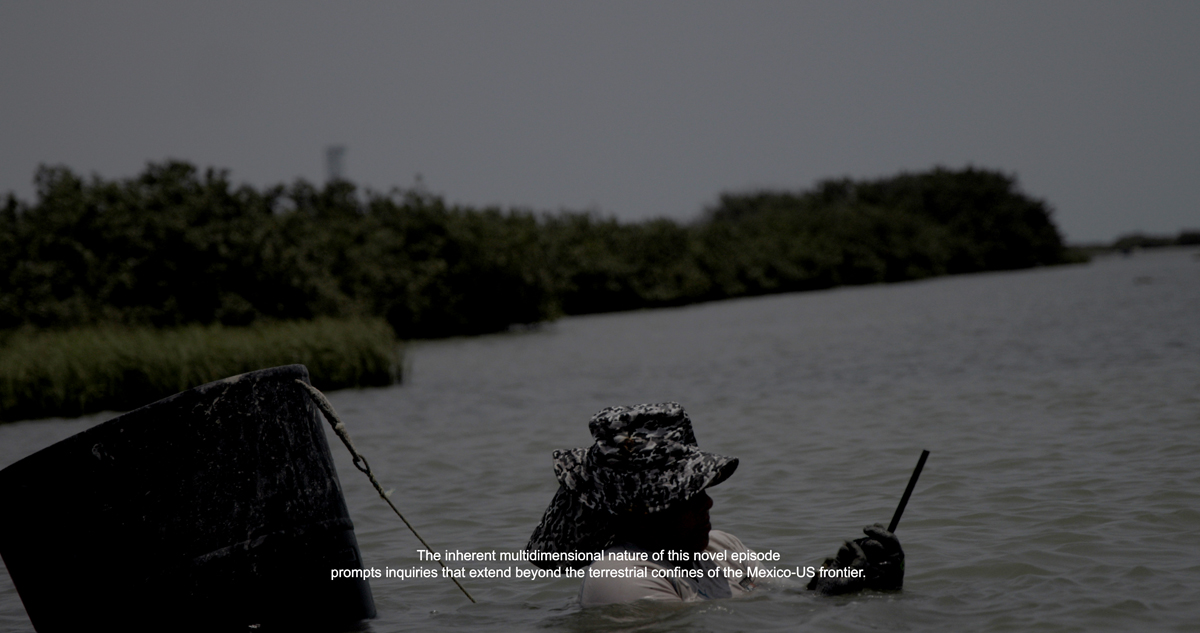
Throughout Void in Resonance, a female narrator1 calmly tells the story of the Playa Bagdad oyster farmers, interspersed with the farmers’ own voices. As they witness rocket launches taking place a mere two miles away, at times covering their ears, desperate birds shriek and scatter across the sky in a futile attempt to escape the sound waves. At decisive moments, Reyes-Retana cuts the film’s visuals, leaving only a black void and the all-consuming audio—an utterly jarring effect. When Void in Resonance was screened at the Denver Art Museum as part of the 2025 Digerati Festival, some audience members covered their ears as well.
SpaceX recently won federal approval to increase the annual number of rocket launches at Starbase from five to twenty-five. With the added onus of sending scores of data centers into space, however, SpaceX executives have projected a substantial increase in rocket launches every year.2
None of this surprises Reyes-Retana. “We’re not trying to stop SpaceX—that would be naïve on our side. There are too many interests embedded in that project,” he says. “What we are trying to do is open spaces for dialogue.” Reyes-Retana has been developing an education initiative with educator Ana Cerino, which he says will also function as a political arena and “aims to provide the community of Playa Bagdad with tools to negotiate with a future that seems unavoidable.”
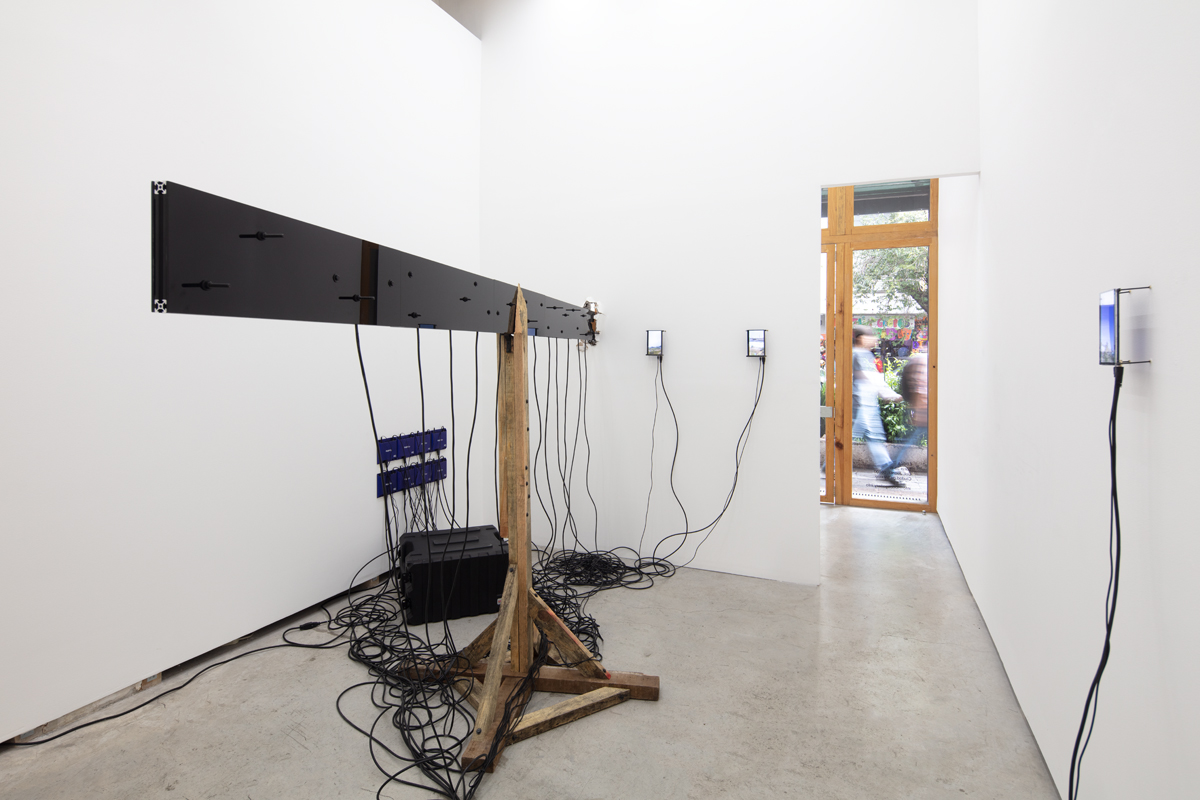
A separate installation, also stemming from Reyes-Retana’s research into the Playa Bagdad/SpaceX Conundrum, was exhibited at the gallery Lodos in Mexico City last year. Titled terranullius.global (2025)—a legal term meaning “nobody’s land” in Latin, historically leveraged to reject Indigenous sovereignty through territorial occupation—this work further amplifies Reyes-Retana’s critique of colonial voids.
Another web of digital audiovisual components, the installation’s main feature is an elongated, rectangular, twelve-channel sound interface rammed violently through one of the gallery’s pristine white walls. Videos recorded by members of the Playa Bagdad community are displayed on eight intimate screens around a central cluster of electronics, supported again by salvaged, splintered wood. To Reyes-Retana, using time-based media to depict marginalized communities is inseparable from “the ethical responsibilities of carrying a camera in a context that’s being harshly affected by violence perpetrated by infrastructure.” In terranullius.global, he inverts the violence, directing it towards the white cube aesthetic chamber.
While Reyes-Retana’s research is focused on colonial voids within Latin America, a broader implementation of void aesthetics is evident across global contemporary art praxis, with various ethical and dystopian implications.
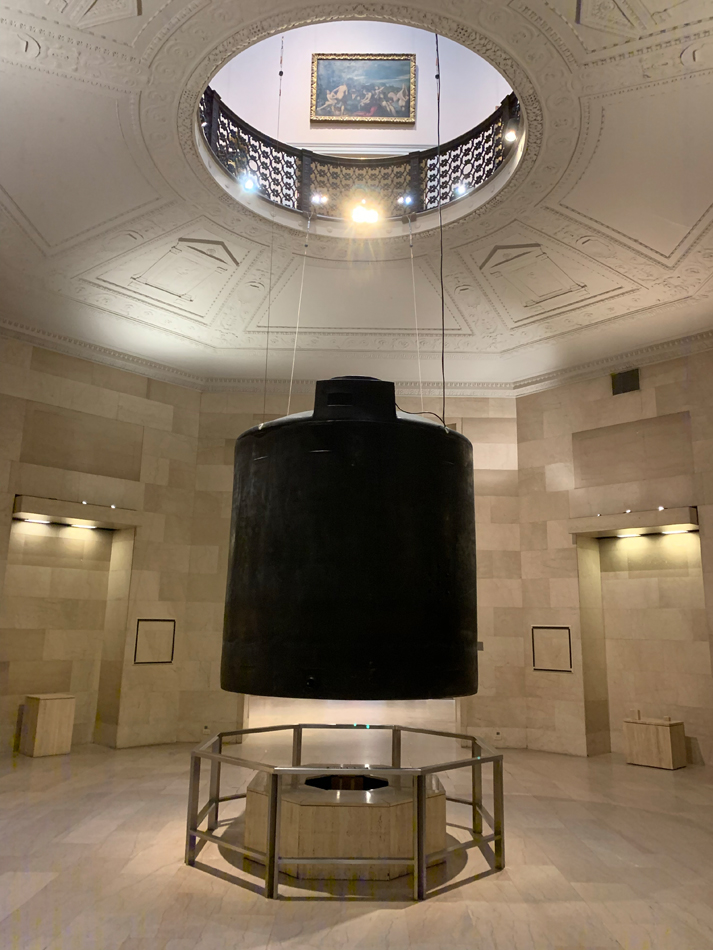
In 2020, Cristóbal Martínez (Genízaro, Xicano) and Kade L. Twist (Cherokee) of the collective Postcommodity suspended a dense black form in the classical rotunda of the Minneapolis Institute of Art, invoking a Death Star floating in space. Created from a 2,200-gallon chemical storage tank, Postcommodity’s installation Let Us Pray For the Water Between Us also functions as an ambient sound sculpture. A meditation on “the forced displacement of Indigenous communities and the complexity of human relationships bound by shared sources of water,” the installation feels particularly acute today, as water-hungry data centers spread across the country like a digital oil spill.
More recently, French artist Pierre Huyghe debuted his film Liminals (2025) at Berlin’s post-industrial techno club Berghain, in which a human-esque figure with a void for a face (and bearing what many critics have labeled a C-section scar) haplessly flops and crawls around an extraterrestrial landscape for fifty minutes. Huyghe created and animated said figure by sampling both analog and digital processes, remixing a live actor and photogrammetry scans with mediated gestures generated by machine learning (i.e., AI). As with Reyes-Retana’s Void in Resonance, an immersive, dissonant soundscape is integral to the work.
The ultimate emblem of modern void aesthetics, however, remains Russian artist Kazimir Malevich’s formative painting Black Square. When Malevich first exhibited the work in 1915, he installed it high up in a corner, a placement traditionally reserved for religious icons.
By 1917, he declared himself “General Secretary of Space” and later developed a speculative framework to reach the moon using satellites, nearly forty years before Sputnik was launched into orbit.3 The Suprematist movement that Malevich spearheaded was heavily influenced by Russian cosmism, which posited that interplanetary colonization would save mankind from extinction.
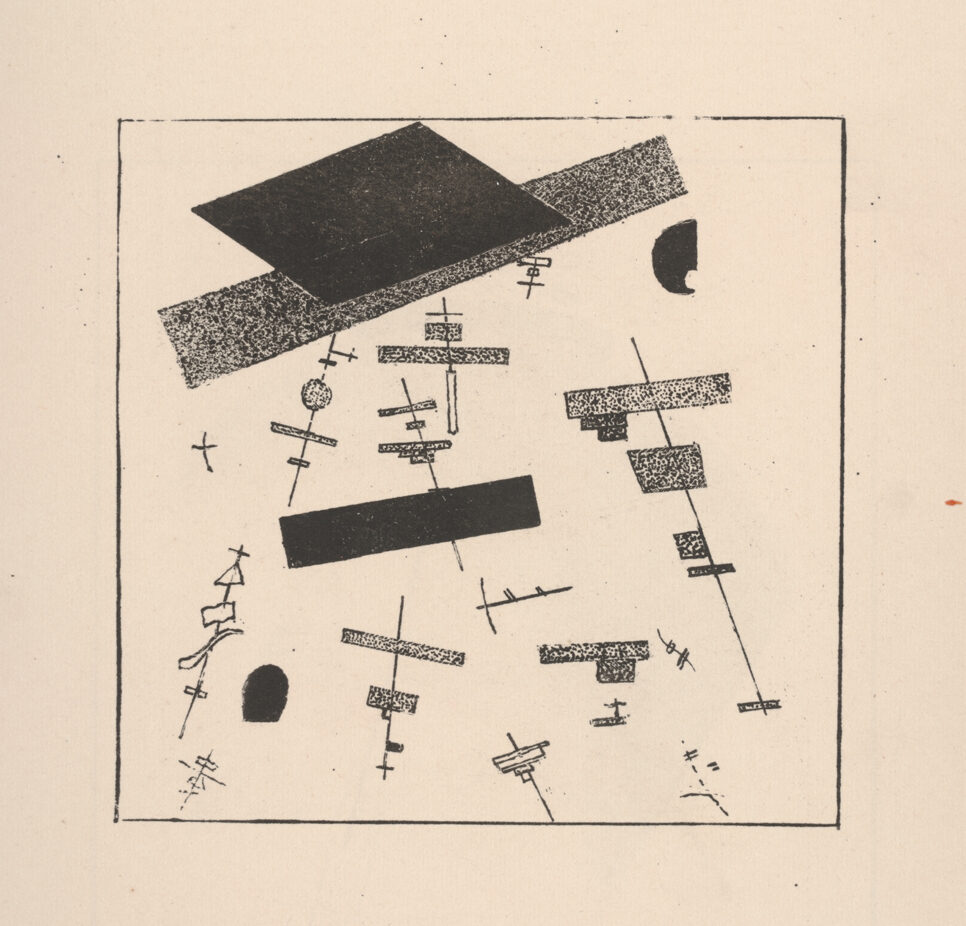
Malevich’s series Suprematist Satellites (1920) is uncanny in its prescient depiction of the technological constructs that have come to permeate daily life—the black mirrors that harvest and transcode our data into generative algorithms. Malevich’s forms float in negative space, untethered by gravity, and yet his assembled shapes bear an almost clairvoyant, albeit abstract, resemblance to Reyes-Retana’s physical installations. This alignment reveals an inherent fascination with the cosmos and an enduring preoccupation with the void.
Practitioners of Russian cosmism believed that mankind’s future was extraterrestrial, and this trajectory would deliver humanity to an immortal and divine cosmic poiesis.4 They were all eventually exiled or eliminated by the Soviet state.
The city of Starbase has been called “a beta test for a rising oligarchy” by The New York Times.5 However, SpaceX has also galvanized an emerging techno-utopian evangelism reminiscent of the 1920s Russian avant-garde—this time with the capitalist infrastructure to back it up.
Reyes-Retana’s ongoing investigation into the Playa Bagdad/SpaceX Conundrum is thus both a critique of corporate industrial “progress” and an attempt to reconcile the future of the North Mexican borderlands as its people resist erasure in the shadow of tech-fueled, cosmic Manifest Destiny run amok. Their localized struggle signifies a more universal existential threat, as the colonial instinct to terraform the void threatens to eclipse the value, perceived or otherwise, of not only Earth, but humanity itself.


- Singer-songwriter Cecilia Bastida, who was also one of the lead singers of the dissident Mexican band Tijuana No!, narrates the film essay.
- A New Yorker article summarized the SpaceX I.P.O. prospectus in which, “SpaceX admitted that setting up a fleet of data centers in space is ‘an incredibly difficult challenge,’ which would require thousands of rocket launches each year…” John Cassidy, “Is Elon Musk’s SpaceX Really Worth $1.75 Trillion?,” New Yorker, June 8, 2026.
- Jonathon Keats, “Out of this World,” Art & Antiques Magazine, 2016.
- Julieta Aranda, Brian Kuan Wood, Anton Vidokle, “Editorial—Russian Cosmism,” e-flux Journal, no. 88, February 2018.
- Amy Gamerman, “Elon Musk is Colonizing Earth,” The New York Times, June 12, 2026.