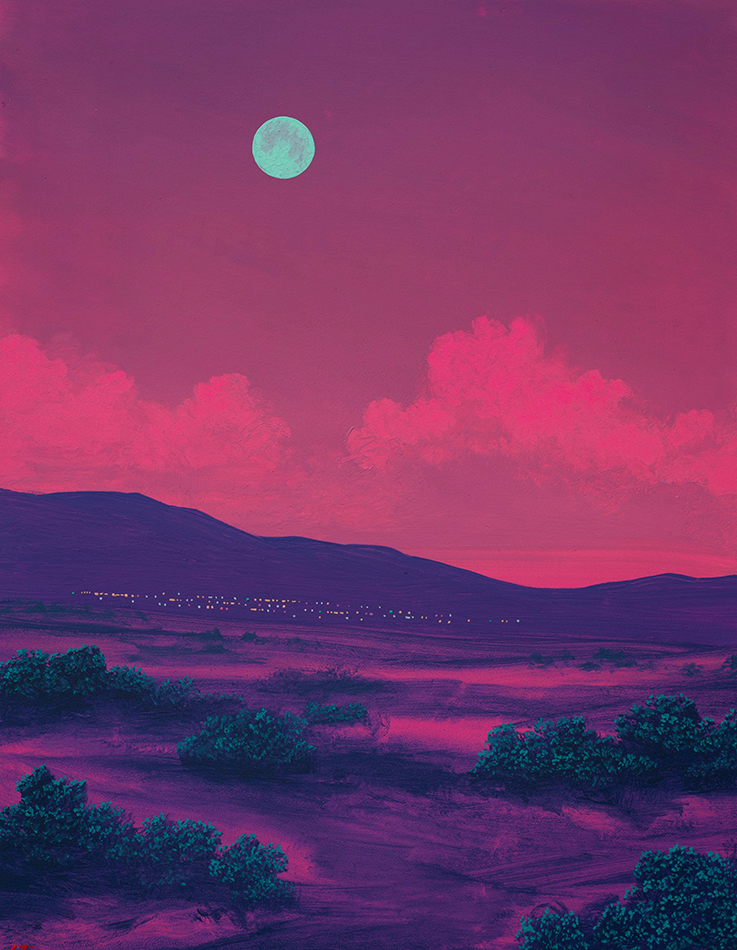
With an electric palette and layered technique, Santa Fe–based painter Jake Trujillo gives familiar Southwest landscapes a surreal spin.
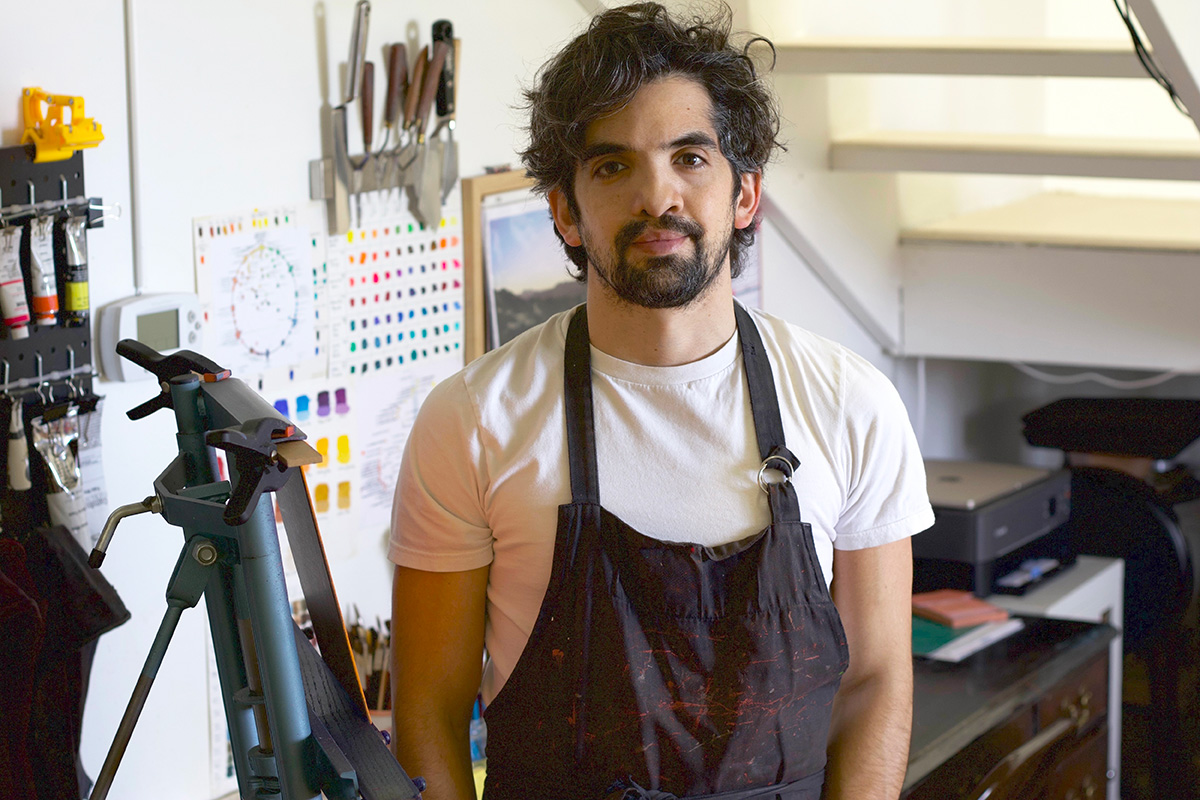
Just a few miles from Jake Trujillo’s live-work studio in the Siler-Rufina industrial arts district of Santa Fe, a road snakes up a hillside leading to an idyllic view of the expansive sky and surrounding mountain range. Trujillo tells me he’s gone to that spot countless times to watch the sunset, as he points out a photograph documenting the view that’s pinned to a bulletin board in his studio.
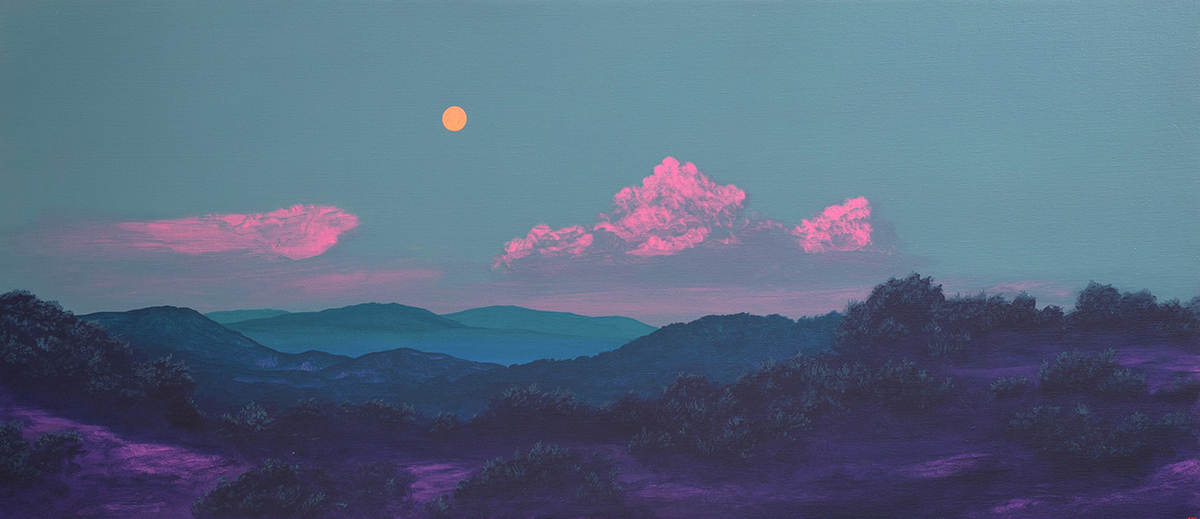
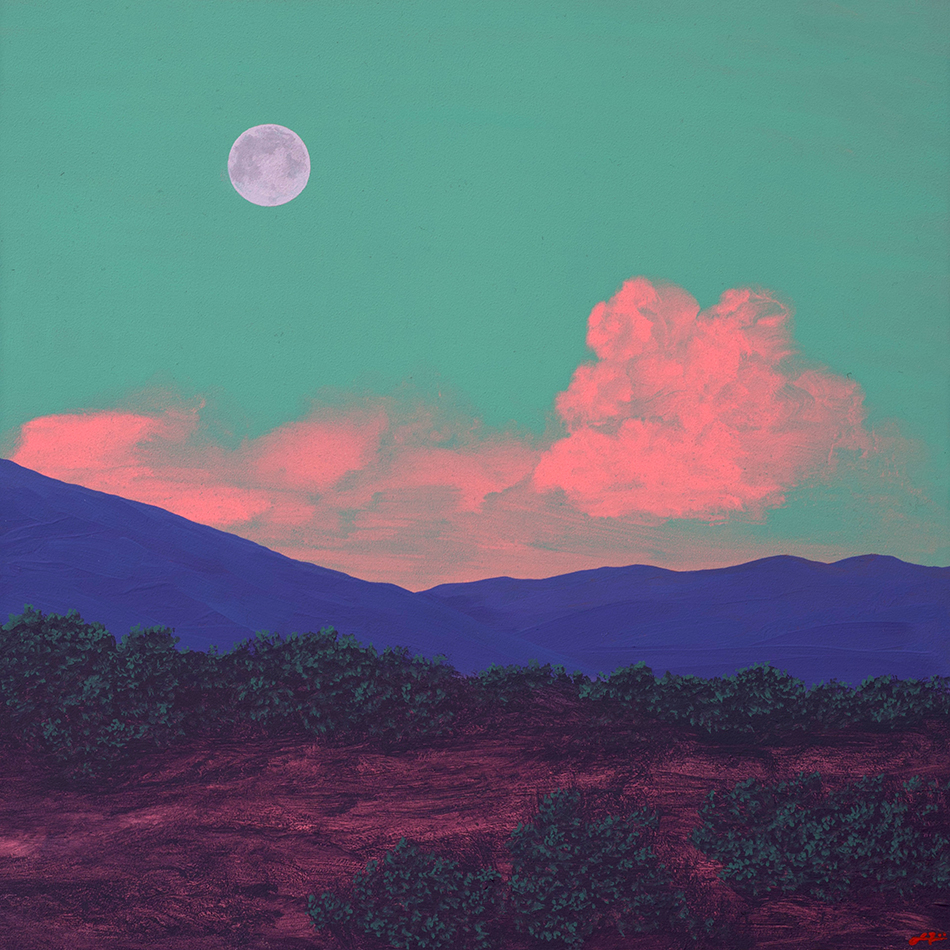
“When I started doing this work, I thought about trying to get back to those types of evenings and trying to get into that emotional space,” he explains. “More than being representational of the landscape,” Trujillo says his paintings aim to be “more about the representation of the experience and the representation of that emotional feeling.”
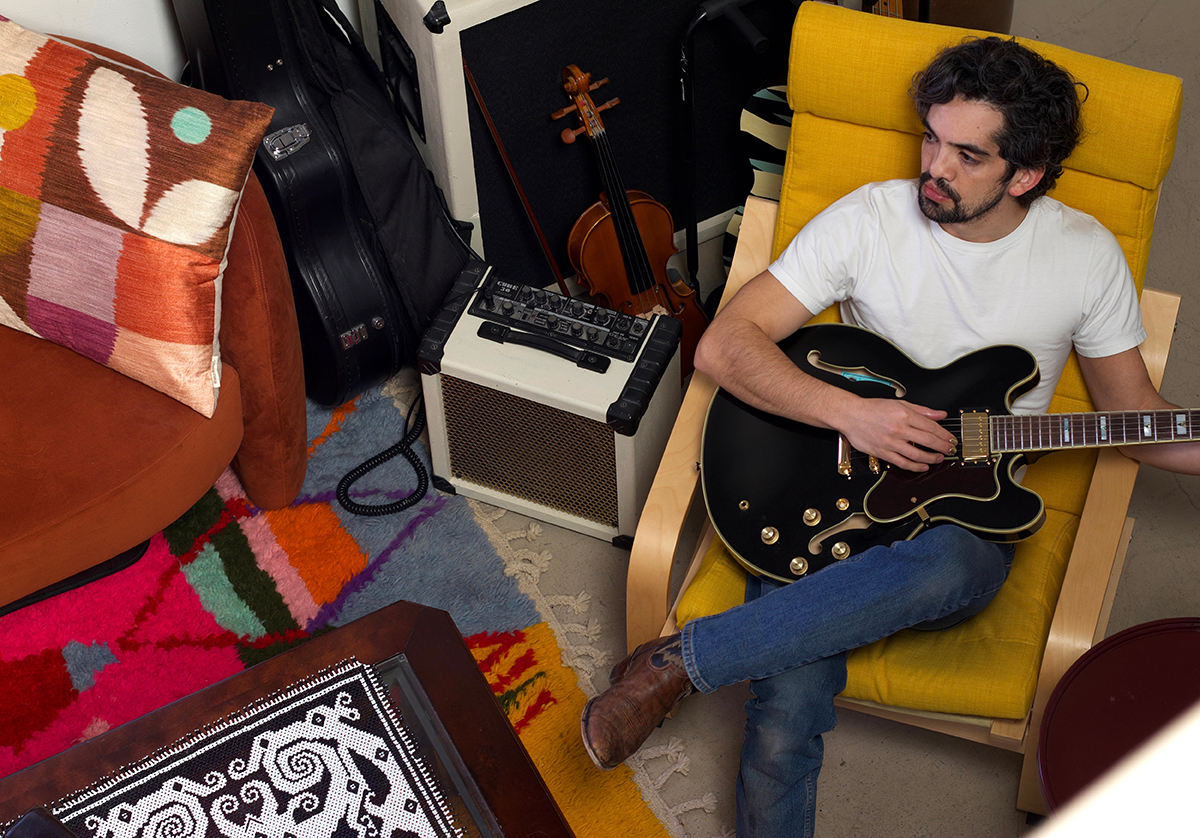
Drawn to the Romantic and Tonalist painters, Trujillo started playing around with the idea of creating dreamlike landscapes when he picked up painting ten years ago, after experiencing a creative block as a musician. The Santa Fe-born and -raised artist studied visual art in high school but it soon took a back seat to music—guitar, piano, and songwriting—which was his creative focus for much of his teens and twenties. But he continued to create some visual art during that time, and says he was influenced by his grandmother, an oil painter who made traditional Southwest landscapes while he was growing up.
I like to feel in collaboration and connection. And this format has been a way to easily share an emotion with people.
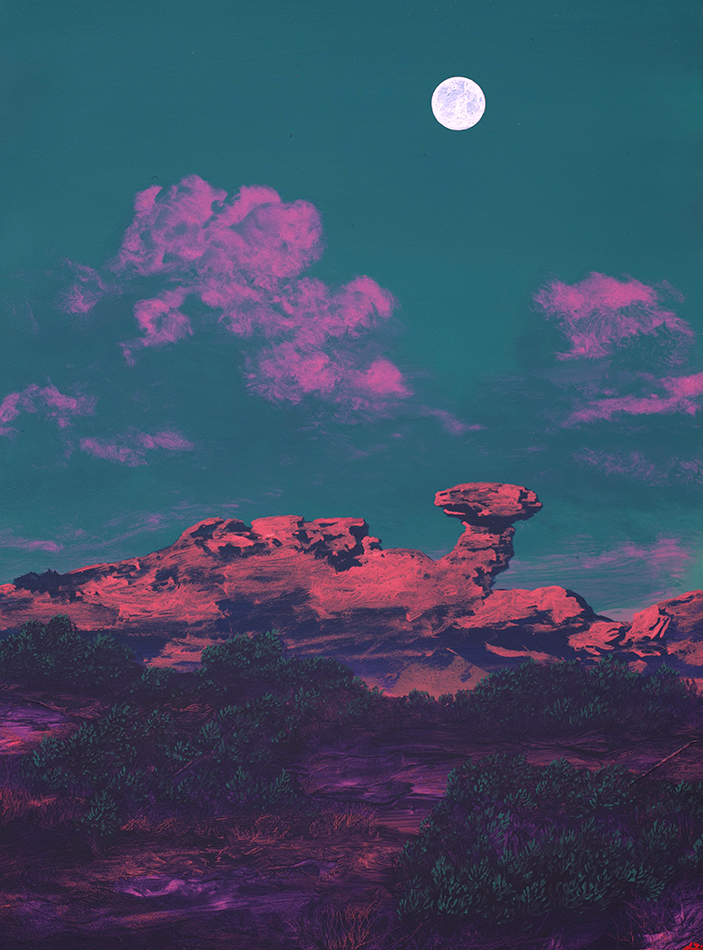
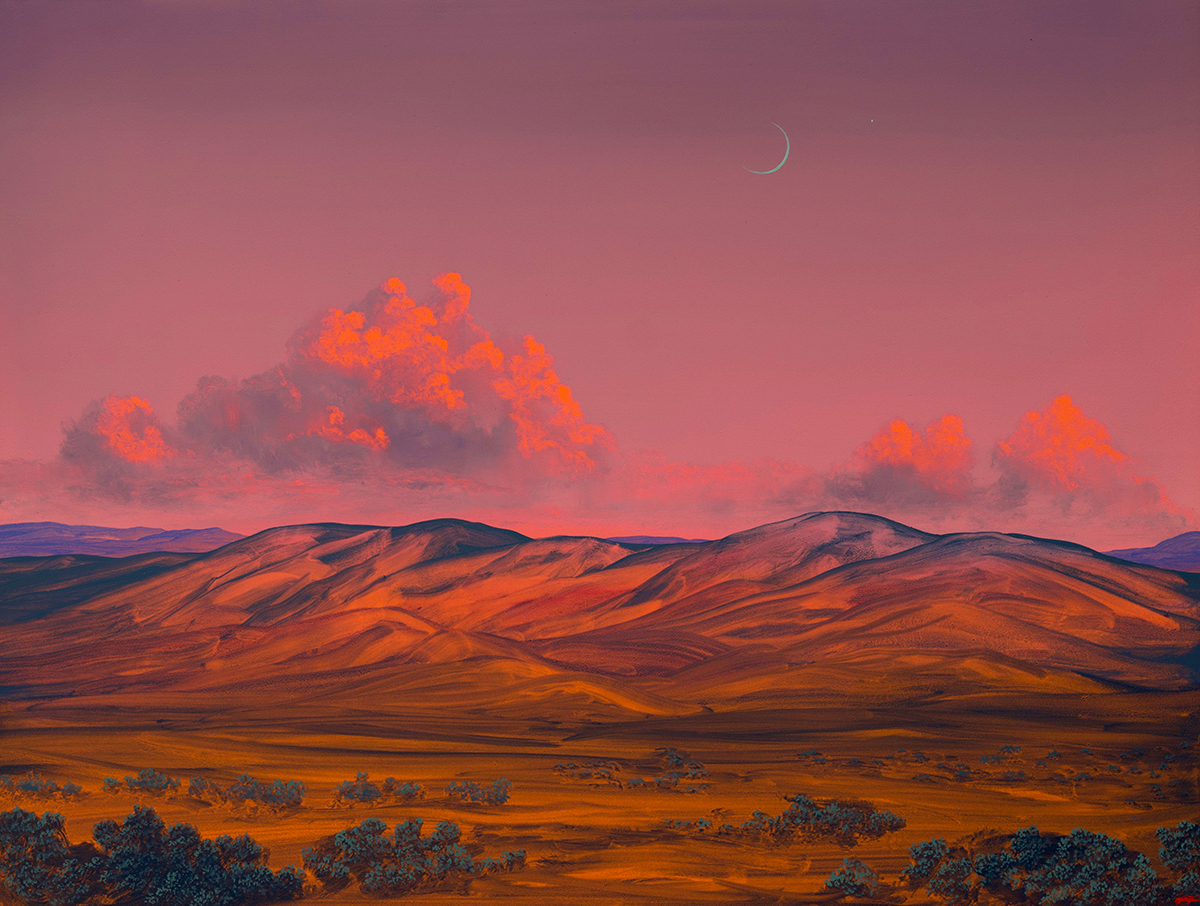
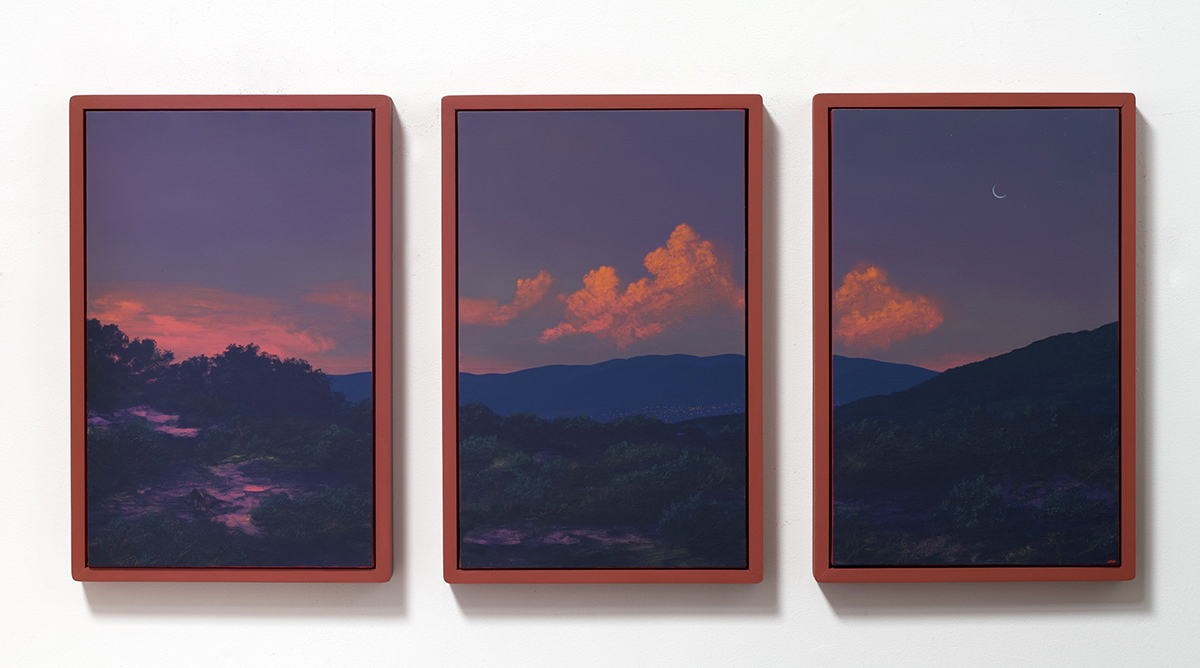
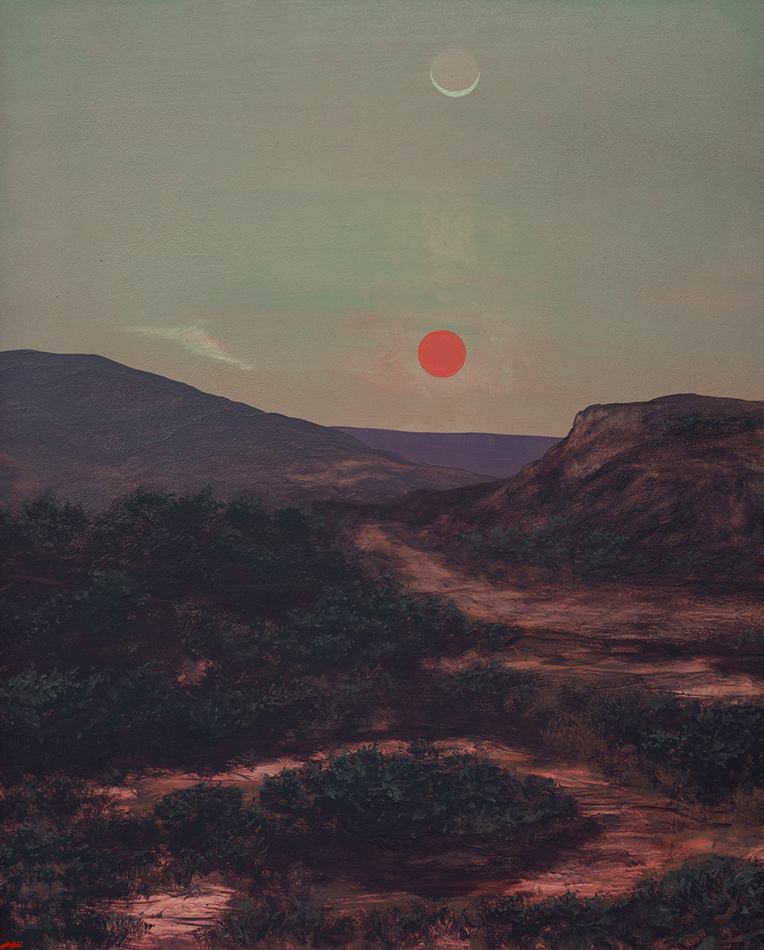
In Trujillo’s studio, a small gallery of his work decorates a wall that climbs to a loft space, and a larger painting of his hangs, like a window view, just above a dining table. The meticulously rendered landscapes of mountains and billowy clouds depict reassuring Southwest scenes. But there are always a few elements that shift his scenes into the surreal: an eye-catching orange or neon green moon, or a magenta sky mirrored in the desert sand.
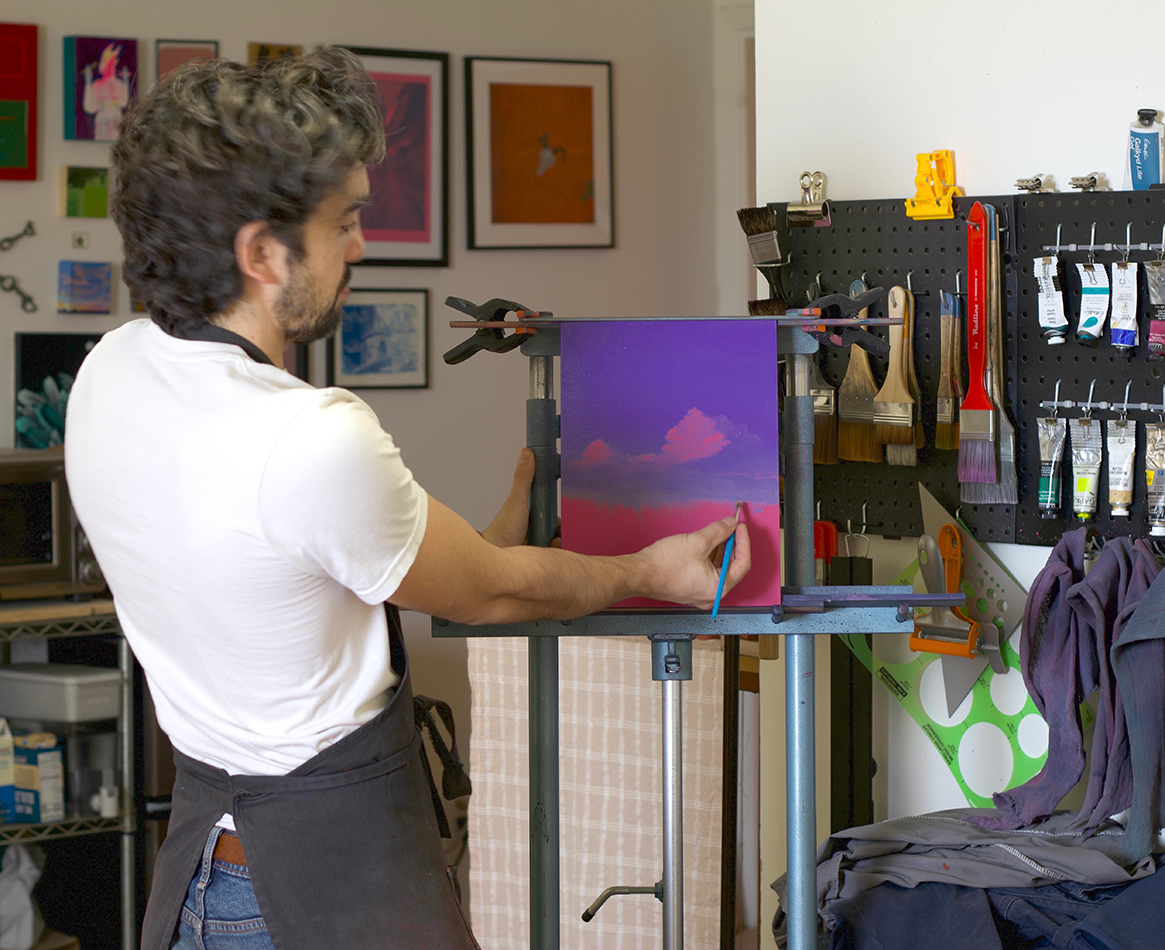
The artist always makes decisions about color first. “I’m a big color theory person,” he says, pointing to a color chart above his desk. Talking about the value and temperature of colors and where they land on the axis, he admits, “This is all stuff I geek out on forever.”
Rarely using primary colors in his work, Trujillo prefers secondary hues and frequently mixes his own blends. “Often when you combine color in unexpected ways you can create emotional responses that are very visually jarring or chaotic,” he says. “It can be… fun to look at, or it can be exciting, or can be a fresh take on a traditional kind of landscape representation.”
Trujillo pushes his oil paintings beyond the traditional through a playful approach to color, matte finishes, and thin applications of paint revealed through a subtractive technique. Several small cloud paintings rest on a drying board. He picks one up to explain how he lifts wet paint to reveal the clouds beneath. The process of lifting “allows for me to create some more organic forms,” he says.
“In my mind, not everything in the world as you visually perceive it is additive. So it can be helpful to have subtractive ways to create shapes and create shadows,” Trujillo says. “It allows me to create natural-looking things that are still very flat.”
The artist enjoys participating in every step of the process, from color choice to subject matter to the framing of the painting, and aims to create artwork that “feels uniform and reliable,” he says. “It’s less about the romance of individual artistic work and more about the design of an object.”
He refers to the enclosed back end of his studio as “the framing workshop,” which services another important component of his work. He has been making his own frames for as long as he’s maintained his painting practice. Rectangular wooden frames evolved into “more rounded, adobe-like frames,” he says, and eventually into rounded concrete frames. The transition to concrete was partly a practical decision, as he found himself spending almost as much time on the framing as the paintings themselves. “I never really stop playing with the framing,” he says. “It keeps me excited to think of them as design objects.”
Trujillo has dedicated himself to his artistic practice full-time since leaving his job as a data analyst with Meow Wolf in 2023. He has since picked up representation with Sun & Dust Gallery in Santa Fe and Madaras Gallery in Tucson, and has shown in group exhibitions and art fairs in Texas, Oregon, and California.
A lot of what I think is powerful about landscape work and about the Southwest is that it’s a shared experience for a lot of people. We all have a way to relate to it.
He’s spent so much time traveling recently, he jokingly shares that he’s thought about painting a series of motel room interiors. But he has yet to find an idea appealing enough to make a formal shift away from landscape paintings.
In answer to my question, “Why landscapes?” he replies, “A lot of what I think is powerful about landscape work and about the Southwest is that it’s a shared experience for a lot of people. We all have a way to relate to it… it’s got a broadness to it.”
He feels touched when someone says they are taken back to an experience or memory of a place upon viewing his work. “I like to feel in collaboration and connection,” he says. “And this format has been a way to easily share an emotion with people.”