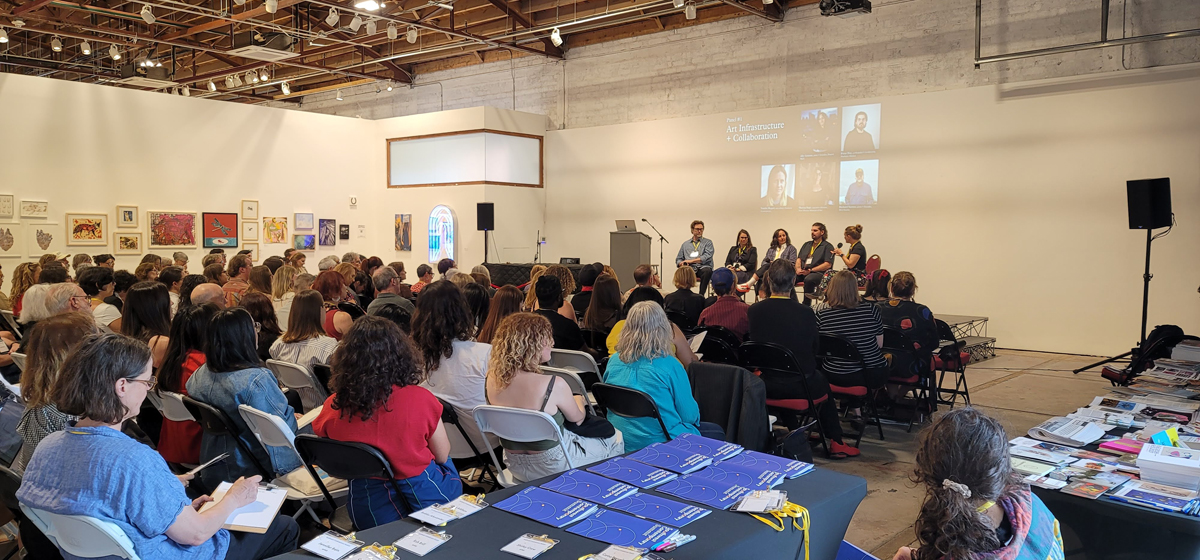
Over 150 artists, art workers, and writers gathered in Santa Fe to talk infrastructure, money, and the future of the Southwest arts field.
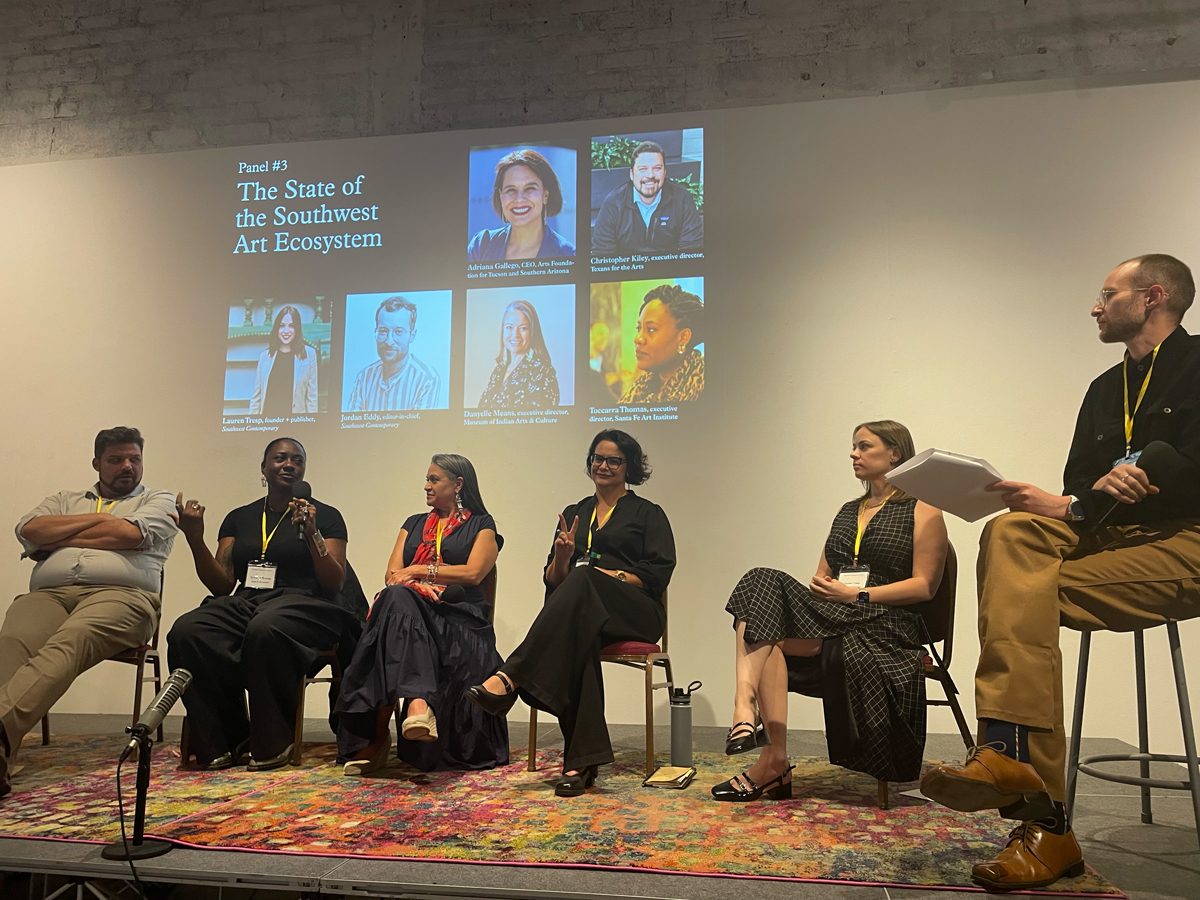
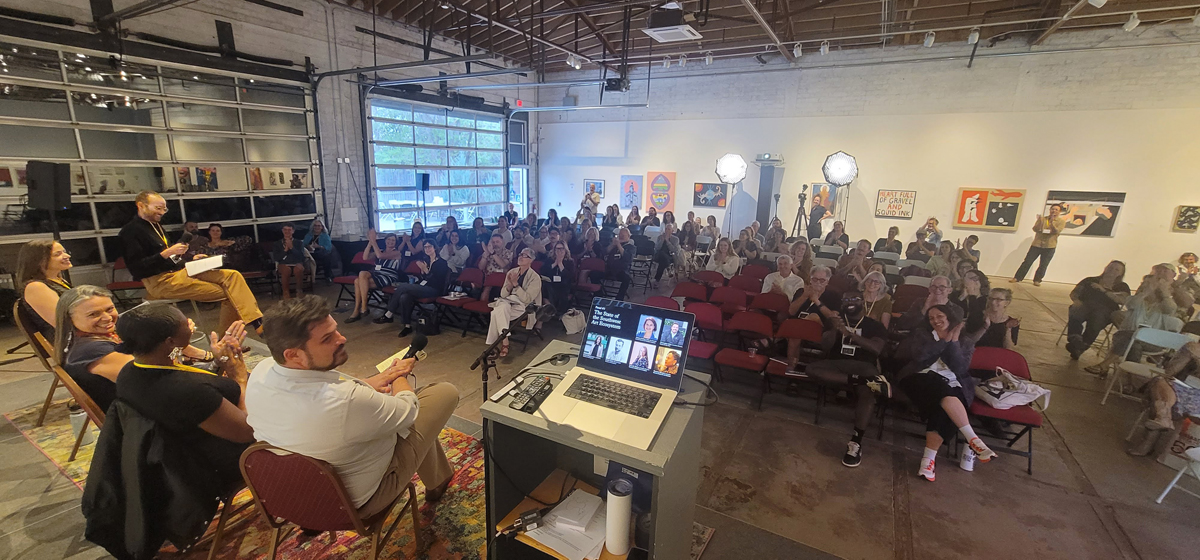
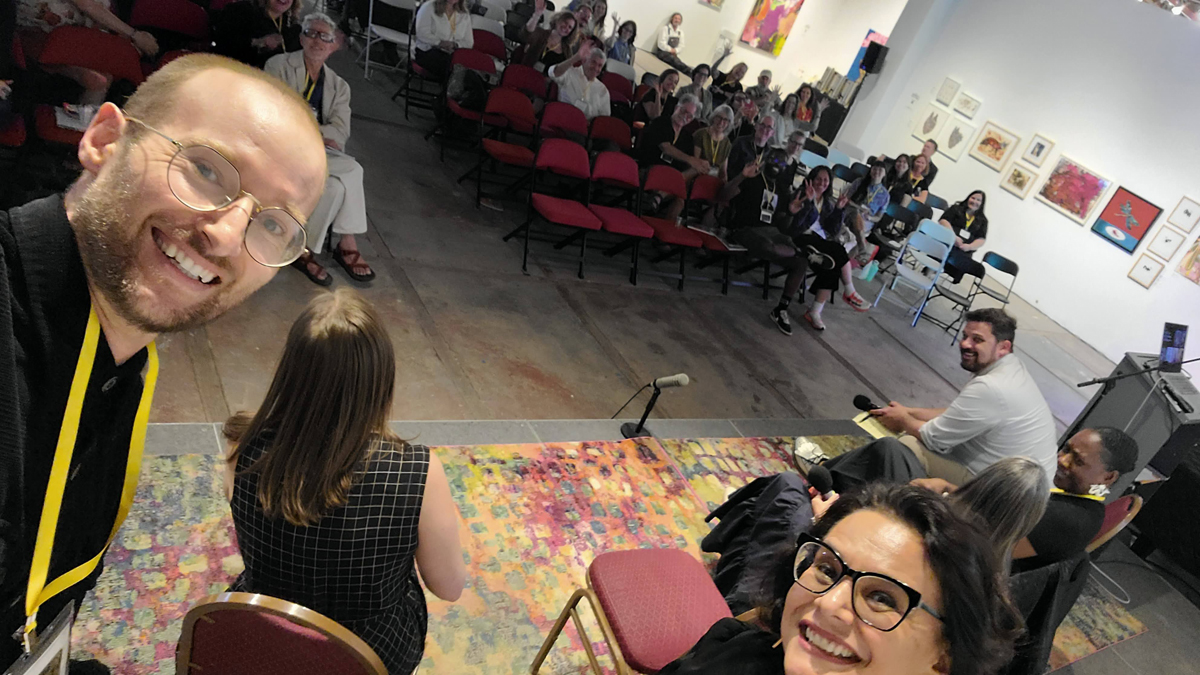
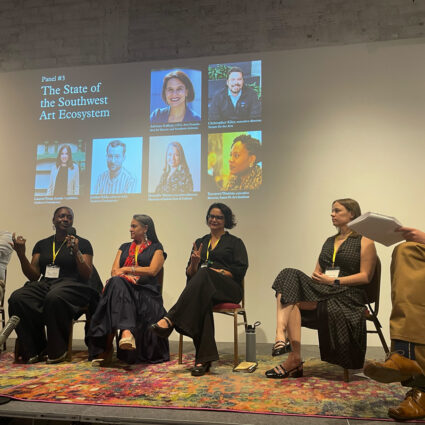
One month ago, more than 150 art workers, artists, and writers smiled and waved as Adriana Gallego, CEO of the Arts Foundation for Tucson and Southern Arizona, took a stage selfie during the last panel of the day. The spontaneous, charming moment encapsulated the impact of the inaugural Southwest Contemporary Summit: when we gathered that morning, many in attendance had arrived as strangers. By the end of the day, we had become a community of friends and colleagues.
For me, the summit was a long time coming. Not just in the many months spent planning and coordinating, but also in the years spent conceptualizing a regional gathering that would take the storytelling and reporting from the pages of Southwest Contemporary into real-time, in-person conversation.
Considering the challenges within the arts sector of the last six to seven years—the rippling disruptions of the pandemic, rapidly shifting technologies, and a fractious political environment—our goals were to create a shared understanding of the visual arts field, to identify opportunities to forge ahead amid changing conditions, and to strengthen a sense of regional coalition-building and community.
In order to row together in the same direction, we need to be clear-eyed about the present conditions we are working within, and informed and inspired about the opportunities that lie ahead. We organized the day of panels around three primary conversations: infrastructure and collaboration, the shape of the market and financial sustainability, and a holistic, far-ranging conversation about the state of the art ecosystem across the greater Southwest.
One moment we were discussing the complexities of artist-relations work, and the next we’d jumped to intergenerational challenges in rallying arts advocates.
The first panel, moderated by Southwest Contemporary’s arts editor Natalie Hegert, included Ally Grimm (artist and founder, Denver Walls), Peter Hay (co-founder, ProArtes México), Marisa Sage (executive director, New Mexico Museum of Art), and Richard Saxton (artist and founder, M12 Studio).
“My panel started the day directly addressing one of the main reasons for our convening: how to form networks across the region and collaborate with different publics and stakeholders,” Hegert reflects on the conversation. “It was a privilege to be on stage with panelists offering such a wealth of wisdom, sourced from years of experience in cross-community collaboration, whether international, statewide, or in rural communities. Advice was dispensed, frank discussions were had, and we got the audience warmed up to do some networking of their own during the rest of the summit.”
Panel number two, moderated by writer and editor Nancy Zastudil, brought to the stage Chelsey Johnson (director, City of Santa Fe Department of Arts and Culture), Doug Kacena (curator and owner, K Contemporary), Juniper Leherissey (executive director, Harwood Museum of Art), and Louise Martorano (Community Arts Stabilization Trust). The topic was money, which is always at the top of everyone’s mind.
The discussion of market forces ranged from the limitations of municipal tax structures to a rapidly shifting commercial gallery market. The panelists also each spoke to the opportunities created by working at the intersection of visual arts and other sectors, whether in securing real estate for artists or expanding the work into community in meaningful ways. While the challenges are endless, so are the opportunities to innovate and look outside of the usual means for garnering financial support.
The last panel of the day opened with my own remarks on trends we have observed at Southwest, and was moderated by our editor-in-chief Jordan Eddy. Panelists Adriana Gallego (CEO, Arts Foundation for Tucson and Southern Arizona), Chris Kiley (executive director, Texans for the Arts), Danyelle Means (executive director, Museum of Indian Arts & Culture), and Toccarra Thomas (executive director, Santa Fe Art Institute), were tasked with reflecting on the health of the regional arts sector through their unique roles and experiences.
“The scope of my panel was dizzying, but my panelists grounded it through storytelling,” Eddy shares. “Looking across the stage at five arts leaders from four states felt like witnessing a living version of the magazine, which was part of our vision for the summit. I was amazed by how well their narratives segued: one moment we were discussing the complexities of artist-relations work, and the next we’d jumped to intergenerational challenges in rallying arts advocates. It was like sitting together in the eye of a storm.”
I have been ruminating on a few overarching themes of the summit (some of which I articulated in our latest Southwest Industry Newsletter):
- One of the biggest questions that is critical to answer to move the field forward is: who and where is the visual arts audience, and what are their needs? Panelists and audience members raised questions about the accessibility of art spaces (and the art market) several times. From affordable price points to inclusivity and accessibility, concerns about the general art-going public feeling, at minimum, welcome, and ideally, called to support the arts, threaded conversations throughout the day. According to a 2025 American Alliance of Museums report, for more than half of museums, attendance numbers are still lower than pre-pandemic levels. Understanding supply-and-demand dynamics within the arts will be critical in magnetizing greater participation and support moving forward.
- The information infrastructure for the arts is thin, and requires care and investment from us all. In this media environment, it will only become increasingly more difficult and more expensive to reach the audiences we seek to serve. For viewers to be made aware of the cultural goings-on around them, we need far more robust information infrastructure if we are going to even begin to compete for attention. And I’m not only referring to art publications like Southwest. This issue transcends the art press and includes everything from arts organizations investing in outreach and artists developing communications skills to government agencies being legible and transparent to their constituents. In an example of a dynamic we may see more of, MOCA Los Angeles just announced it has hired not an art-world figure as its next director, but nonprofit media executive Jonathan Abbott.
- Biodiversity is critical to ecosystem health. The field needs to preserve a range of arts experiences, with different entryways and at different price points. When real estate rates price out all but the largest galleries, we lose the smaller, more experimental projects that can help develop an artist’s practice (and that provide more affordable artworks to buyers). When small organizations close up shop, their communities lose the spaces that serve as vital launchpads for local talent. When a few key players have all of the influence or resources, we lose cultural vibrancy. And these dynamics are felt more acutely in small and mid-size markets like those across our region.
- The need for advocacy work is urgent. There is a vacuum when it comes to active local and regional advocacy bodies, and there is a real need and opportunity to establish a collective agenda to galvanize the visual arts sector. Advocacy groups led by artists and arts leaders could be critical in reinforcing just how essential the arts are—and communicating some of the issues mentioned above—to audiences, philanthropists, and the private sector. All parties need to be active participants—not passive recipients—to forge a path toward sustainability.
So, what comes next? We look forward to further developing these conversations. Now that we’ve laid the groundwork and established a baseline for future iterations of the summit, we’re keen to home in on more specific topics and success stories. We’re interested in tracing developments and collaborations that will undoubtedly emerge out of the weekend, and celebrating those projects.
And of course, we remain committed to reporting on the regional ecosystem as writers and critics, taking the bird’s-eye view to make sense of the landscape of the Southwest and West within the context of the greater national art scene.
If you’re interested in joining us for the next summit, please be sure to subscribe to our newsletter. And, if you have ideas for future topics, please contact us at info@southwestcontemporary.com. We hope you will join the conversation!
The 2026 Southwest Contemporary Summit was generously supported by the City of Santa Fe Arts and Culture Department, Century Bank, Heritage Hotels, and CCA Santa Fe.