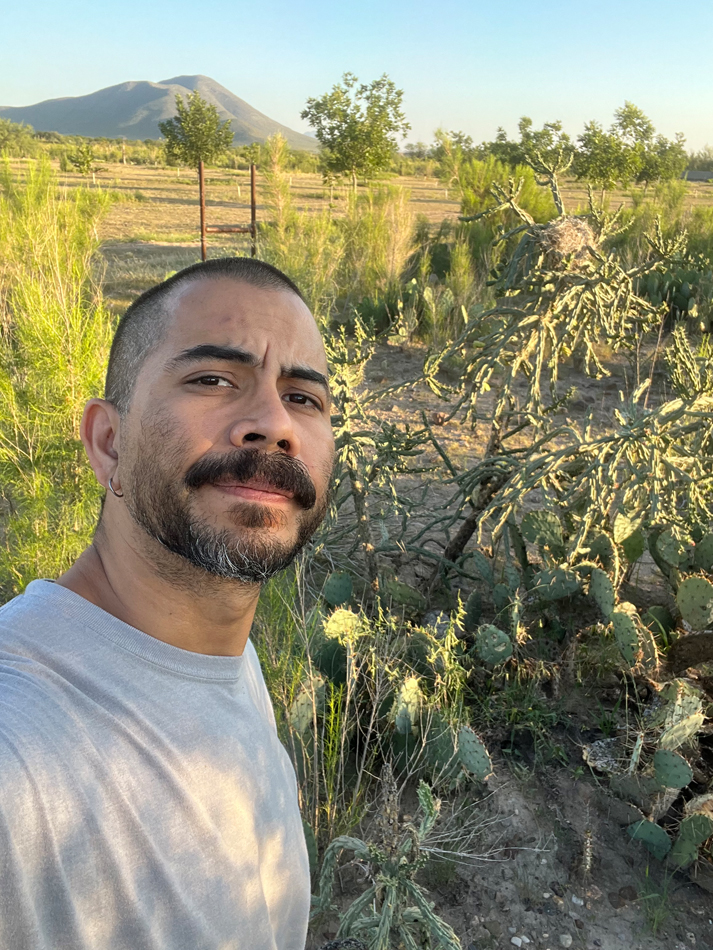
Rubén Ulises Rodríguez Montoya has dedicated himself to rewilding our imaginations about the border region through his monstrously outrageous sculptural works.
This article is part of our ALIEN series, a continuation of the ideas explored in Southwest Contemporary Vol. 14.
The Rio Grande is a fluvial boundary that, in art circles, functions primarily as the metonym for the U.S.–Mexico border. A natural resource between two structures of varying power, it has long evoked a visual culture and art history rife with political tensions, cultural crises, para-state violence, and environmental resource extraction. The Rio Grande experienced its most toxic degradation throughout the mid-1990s; the already taxed set of waterways struggled with raw sewage and industrial waste even before the North American Free Trade Agreement expanded maquiladoras along the border.
The last three decades has seen much art about the societal fallout and cultural decline that comes from job losses, wage suppression, and trade deficits in countries with struggling economies. It would refract the pessimistic arc of economic history we have lived through in our respective social- and geo-political roles that corresponded to our North American lives. There were those of us positioned to be optimal consumers. And then there were the lives of those who live in places conditioned by the toxic run-off of a river in perpetual distress or the waste disposal facilities situated in the part of New Mexico that butts up against Chihuahua and Texas.
These observations occur to me as I am talking to Rubén Ulises Rodríguez Montoya about his upbringing in Sunland Park, New Mexico, a small municipality near El Paso. He is an artist whose abstracted nude images would circulate in my social-mediatized networks soon after meeting him the summer of 2017 in West Texas. We had both been assisting in creating adobe bricks that would undergird rafa esparza’s Tierra.Sangre.Oro exhibition at Ballroom Marfa later that year. But the themes in Rodríguez Montoya’s work would shift away from those nude autoportraits—of himself as the brown luscious body in provocative desert repose—over the next decade.
“When I walked in the desert, taking nudes, I would see a crane or a rabbit, its [carcass], and I could sort of see its insides, its decomposition,” Rodríguez Montoya tells me. “It was normalized for me. After grad school I realized I took these nudes as a way to tie my brownness to the desert, and feel the way the sunset would hit and warm my skin as it would the desert, but I was too fixated on the outside. Once I finally had a studio and time [I was able] to reckon with what it means to be a border artist, or what it means to come from the inside of that place.”
Earlier in our conversation, Rodríguez Montoya recounts how he arrived in this corner of the borderlands as a two-year-old, laughing on his mother’s hip the whole time the two of them walked through the most contested area marked by the river. Rodríguez Montoya recalls this defining anecdote as he narrates his birth in Parral, Chihuahua, and the crops his grandparents farmed (sorghum, corn, melons, and eventually pecans) before he was born. His childhood happened in two places—in the Villa López hamlet near Parral and in a part of New Mexico flanked by the toxic run-off of a river under perpetual duress and the Sunland Park landfill.
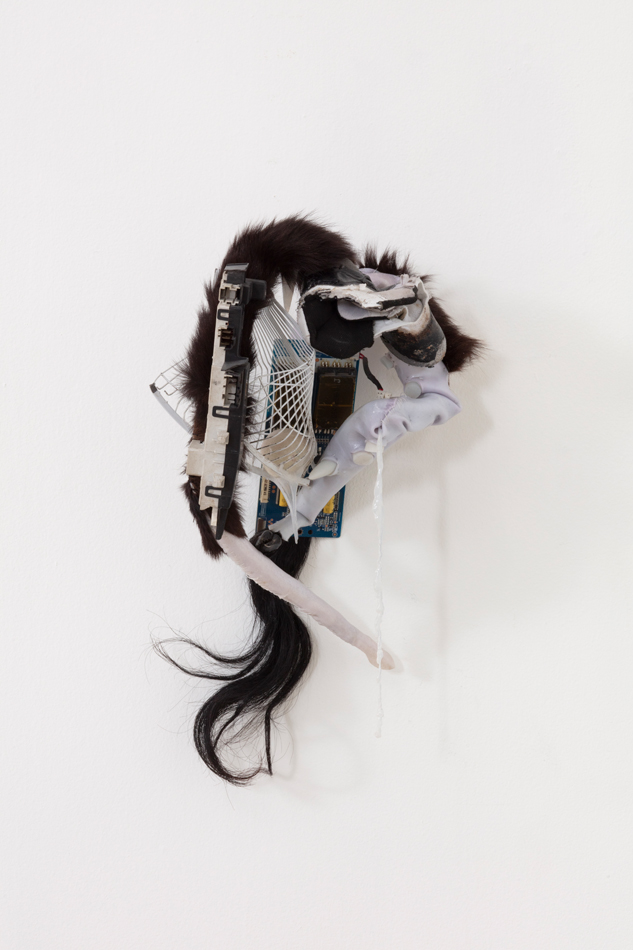
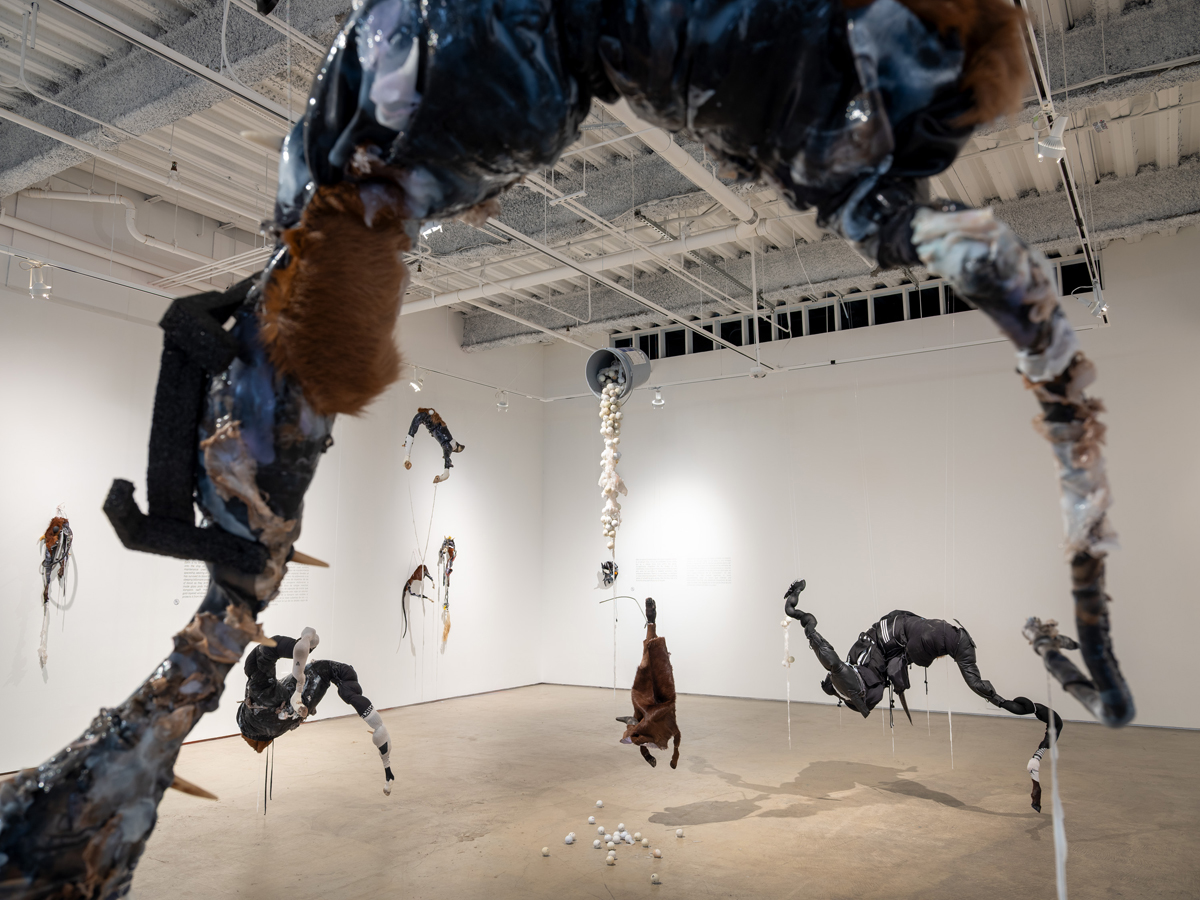
Rodriguez Montoya has recently had two solo exhibitions: In the Garden of Earthly Delights: I Bend to Paradise in 2026 at ICA San Diego and Skinchangers: Begotten of my Flesh in 2024 at MOCA Cleveland. He had previously shown early versions of this work in galleries such as in Murmurs in Los Angeles and Sargent’s Daughters in New York—places where the context of surviving a borderlands apocalypse is never far off thanks to his original perspective. His work is a conceptual postmortem that considers the cross-section of literal and social death scenes, the macabre interiors where vulnerable creatures are pushed past their limits in an uninhabitable dimension.
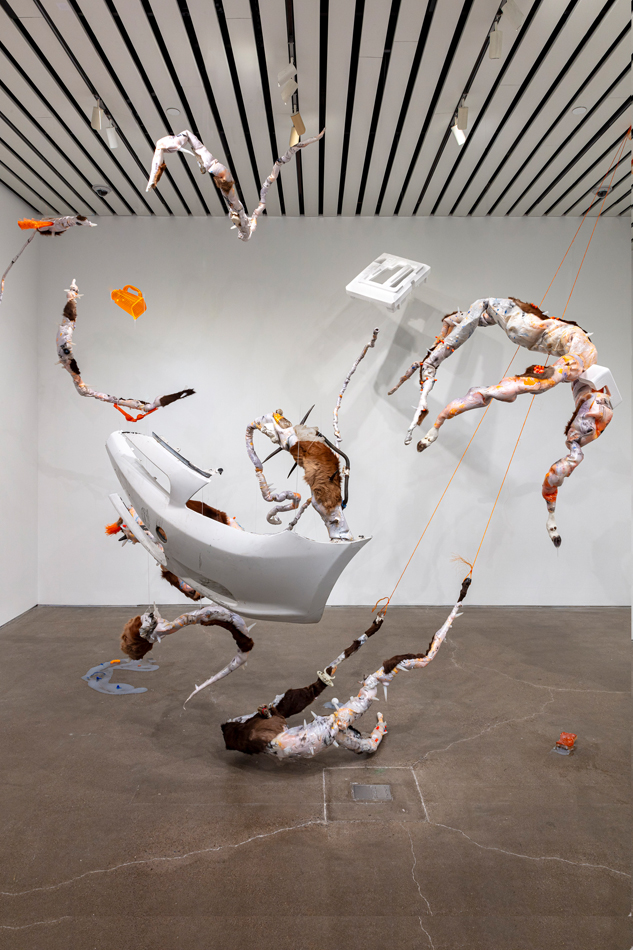
A recent recipient of the Joan Mitchell Fellowship, Rodríguez Montoya has been able to go back and forth between studios in Sunland Park and Mexico City where he is steadily creating several series of works that draws on the images imprinted upon his childhood memories of both places. He brings the ghost of the gutted goat of big family celebrations into his work. He conjures the environmental phantoms from the old Asarco copper smelter that shadow his family’s chronic illnesses. He shapes the clash between animal and machine—a dissonance he fashions after the mysterious viscera and the grill of a vehicle it has been culled from as it’s pulled to the junkyard by his uncle’s tow truck business. He draws an energetic connection from his sobadora paternal grandmother and imbues it into his practice. He has known the mutated species firsthand as a youth running the parallels of the river while running from the heavy-handed implications of being a border kid.
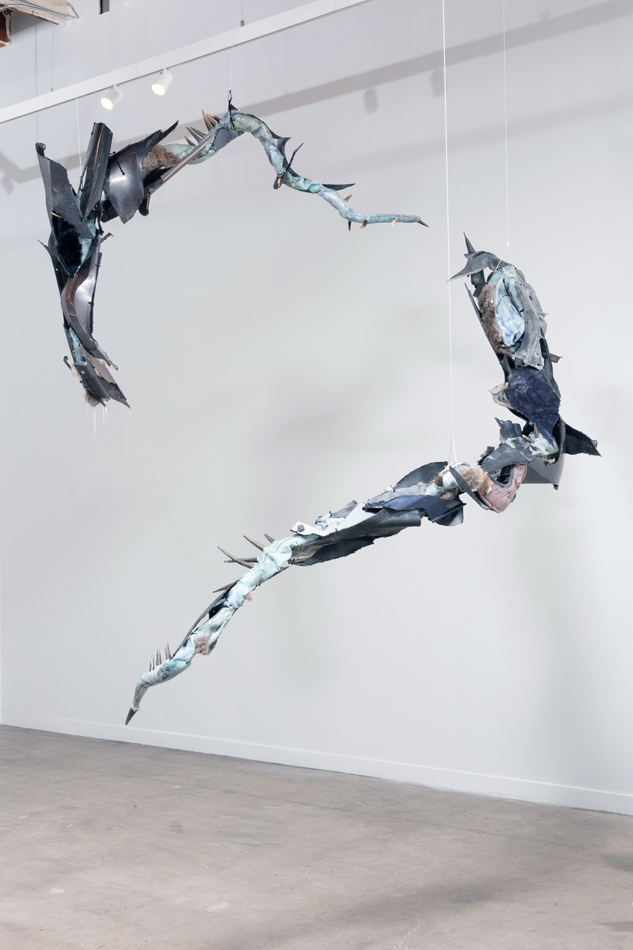
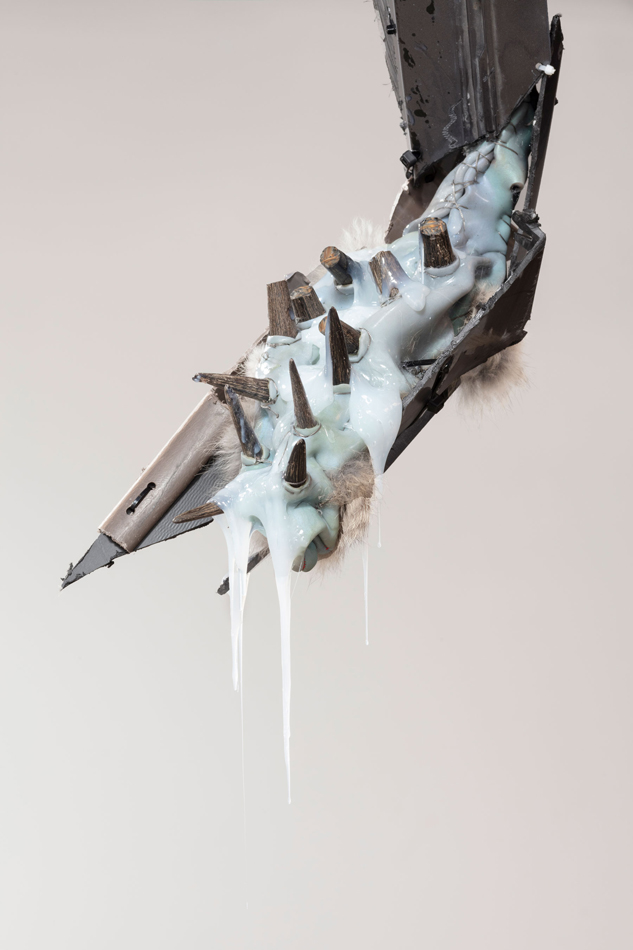
Rodríguez Montoya has dedicated himself to rewilding our imaginations about this region through his monstrously outrageous sculptural works. His pieces with titles as darkly storied as the materials gathered from debris from the roads leading to and from the river and the landfill tell the story of eschewing survival for pleasure beyond the limits of a human form. In his hands they are cast into a powerful post-humanist nomenclature that draws on both science fiction and animism.
I started to alchemize these things toward a visual language that are like tiny snippets of the violence I had experienced.
Works such as the Ex Situ Canis Latrans (2021) gestures towards an environmental ancestral futurity built through a roving compendium of monsters and other post-human inventions, the kind of specimens that thrive in disaster and even live well in the cataclysmic lands of the border region. We meet Tlahuelpuchi, a lone vampire cast in a whirlwind variety of Ciudad Juárez car parts, welding rods, horn tips, and dragon skin silicone who “haunts the rural towns of southern Mexico.” A vampire who reads early 20th-century Latin American masters. A vivid, versatile persona, a post-apocalyptic nahual, who burns copal and raises carrion birds “as pets to help consume the food scraps she leaves behind.”
It was fantasy as storytelling that enabled Rodríguez Montoya to explain the violent phenomenon of border life without having to shoulder the burden of offering answers to the unfathomably cruel problems of unappeasable capitalism. “There are other ways of people being political with their experience, but I think for me as a maker, I started to alchemize these things toward a visual language that are like tiny snippets of the violence I had experienced.”
“I started to contend with my own self assimilation, to come to terms with these sorts of gestures of abjection that come with trying to figure out how to be American,” Rodríguez Montoya says. “These graphic gestures of innards becoming visible became like these self-mutilations that happen through assimilation or [for having] close proximity to landfills and coal mines, [and/or] being in brown communities that you know there’s no access for thinking outside of what this space creates for you.”