The Chinati Foundation’s solo exhibition by the British land artist invites a reconsideration of founder Donald Judd’s devotion to land stewardship.
In 1988, the late American sculptor Donald Judd acquired British land artist Richard Long’s Sea Lava Circles (1988), which he permanently installed at the Chinati Foundation, his sprawling museum campus in Marfa, Texas. The acquisition established a connection between their practices, bringing Long’s gestures with natural materials into a site shaped by Judd’s ideas about permanence, architecture, and landscape.
Long returns to Chinati with his solo exhibition ROCKS RIVER, on view through June 20, 2027, an exploration that brings land into the gallery as both material and subject. The site-specific exhibition arrives at a particularly charged moment for thinking about land in West Texas. I first came to know this landscape as a Land Management Fellow at Chinati in 2025, an experience that transformed how I understand land-based art practices. I returned to Chinati to walk Long’s exhibition, approaching a landscape I had come to know through stewardship from a different perspective.
Judd and Long both broke through in the 1960s, an era in which body-centered practices increasingly examined the relationship between the individual and their environment. In 1967, Long created A Line Made by Walking in England, in which he left a temporary line in the grass through repeated footsteps. This work established a continuous standard of his practice: the body as an instrument for marking and experiencing landscape, while the resulting sculptural gesture remains ephemeral.
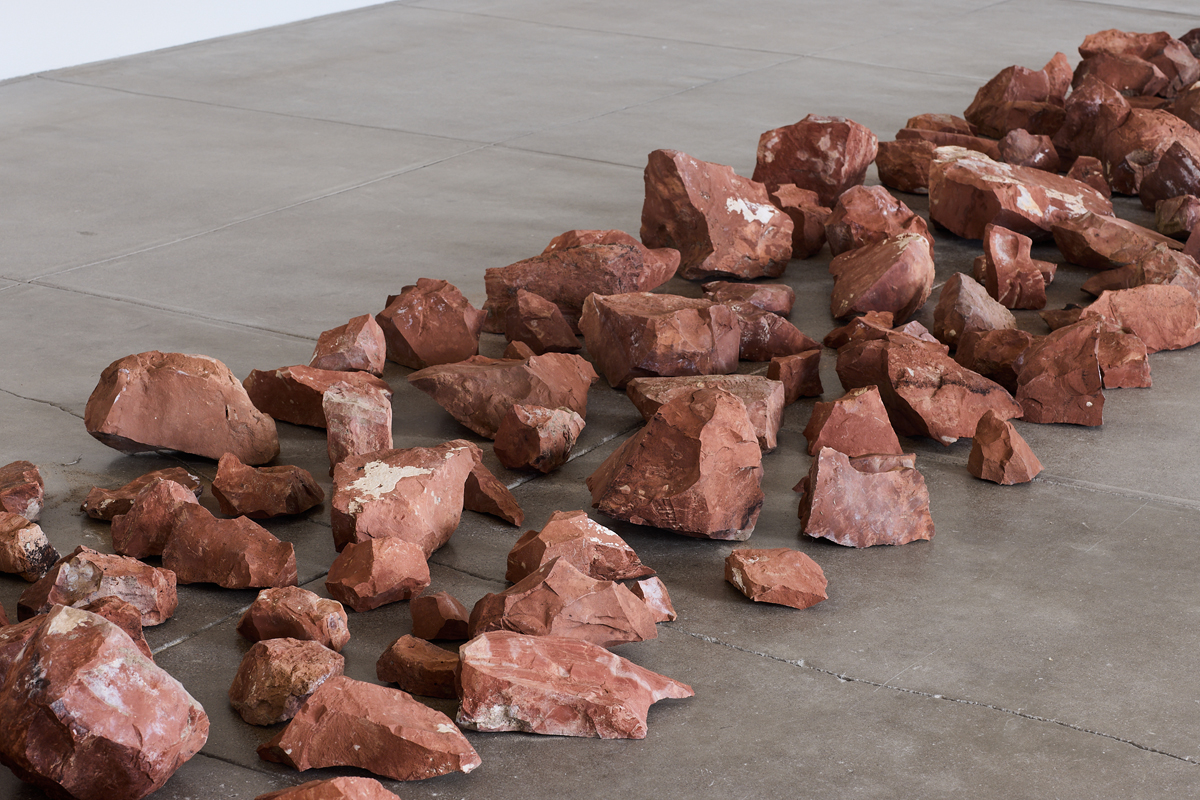
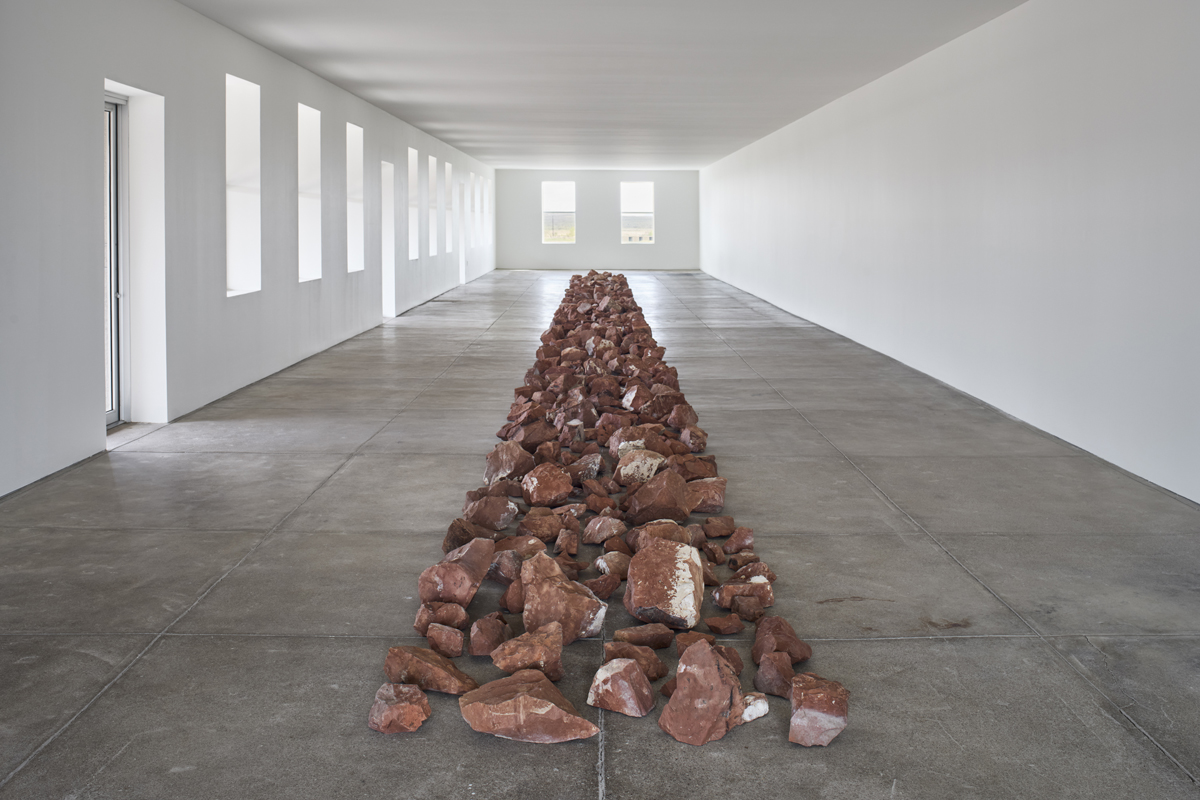
In ROCKS RIVER, Long localizes this inquiry through four works drawn from the Trans-Pecos region. On the floor of the south side of the gallery, Prairie Stones (2026) is a sculptural line composed of deep red igneous stones gathered from the Chinati Mountains. Roughly the width of a footpath, the stones connected my gaze to the energy of the mountains, transmitting their presence throughout the gallery. The line of stones reads like a geologic poem, a surface language shaped through material, gesture, and time.
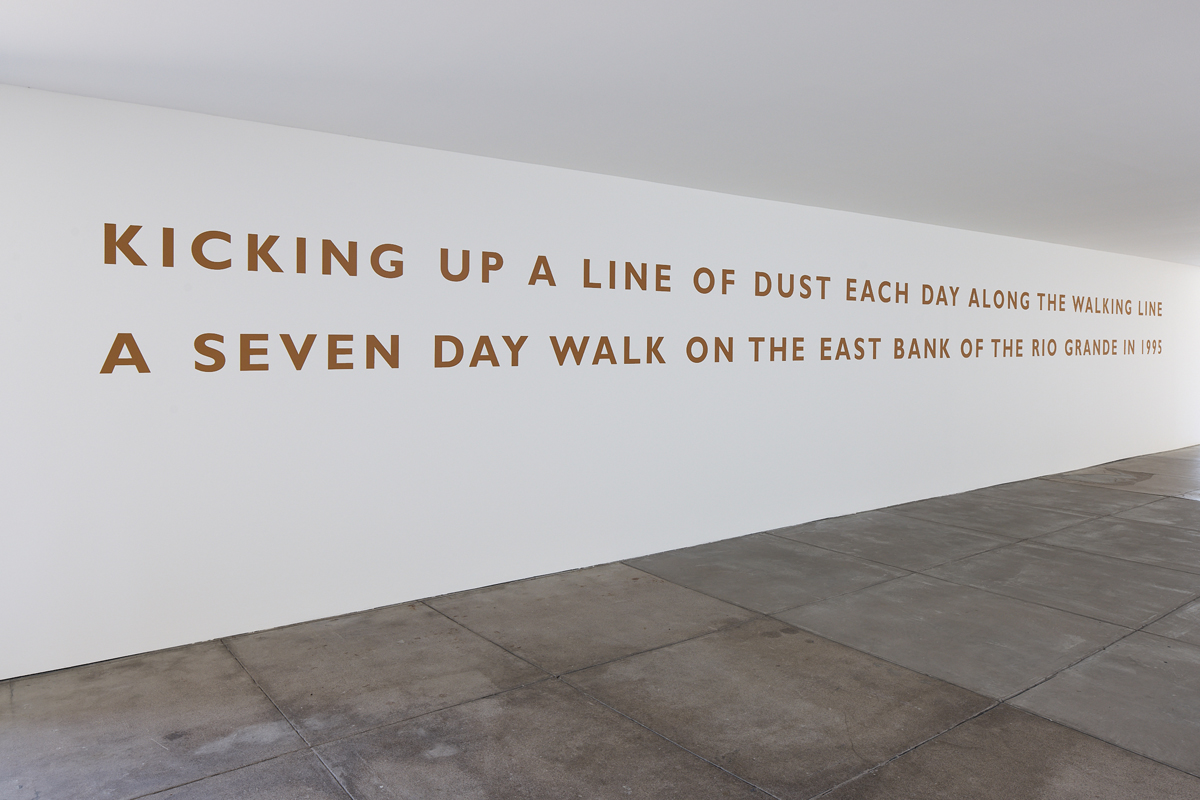
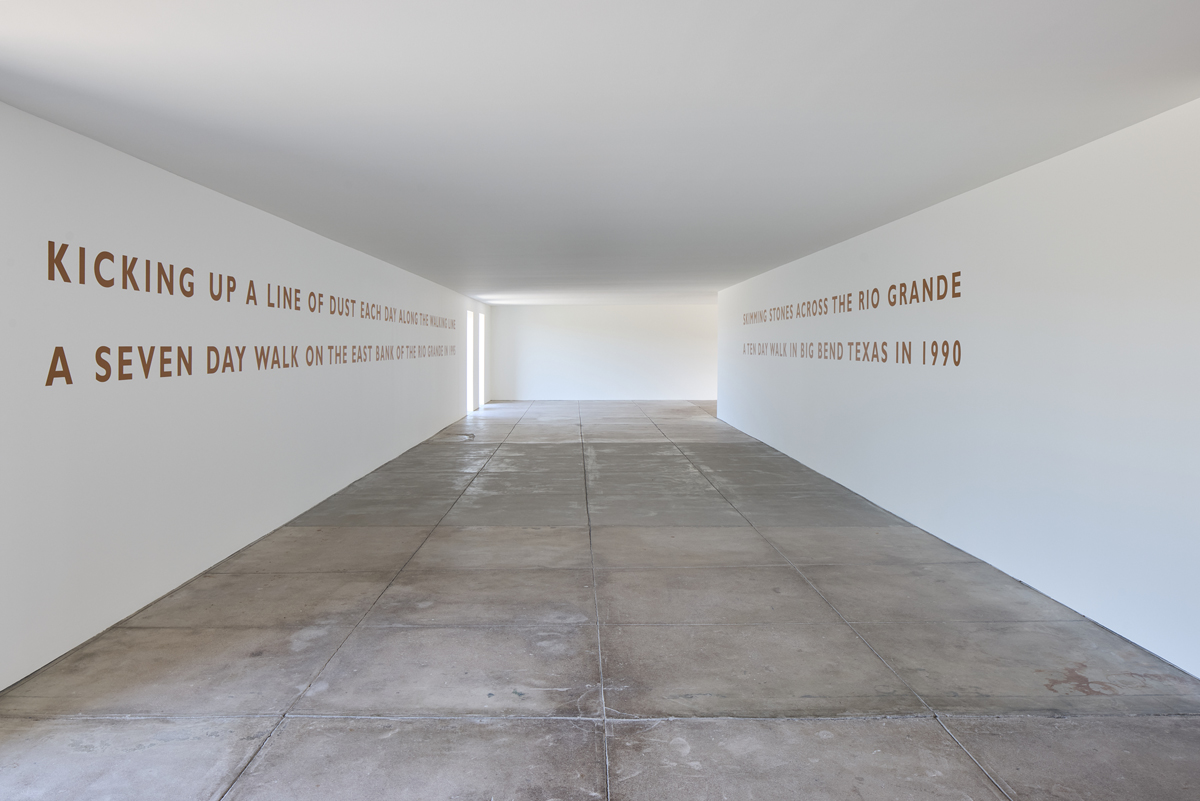
Down the hall, two accompanying vinyl text works, Skimming Stones and Kicking up a Line, draw from walks Long made in the Big Bend region in 1990 and 1995.1 Here, the text becomes a walkable record of a spatial encounter, much like a map or photograph. One reads in part, “Kicking up a line of dust each day along the walking line.”
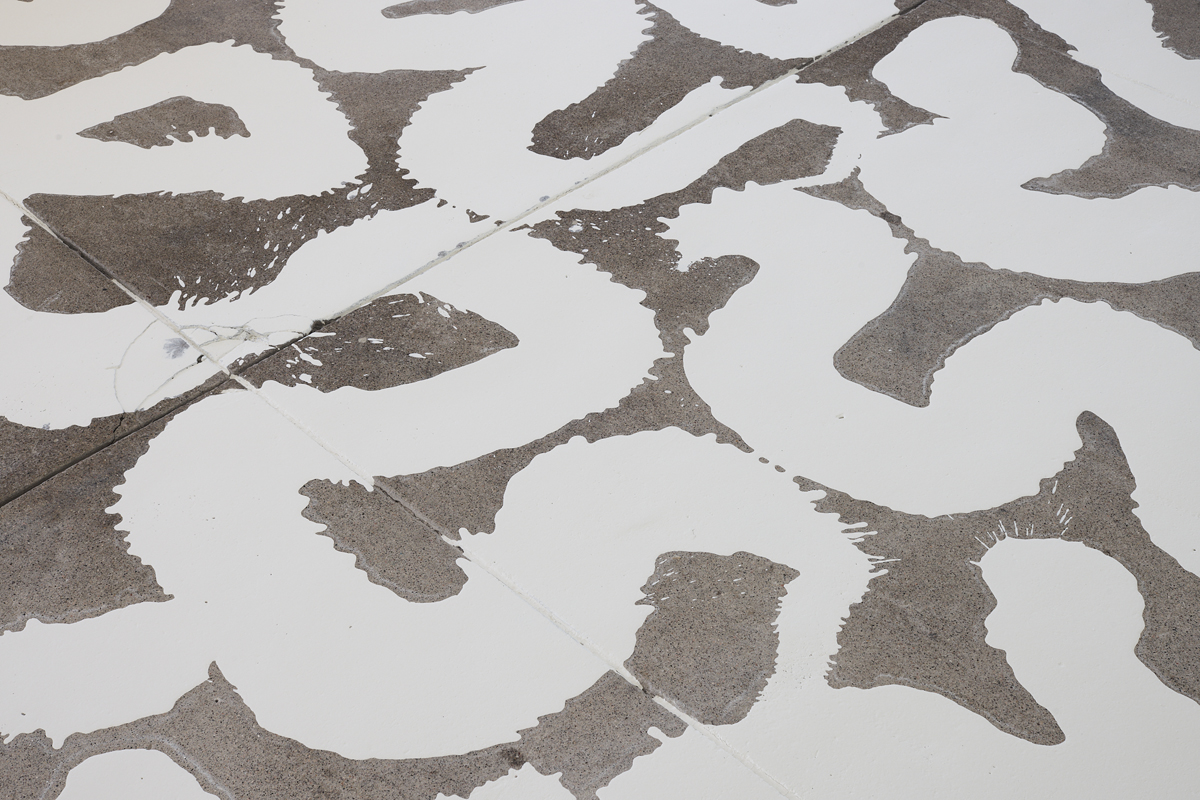
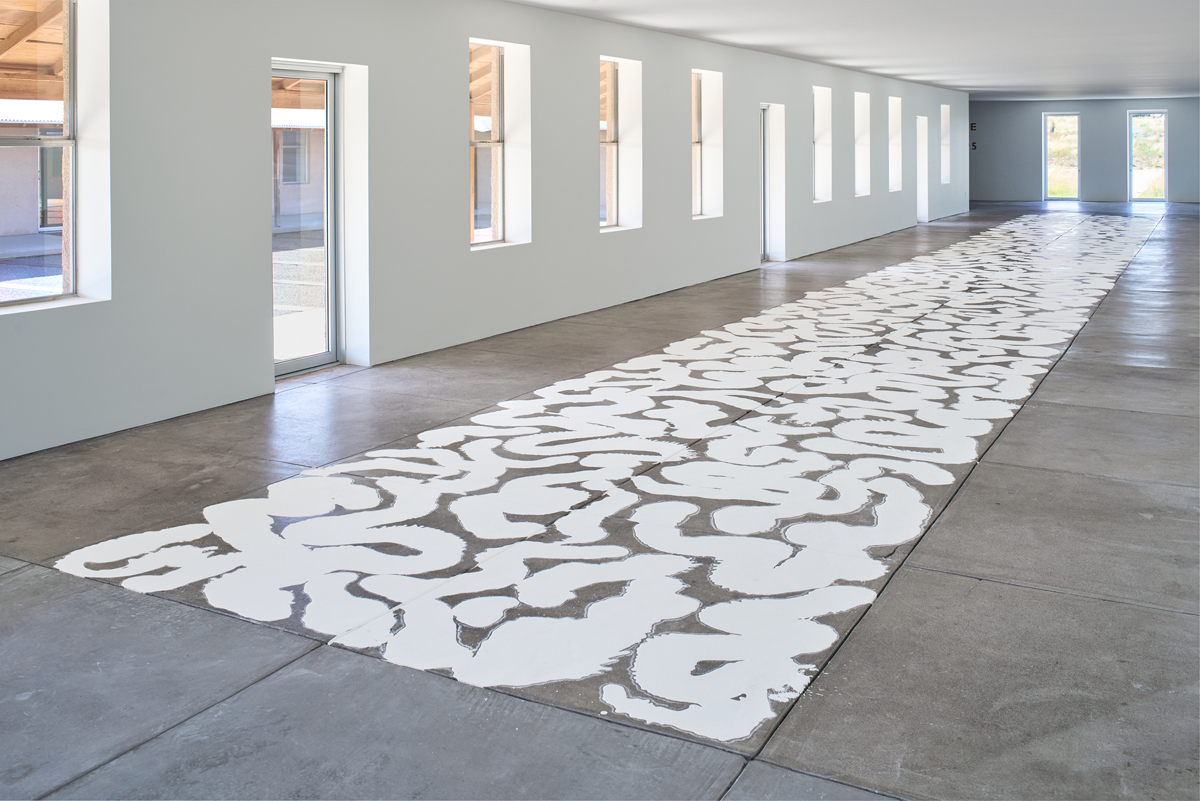
Resonating with Long’s evocative language, River Dreaming (2026) is a meandering line of white clay that recalls the memory of water. Natural light adds reflection, motion, and a sense of playful yearning, which made me imagine the movement of a river within an otherwise still space. Across these works what remains is the gesture in time: a trace encounter with the natural world.
Long’s translation of the landscape into material and gesture offers a point of entry into Judd’s own relationship with West Texas. Judd believed the land was not simply a setting for art but something deserving attention, respect, and care. Beginning in 1973, he acquired properties in Marfa, eventually expanding his vision to the former military installation, Fort D. A. Russell, with support from the Dia Art Foundation in 1978.2
For Judd, landscape was inseparable from architecture. Rather than imposing monumental interventions, he worked within existing conditions, recognizing the consequences of development. This perspective distinguished his approach from the large-scale earthworks of contemporaries such as Michael Heizer, Robert Smithson, and Walter De Maria. Judd’s assertion that “here, everywhere, the destruction of new land is a brutality”3 reveals an ecological sensibility that informed his approach to building, preservation, and environmental stewardship.
As Long suggests, ‘A good work is the right thing in the right place at the right time. A crossing place.’
While establishing Chinati, Judd planted cottonwoods, pecans, and pinyon pines, and tended a vegetable garden. This commitment to the land continues through work by the foundation’s Land Management Fellows. For the past three years, fellows have supported the care of the 340 acres surrounding the foundation, extending preservation beyond the built environment to the landscape and its ecological systems. Landscape tours and an annual Grasslands Restoration Practicum invite visitors and volunteers to learn more about the botany and ecology of the changing landscape. Rainer Judd, the artist’s daughter, directs land initiatives at the Judd Foundation.
For Judd, staying with the land meant taking responsibility for what comes next. His attention to the land invites a broader understanding of place, one shaped not only by its immediate surroundings but by the ecological, geological, and political forces that extend beyond its boundaries. These tensions are particularly visible in and around Big Bend National Park, where ongoing protests seek to halt plans for border wall construction that threaten to fragment the landscape and disrupt ecological corridors.
This raises a question that sits at the intersection of Long’s and Judd’s practices: How, then, does one come to understand a landscape? As a Land Management Fellow, I found myself grappling with this question. To stay with the land meant observing how the landscape changed with light and time. I learned to recognize its native and non-native species, and listen to the sounds that marked its daily rhythms.
As an artist and researcher who works with sound, I experienced the land as a continuous field recording, sounding whether or not I was listening. To understand a landscape is to be attuned to the conditions that shape it, and to the lives, human and non-human that inhabit it. Long’s works in ROCKS RIVER suggest a similar kind of attentiveness, one developed through working with enduring materials in ever-changing conditions.
Borrowing from Gaston Bachelard’s phrase, there is an intimate immensity4 to the region: an expansiveness of land and sky that draws attention to geological time, a distinct paleomagnetic pull, and a shared sense of connection to the land. At Chinati, the landscape is not merely a backdrop to the collection but an active presence, holding histories that stretch above, on the surface, and below ground. As Long suggests, “A good work is the right thing in the right place at the right time. A crossing place.”5 At its best, Chinati becomes just that: a crossroads where art, architecture, and land converge.