For nearly four decades, Guillermo Gómez-Peña has revisited alien iconography. Graciela Blandon grapples with his new AI project, and what his little green men teach us about facing the unfamiliar.
“Abomination” was the first word that came to mind when I saw Guillermo Gómez-Peña’s most recent work. “Slop”—Merriam-Webster’s 2025 Word of the Year—was the second.
On his website, the co-founder of the Border Arts Workshop (1984-89) and perhaps the most recognized “border artist” in the canon, highlights an AI-generated image of Jesus Christ holding a burrito, standing next to a little green man in a desert landscape. It’s titled Welcome to America. Another image recreates da Vinci’s Last Supper with little green men in mariachi outfits. These are images from the Chicanx AI Lab, a collaborative, experimental project1 that explores the creative possibilities of generative artificial intelligence. Gómez-Peña has long trafficked in the provocative, perverse, and blasphemous, but with the Chicanx AI Lab, he reaches a new height of absurdity—no small feat for a man who once staged a performance from inside a pig carcass.2
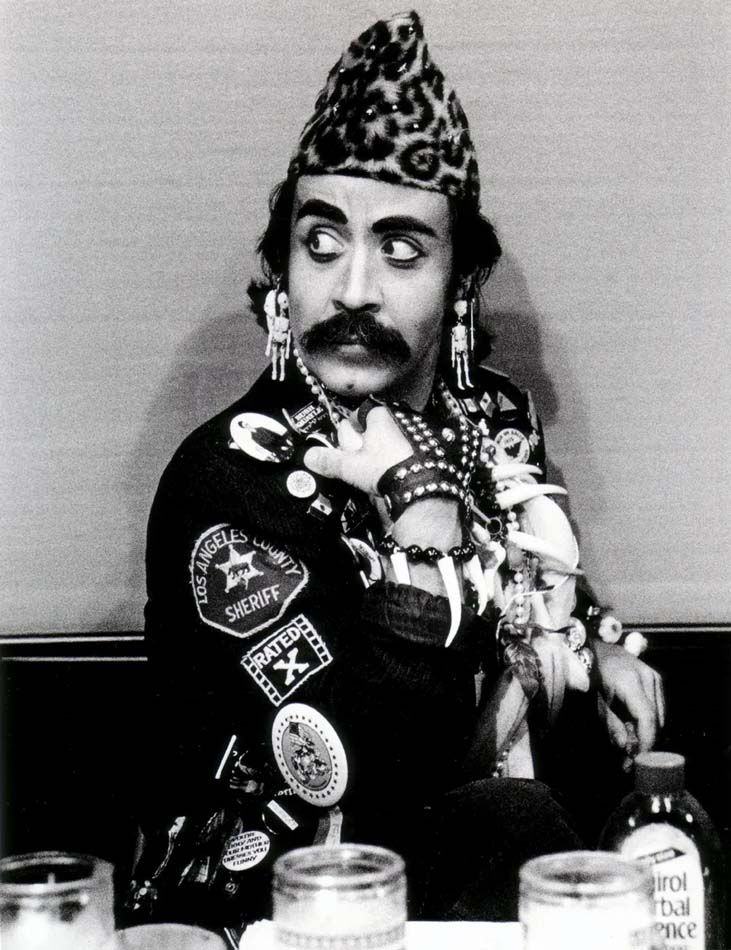
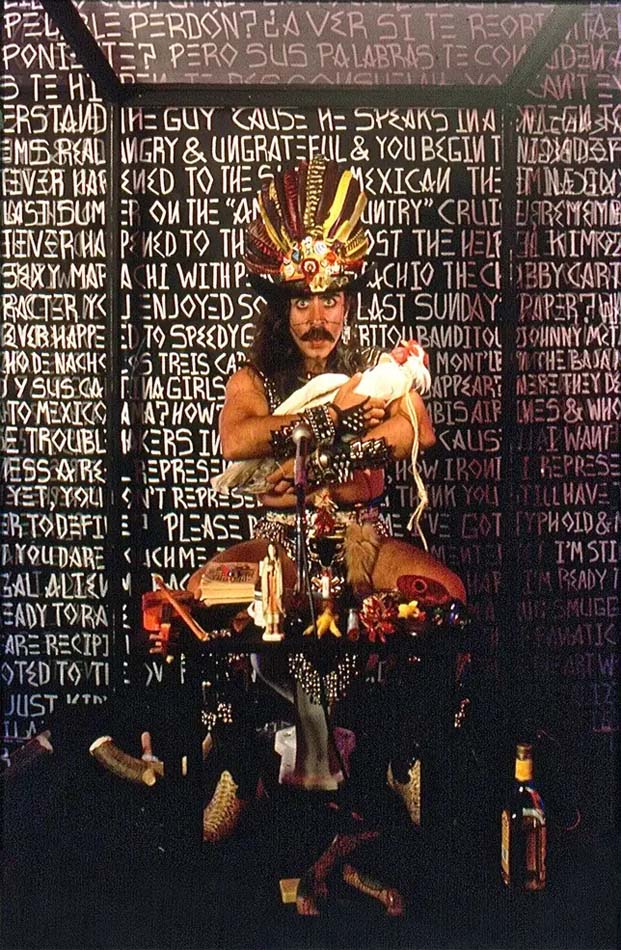
It was not the first time I had clutched my pearls at a Gómez-Peña work. My first close encounter with the Mexico City– and San Francisco–based artist came in 2023 when I watched Border Brujo (1988-89), his pivotal performance of exaggerated border stereotypes. It produced a churning in my stomach: the sense that someone had trespassed onto forbidden territory.
I grew up in the El Paso–Juárez borderlands, and it came as news to me that there was an artist who, since the 1990s when he lived in the San Diego–Tijuana corridor, had been appointed my region’s foremost cultural ambassador. (I blame only the Texas public school system, which lamentably never found room in its curriculum for radical performance art.) As I dug through his work, I found infinite tomes by art-world authorities celebrating this bunch of “gente ‘rarita’”3 who walked around naked in front of the border wall in the name of Chicano, Mexican, and immigrant rights.
In light of the 2019 El Paso massacre—when a white supremacist drove hundreds of miles to exterminate Mexican immigrants—and the mounting death toll in the desert between Mexico and the U.S., his performances struck me as irreverent and offensive. I understood the border to be humorless: economically exploited, environmentally polluted, and culturally demonized. Border art, therefore, should maintain solemn fidelity to the literal. My first instinct—well, he’s not even from here, so what does he know?—was uncomfortably close to the conservative gatekeeping I ostensibly oppose.
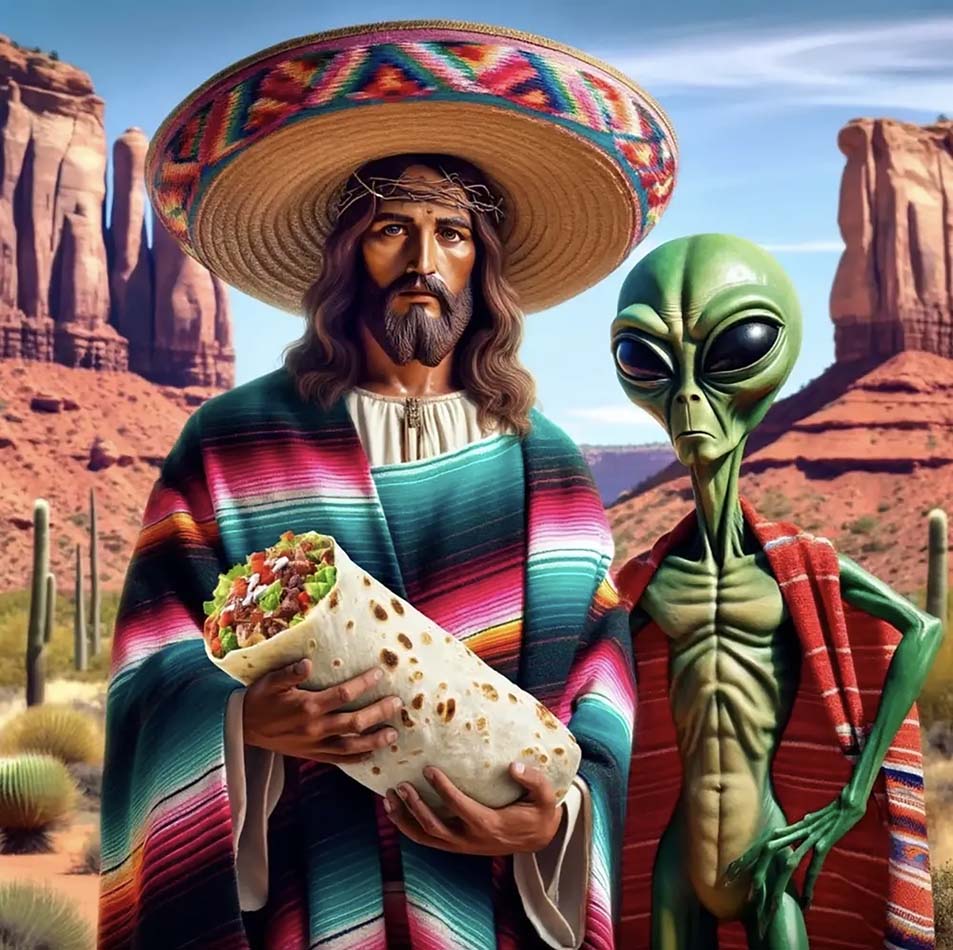
Looking at Gómez-Peña and his collaborators’ AI alien offspring, I felt the same defensiveness. Once again, humor grated against a terrible, unamusing reality. Why, I wondered, were some of my community’s most celebrated artists entertaining the apocalyptic slough of a technology seemingly hostile to the people they had spent their careers defending? After all, the tech company Meta was courting the borderlands for its newest data center, raising the specter of depleted water resources and data maquiladoras in my own backyard. At such a critical moment, I couldn’t decide whether the aliens of the Chicanx AI Lab represented a betrayal of Gómez-Peña’s artistic legacy or its most faithful expression.
The answer, I suspected, lay somewhere in the four decades of work that came before it. Gómez-Peña has long treated the border as a stage where the categories of citizen and “alien” could be rehearsed. “Unfortunately, when you travel north you become an ‘alien’ whether you like it or not,” he tells me by email. Border Wedding (1988), for example, united Gómez-Peña, standing in Tijuana, with artist Emily Hicks, standing in San Diego, in a symbolic cross-border marriage.
Alien imagery first entered Gómez-Peña’s performance work in the 1990s, a time when “the far right was beginning to use the words ‘illegal alien’ to describe the undocumented migrants from the south,” he shares. He was “politely playing” with the green alien “as a metaphor to illustrate America’s inability to deal with cultural otherness.” In 2001, he began painting his collaborator Juan Ybarra green during performances by their troupe La Pocha Nostra.
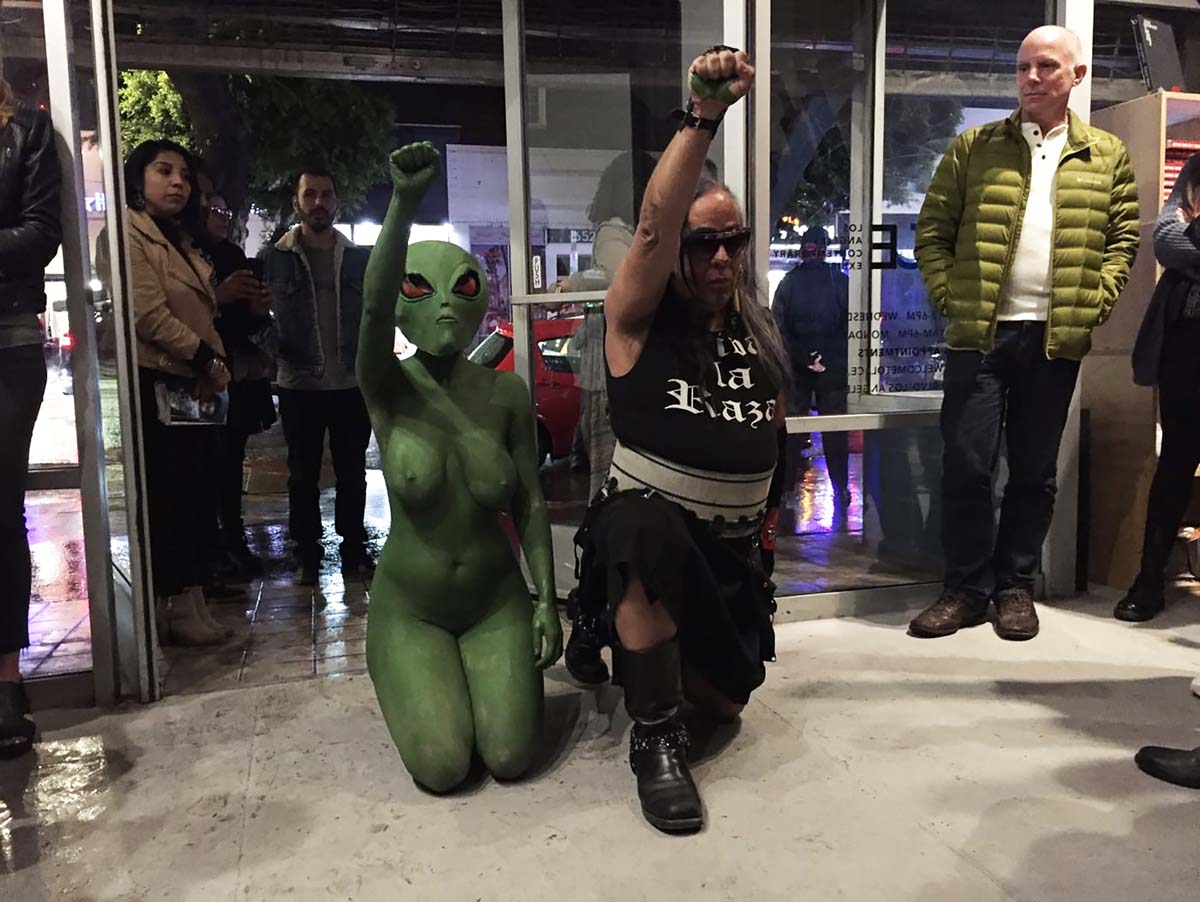
Since then, his work has only become more pointed. In 2018, the artist walked into Los Angeles Contemporary Exhibitions accompanied by a nude performer painted green and wearing an alien mask. Staged during the early years of the Trump administration, The Most (un)Documented Mexican Artist (2018) saw Gómez-Peña and his extraterrestrial accomplice take a knee to denounce the “Trumpocalypse.”
Today, Gómez-Peña reflects that “when I began this work at the border decades ago, I couldn’t comprehend that it would persist, and even become more intense than ever.”
The alien and terrestrial technologies have made easy bedfellows in Gómez-Peña’s work: UFOs, satellites, probes, computers, and cyborgs are natural vehicles for his longstanding fascination with the “ethno-techno.” Consider The New World Border (1996), a performance set in a future where national boundaries have disappeared, replaced by a cyborg-like robo-raza whose cultural hybridity has dissolved conventional identities—and with them, any sense of collective purpose.
Elsewhere, projects like Temple of Confessions (1995-96) invited participants to confess their “cyber-sins” online, while Love Conversations with My Computer (2009) captures an intimate dialogue between artist and device. Long before people were falling in love with ChatGPT, Gómez-Peña was already whispering to his laptop, “My body is devoted to your hardware…,” for it to reply, “Vice versa, loco. We’ve merged into one single identity…”4
Gómez-Peña was at the forefront of technological experimentation at the turn of the century when, as he put it, the “art world went high-tech overnight”5and the internet promised to dissolve borders. His ethno-cyborgs punctured the fantasy that the digital world could transcend race, class, and gender.6 His attitude toward technology remained remarkably consistent as he experimented with CD-ROMs, early web design, and radio transmissions.
In the early ’90s, he argued that he was not interested in “gratuitous use of high technology,” but rather in using digital media “in a socially responsible manner to reveal the contradictions of living and working between a pre-industrial past of mythical dimensions and a post-industrial present in permanent states of crises.”7 He wrote in 2000, “Once I have the apparatus in front of me, I am uncontrollably compelled to work against it—to question it, expose it, subvert it, and/or imbue it with humor [and] radical politics.”8
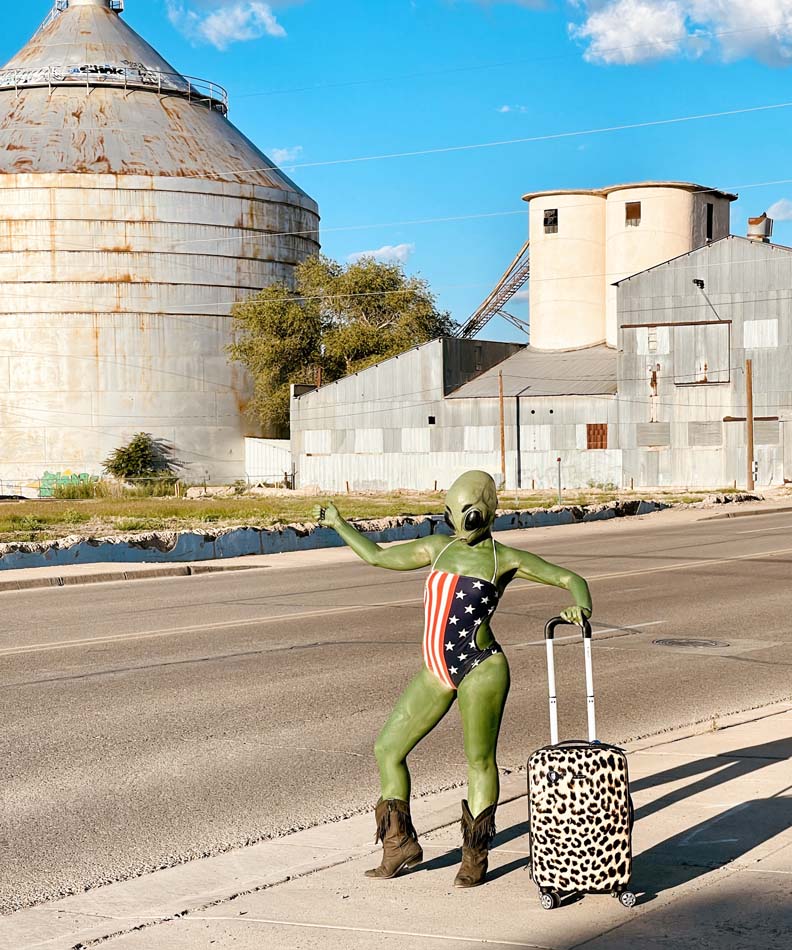
Today, Gómez-Peña seems most inspired in the company of extraterrestrials and computers. In the final scene of the 2022 collaborative short film Alien Planet 2.22,9 he stands beside a green alien in a Stars-and-Stripes unitard with the easy confidence of someone inoculated against the fear of the other.
This spirit of provocation and subversion is what keeps drawing me back to Gómez-Peña’s work after my initial defensiveness. Critics and audiences have long taken the artist to task for metaphorizing the border and abstracting the realities of exploitation and death en la frontera. But I reconsidered Gómez-Peña as I developed an allergy to the truisms that claimed to authentically represent those realities. I have grown weary of the endless cacophony of experts calling the border a wound, a business investment, a paradise of hybridity, a crisis. I’ve become suspicious of any authoritative claims about the region; these platitudes remain captive to their own fantasies, leaving little room to imagine alternative futures for the borderlands.
Gómez-Peña distorts such claims until their absurdity comes into view. His diagnosis for our attachment to certainty is what he calls “cultural vertigo”: the disorientation that accompanies an encounter with the alien and sends us scrambling for stable ground.10 At their best, he argues, his creations are “a constant reminder to society of the possibility of other artistic, political, sexual, and spiritual ways of being.”11 I understand, then, that cultural vertigo is not a symptom of his work, but its prescription. Gómez-Peña’s art is not asking me to tame the border’s inscrutability by putting up walls against charged images. It asks me to keep probing them—to become comfortable enough with contradiction that I can laugh at it, perform it, and perhaps even challenge it.
If any artists are equipped to grapple with the ambiguity of our humanoid cyber-futures, it is those already practiced in the ambivalence of life in the borderlands, where incompatible worlds coexist and the past and future collapse into one another.
Could I adopt the same attitude toward Gómez-Peña’s newest alien creation? Any deterministic position on AI, like any claim to certainty about the border, depends on the idea that humans are entirely captive to technological forces. I am compelled to reject that premise just as firmly as I reject the fantasy that AI will usher in a borderless technological utopia.
When it comes to aliens and cyborgs, science and technology scholar Donna Haraway reminds us that we are dealing with “contradictions that do not resolve into larger wholes, even dialectically… because both or all are necessary and true.”12
Such contradictions have always been Gómez-Peña’s fodder: organism and machine, the U.S. and Mexico, body and land. None of this absolves AI of its ecological violence, nor does it do much to quell the anxieties of a run-in with the metahuman. But if any artists are equipped to grapple with the ambiguity of our humanoid cyber-futures, it is those already practiced in the ambivalence of life in the borderlands, where incompatible worlds coexist and the past and future collapse into one another.
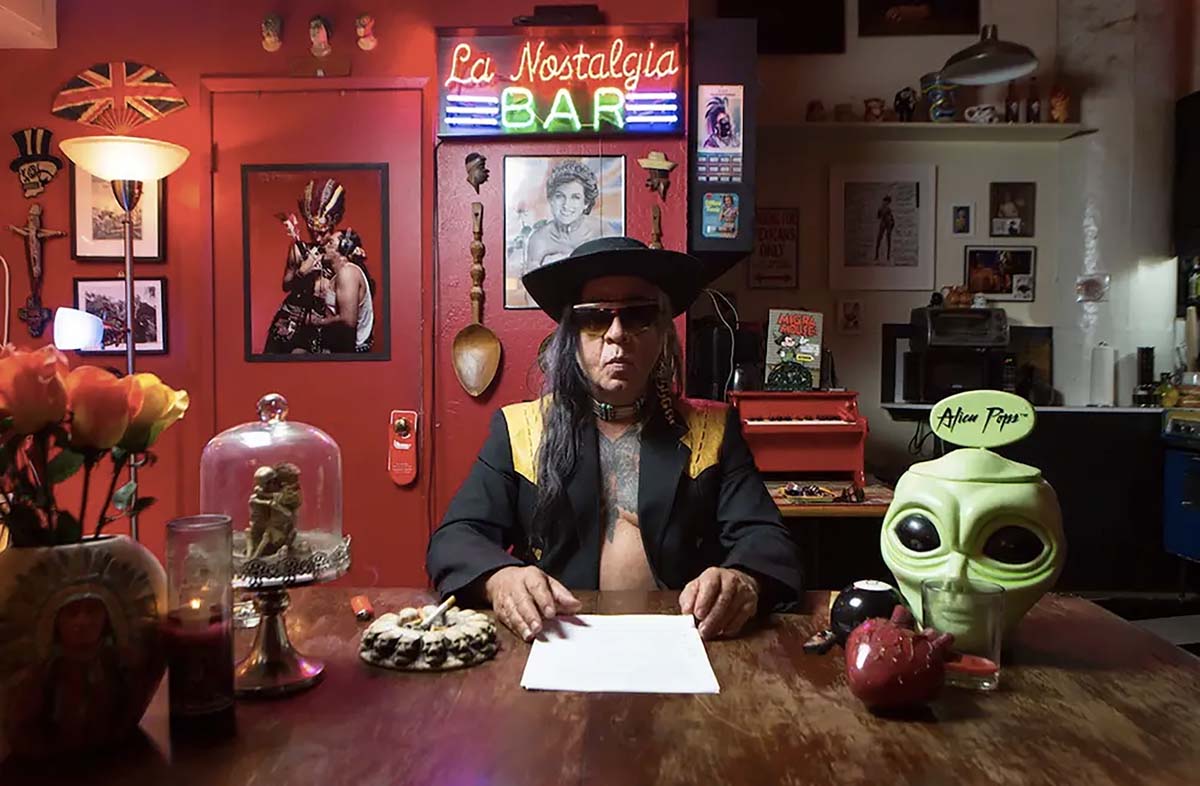
Gómez-Peña has spent his career refusing to surrender human creativity to technology, instead using humor and collaboration as “culturally specific strategies” through which to address “very delicate political issues.”
His legacy, therefore, is ultimately a pedagogical one. His recent encounters with the alien are part of his “new strategies to remain pertinent” as an “online border crosser.” He continues to unsettle essentializing truths while keeping alive a tradition of the perverse, happily traipsing around Area 51 while others argue over whether to approach the fence. Where I initially sought political salvation from the dysphoria of border life in the form of hard, fast, quotable truths, Gómez-Peña’s work offers a way of “staying with the trouble,” in Haraway’s terms.
When I face the bizarre aliens emanating from the Chicanx AI Lab, I can laugh at them, recoil from them, fear for the ecology of my beloved borderlands, and admire an artist’s willingness to venture where so many refuse to go. With AI, we are approaching alien territory. But for four decades, Gómez-Peña has given us a compass to navigate such terrain, as well as the permission to explore with bravery and disarmed curiosity.
In his 2026 poem “THE WORD ALIEN: A pata/physical glossary,” Gómez-Peña writes:
Honey, you ask me,
If the world has been ending forever,
What are we afraid of?