The Rest is Drag remaps Route 66 through queer performance, lowriders, and other vibrant cultural byways. But does it give drag queens their due?

The Rest is Drag
July 11–October 10, 2026
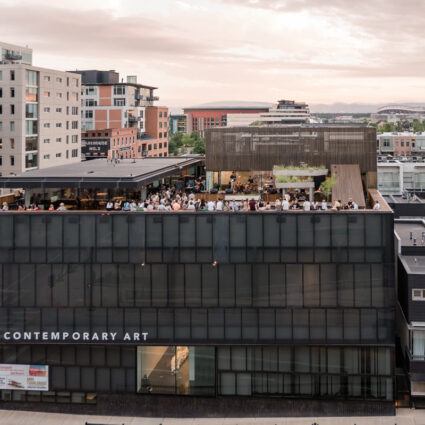
516 Arts, Albuquerque
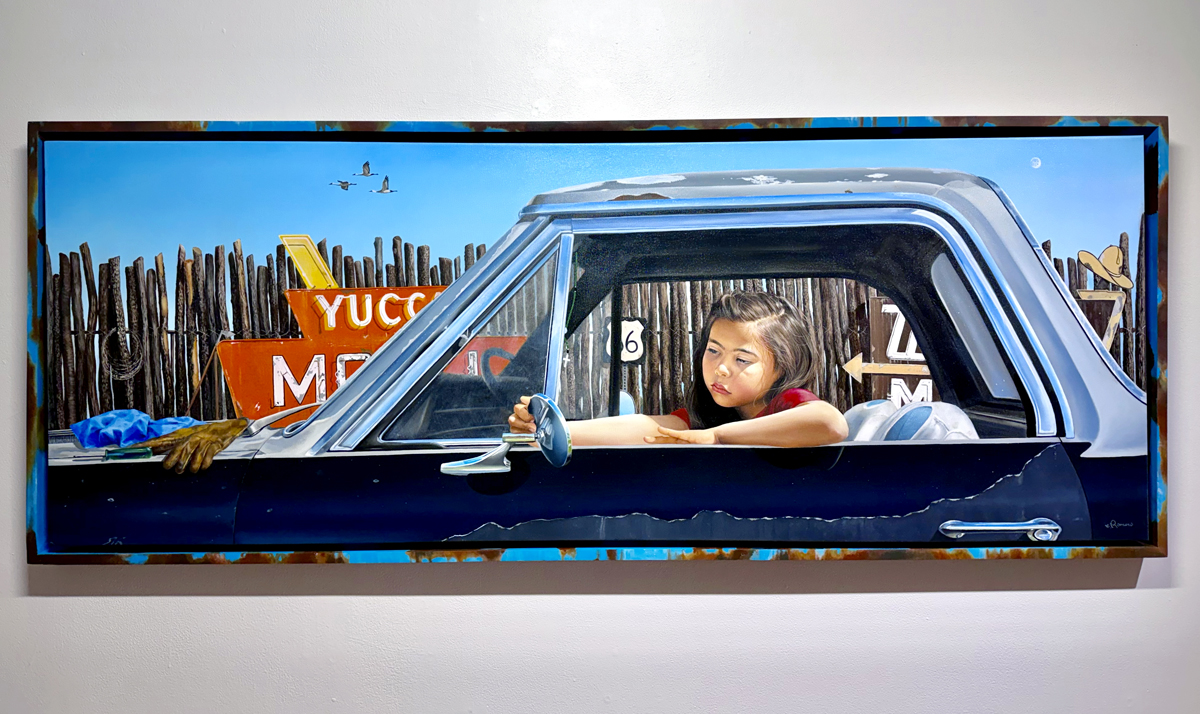
Eric Romero’s cinematically wide oil painting Ruta de Mañana (2026) anchors the second-floor passage of the sprawling exhibition The Rest is Drag. As I viewed the portrait of a brown child in the driver’s seat of a classic car directing the side-view mirror to meet their gaze, I imagined both the child’s self-image and their self-imagining. In Romero’s young subject, I saw an architect of future worlds, one that finds not only fodder, but harmony in the overlapping cultural landscapes and influences that encircle them.
The painting somehow finds the heart of a curatorial conceit jammed with disparate themes such as lowriders and time travel, fast food and regional deities. The Rest is Drag is 516 Arts’ final offering in its Central Avenue headquarters, and it combines diverse interpretations of “drag” to include Albuquerque’s “main drag” of Central (previously part of Route 66), as well as drag racing and drag performance.
Adding to New Mexico’s statewide zeitgeist surrounding the centennial of Route 66, curator Olivia Amaya Ortiz examines formations of identity, performance, and community along America’s “Mother Road” through queen-of-drag RuPaul Charles’s iconic spin on a notion by drag performer Tede Matthews: “We’re all born naked and the rest is drag.” With its present location on Central (until its move this fall), 516 is well-positioned to reflect on the complex social spheres of Route 66, but I bristled when I first learned of the show’s framework.
Route 66 was a neocolonial project. […] Drag performance, on the other hand, is an enduring, life-affirming, and highly marginalized art form.
The idea made me wonder if U.S. westward expansion would somehow get credit for inspiring works of art and liberatory spaces made by and for queer people. Route 66 was a neocolonial project after all, mired in extraction, militarism, and violations of Indigenous sovereignty. Drag performance, on the other hand, is an enduring, life-affirming, and highly marginalized art form.
“I don’t think any of the works really uplift Route 66,” said Ortiz in our interview during the exhibition’s installation. She explained her focus on emergent social constructions along Route 66 through the concept of heterotopias. Citing cultural theorist Michel Foucault’s idea of niche utopias enacted on real sites, Ortiz described her experience of Albuquerque’s main drag as exemplifying these kinds of real, imagined, varied, and layered uses. Though not explicitly queer, Foucault’s heterotopic examples include historically queer havens like bars and bathhouses—places that might strike outsiders as “other.” You can spot this kind of queer-coded world-within-a-world-building in the legions of lowriders that parade past all three of the city’s Latine- and Indigenous-packed gay bars every weekend.
My preliminary research for this review confirmed Ortiz’s phenomenological observation, uncovering works by queer historians documenting all sorts of intersectional ties between queer cultures and Route 66. Lazarus Letcher’s El Palacio article “Cruising the Mother Road” (2026) reveals precious sites of solidarity for queer Black travelers along New Mexico’s roadways. StormMiguel Florez’s documentary The Whistle (2019) recalls safe spaces along Central in nearly a dozen lesbian haunts that served a cross-town and cross-generational sapphic community in the 1970s and ’80s.

In line with these histories, Apolo Gomez and artist collective fronteristxs each present interpretations of drag performance worlds on Route 66, with the former documenting a real past and the latter projecting into an imagined future. In works more tied to cars than queerness, Jesse Littlebird’s immersive video installation and Christina Fernandez’s glossy photo series illustrate car-ride conversations as temporary heterotopias. And in Vita Kari’s bedazzled burgers, immigrant imaginaries of the “American Dream” form household heterotopias hybridizing new home and homeland.
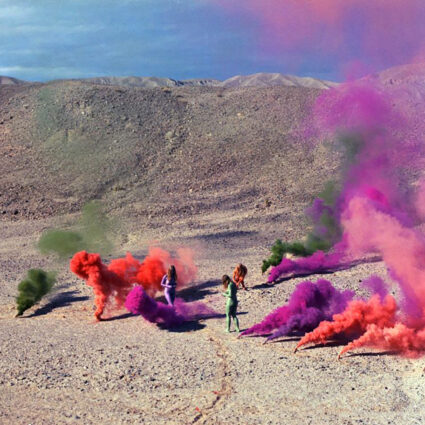
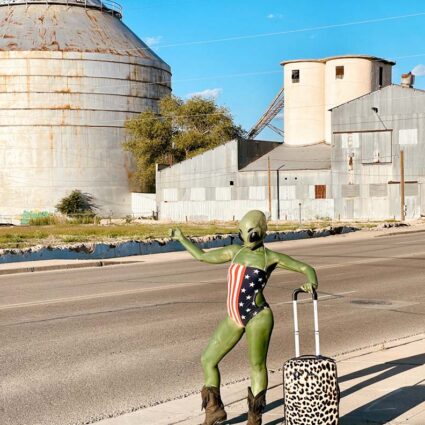
Whether referenced directly or through “drag-y” media such as rhinestones, drag performance is highly visible in The Rest Is Drag’s material and art historical discourses. Depictions of drag artists abound, queering the machismo often associated with lowriders, landscapes, and Our Lady of Guadalupe. Chris E. Vargas curated clips from RuPaul’s Drag Race. Jonathan Loretto (Jemez and Cochiti Pueblos) sculpted a frybread-selling drag queen doll. And in addition to the aforementioned works by Gomez and fronteristxs, selected subjects of Nate Lemuel’s (Diné) photography also perform in drag. Taken altogether, the works in the exhibition invert dominant cultural demands to prioritize cisgender and heterosexual perspectives, and contextualize the flamboyance of other Route 66 art forms as deriving from drag aesthetics.
[The Rest is Drag] situates drag performers as artistic subjects, rather than artists to be respected in their own right.
Though the choice to interpret diverse disciplines and artists (not all of whom are queer) through a queer-authored art form does important art historical work, I did find myself wondering: Where are the drag artists? As a queer community member, fierce drag fan, and POC performance artist myself, I was thrilled to spot local drag stars such as Kayla Chingada and Gemmarhoid lovingly depicted by artists who are clearly committed to drag scenes. I was ecstatic to see Diné drag queen Lady Shug presiding over the opening reception. But I was also disappointed by the absence of these names and others on the exhibition’s artist list, a choice that situates drag performers as artistic subjects, rather than artists to be respected in their own right.
Though The Rest Is Drag makes needed progress toward centering queer culture in Route 66 history, its positioning of drag practitioners as muses raises age-old questions: What is lost and what is gained when subcultures enter mainstream conversation? Do the voices of highly marginalized cultural practitioners, like drag artists, require mediation by other types of artists? Without drag performers in the driver’s seat, is it even possible to apply the term “drag” to another art form?
So when you see the show (and you should see the show), I hope you’ll ask yourself similar questions as you honor the artists and works onsite. I hope you’ll imagine yourself as the child in Romero’s driver’s seat, and consider the heterotopias you participate in and those you wish to co-create. But afterward, make sure to also find, fund, and platform a drag performer near you.