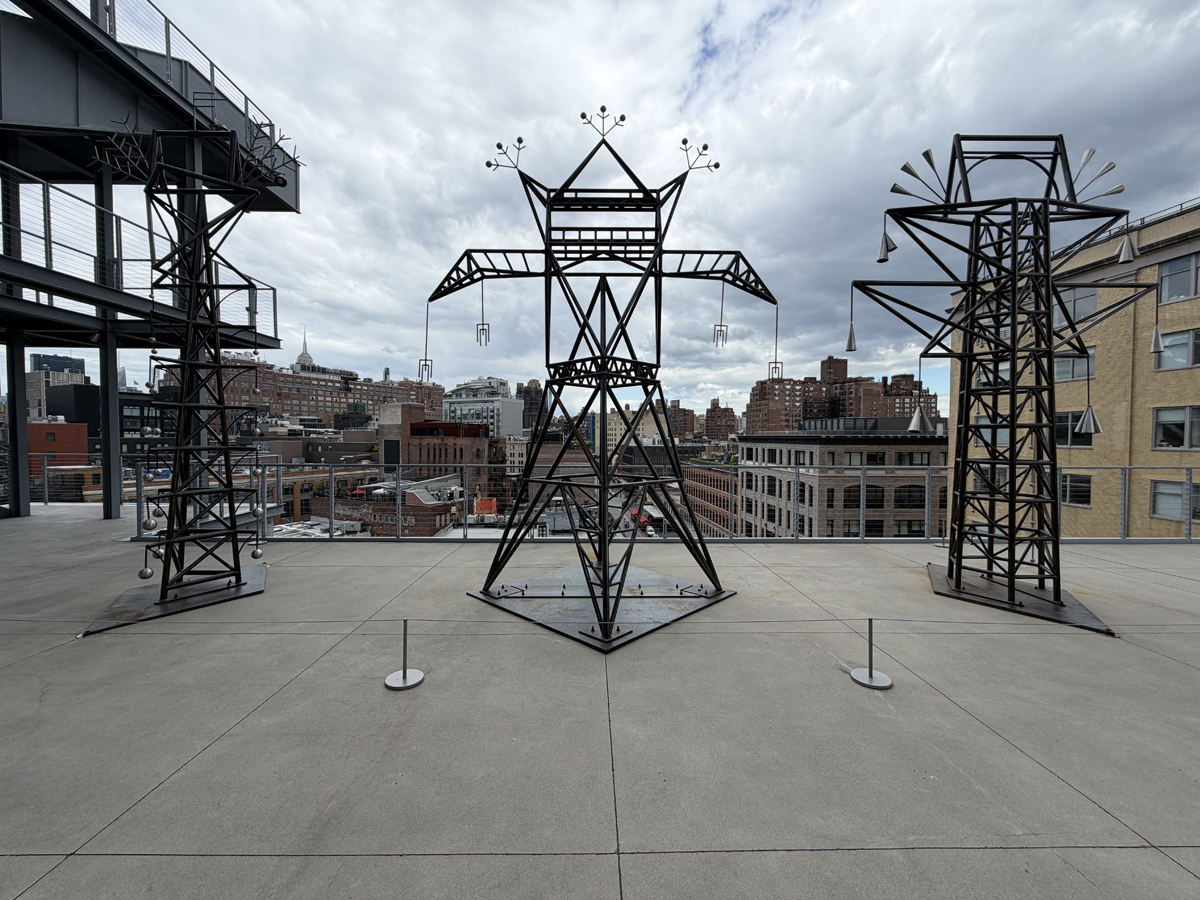
Nani Chacon’s steel gods at the Whitney Museum match Manhattan’s skyline. Now she’s bringing the project home to the Navajo Nation.
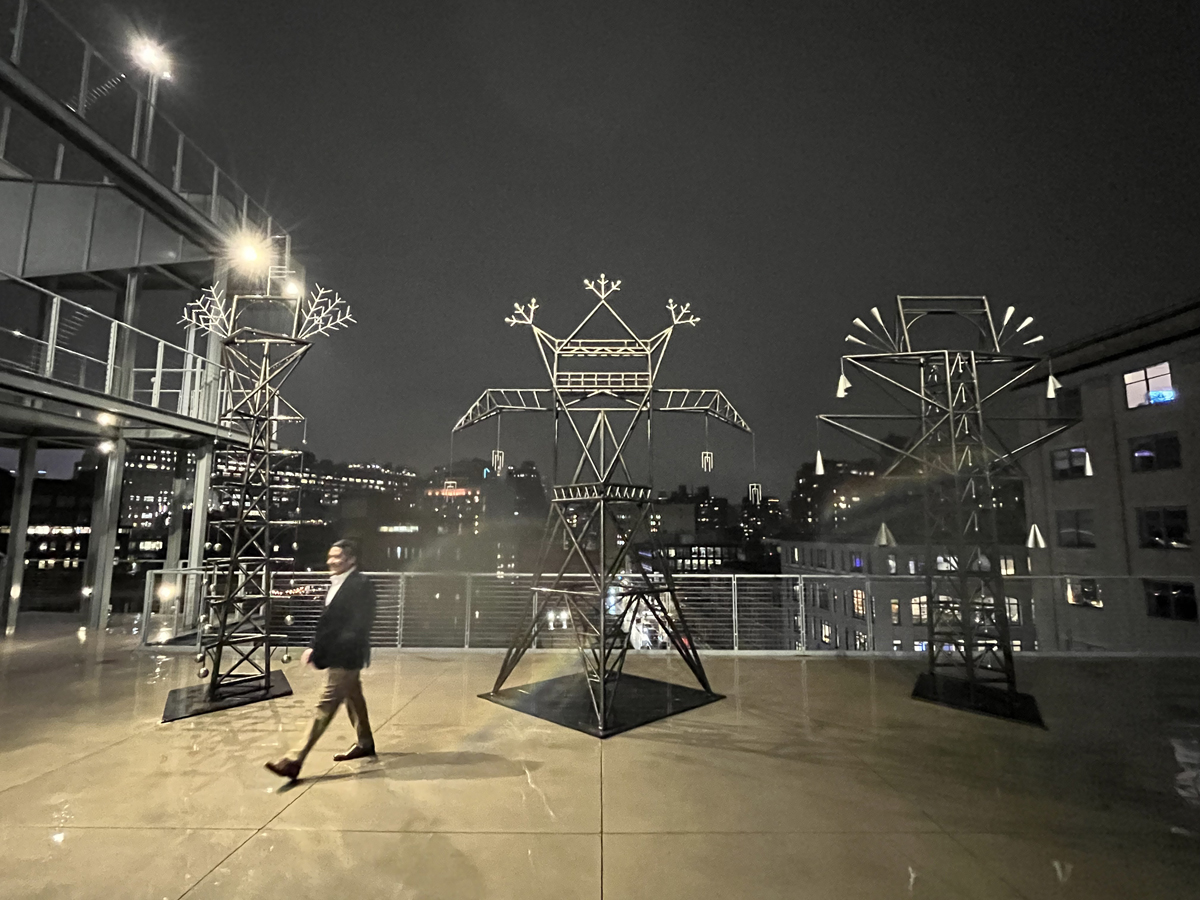
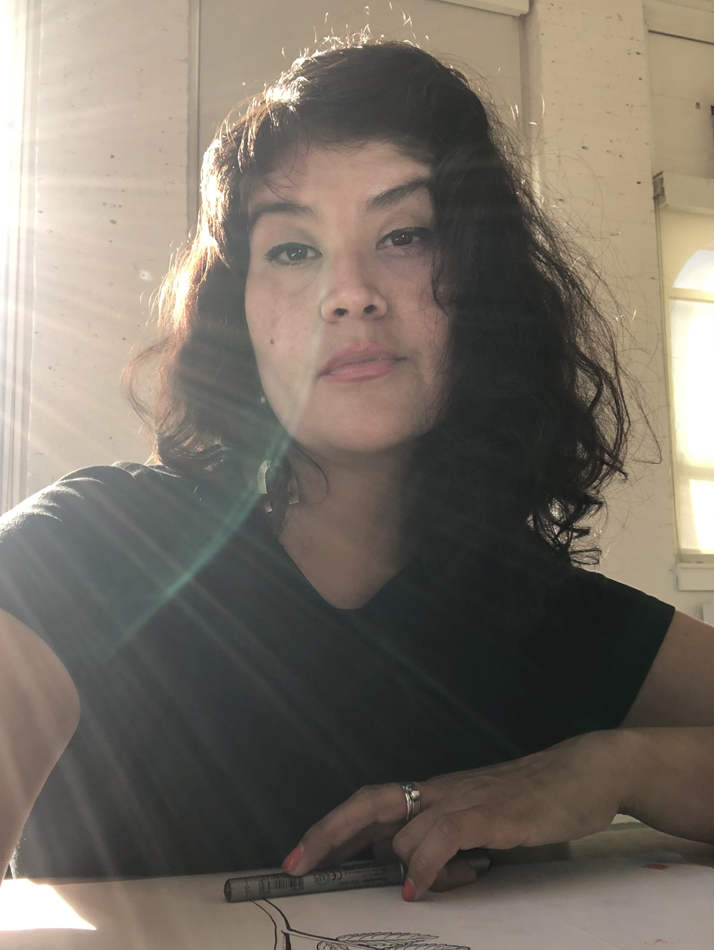
Electrical towers punctuate the Navajo Nation landscape, visual markers of the United States’ extractive legacies, political economics, and colonial-settler interests. More than 2,000 miles away, three tower-like steel sculptures sit atop the Whitney Museum of American Art’s sixth-floor terrace, each fifteen-foot-tall sculpture aligning with the geometric architecture of Manhattan. Created by Nanibah “Nani” Chacon, a Diné (Navajo) and Chicana artist who lives in Albuquerque, New Mexico, these monumental artworks comprise her series Our Gods Walk Among Us, installed as part of the 2026 Whitney Biennial.
Chacon’s initial inspirations stem from when she was a child growing up on the rez seeing Navajo sand painting deities, the triangles and patterns in rug weaving and textiles, and of course the electrical towers. “As a kid, I didn’t know what those towers were,” she tells me during our studio visit. “I always wondered why they looked like the depictions of our gods. It was just always this curious coincidence.”
As a kid, I didn’t know what those towers were. I always wondered why they looked like the depictions of our gods.
That coincidence has generated an abundance of creative energy for Chacon over the past few years. In 2023, she applied for a Creative Capital Award with the initial idea for Our Gods Walk Among Us; in early 2024 she received the award and also had a studio visit with Whitney Biennial curators Marcela Guerrero and Drew Sawyer. Additionally, she set up a table at the Navajo Nation Fair and asked people to voice their good intentions—wavelengths more aligned with her understanding of relationship with the land—which she recorded as part of her project.
In February 2025, during a residency at Diné College, she hosted a workshop and collected similar recordings. That September she tabled at the fair again, this time with her sister, multimedia artist Autumn Chacon. The year concluded with Nani Chacon being named as one of the 2026 Whitney Biennial artists.
At the time, another generative force was at work. The Navajo Transitional Energy Company announced the return of a 2,211-acre parcel to the Navajo Nation, the portion where mining operations first began in 1957. Although active mining ended in the early 2000s, the act of rematriation emphasized the importance of Navajo Nation’s sovereignty over its own natural resources.
“Within Navajo culture, everything we perceive and what we value comes from the land. Our ideas of God and our concepts of beauty and balance all come from understanding our relationship with land,” Chacon explains. “Now we’re grappling with this influx of modernity that has, in some ways, led to our own demise,” she says. “So how do we begin to return that material back to Earth or have some kind of balance within that?”
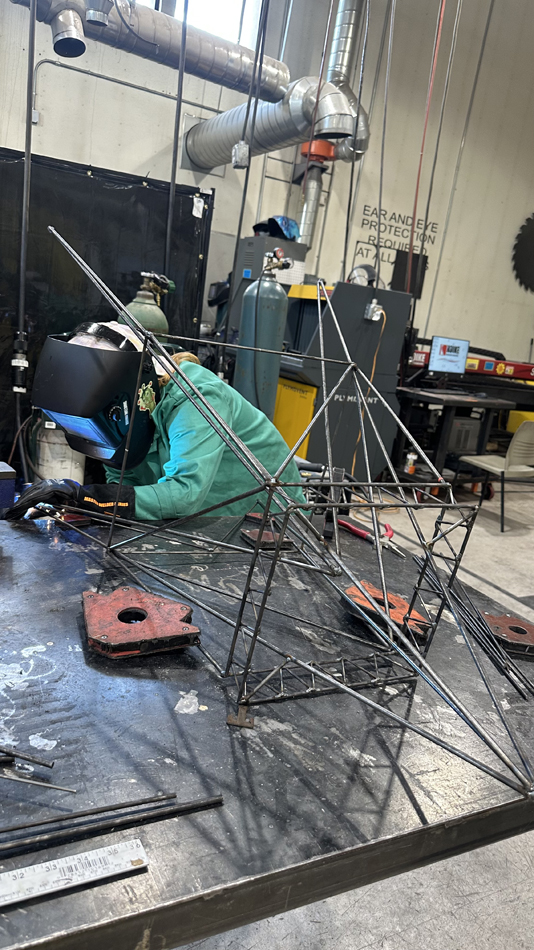
Her response, in part, is to create (and donate) a towering steel sculpture specifically for the Navajo Nation Museum, the installation of which is planned for 2027 to coincide with the Navajo Nation Fair, bringing the project full circle. The new piece will include those recorded spoken intentions embedded in a low-frequency FM transmitter and antenna, broadcast across the landscape. Chacon shares an affinity for sound art with her siblings, the aforementioned Autumn Chacon and the award-winning artist, composer, and musician Raven Chacon.
Chacon loves working with steel, and embraces its contradictions as a natural material from the earth that propelled the Industrial Revolution. “We exist in an environment that is not only implicated by industrial objects and industrial structures, but also wavelengths that are all around us,” she says. “So how do we also begin to acknowledge, but also have agency over, a multitude of wavelengths that exist in our environments?”
How do we… begin to acknowledge, but also have agency over, a multitude of wavelengths that exist in our environments?
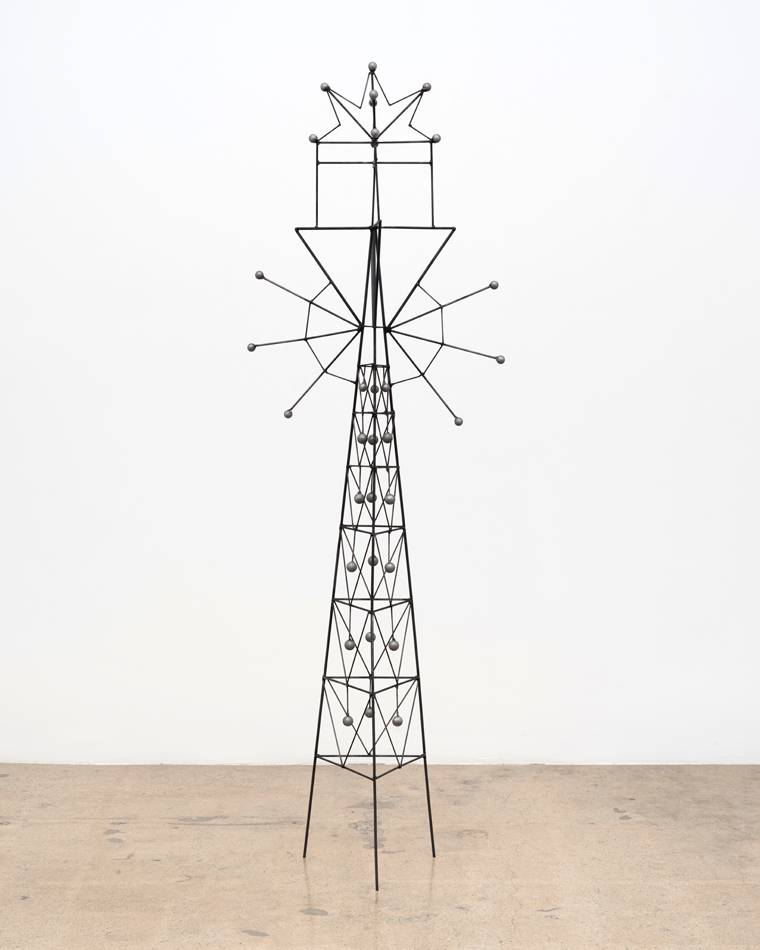
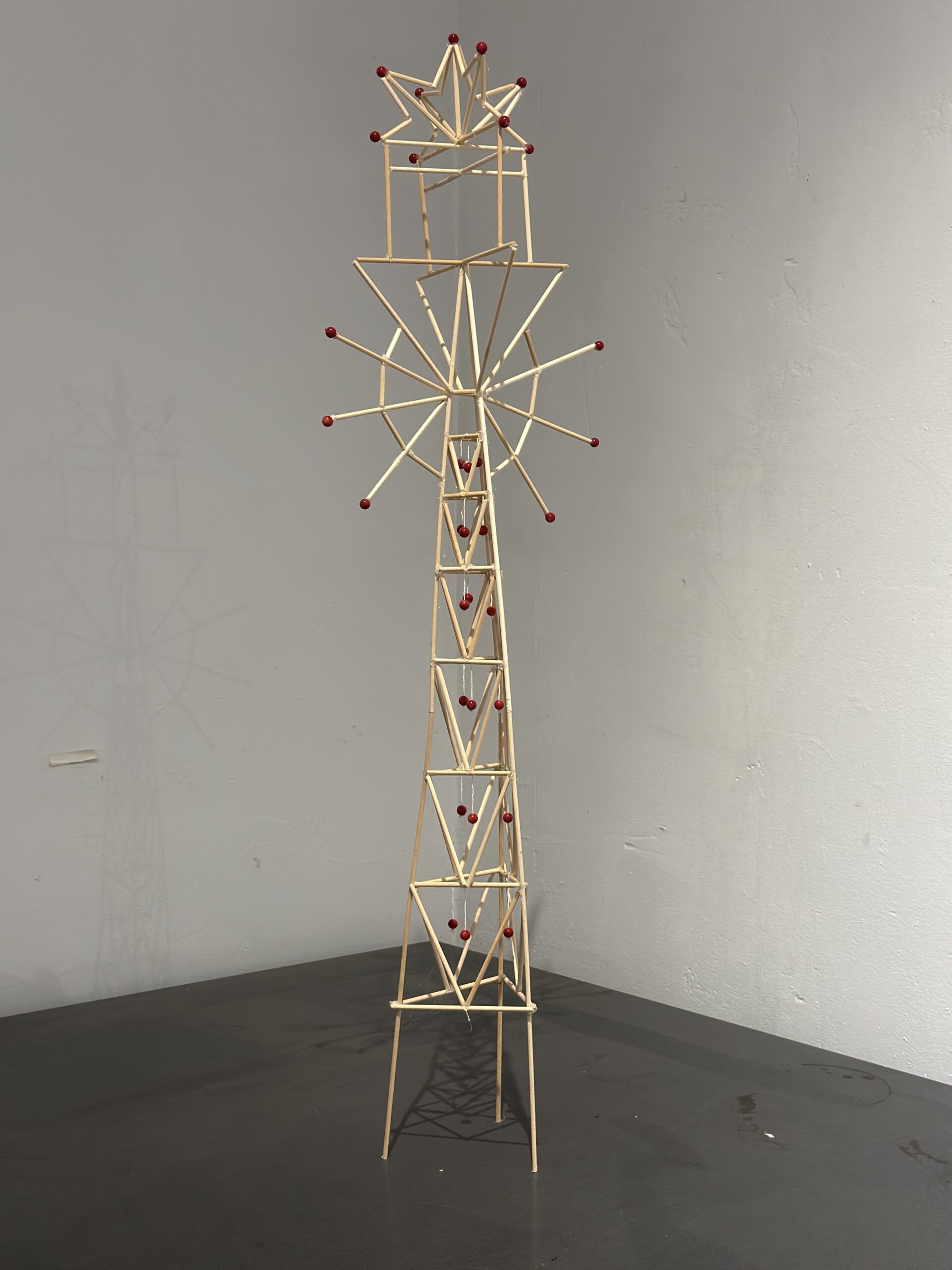
Although Chacon’s recent metal sculptures may come as a surprise to those familiar with her large-scale paintings and murals that incorporate images of nature, geometric patterns, and Indigenous figures, the artist isn’t exactly new to three-dimensional work. If you happened to catch her 2022 exhibition at Site Santa Fe, you already know that her wall weavings emphasize the spatial physicality and dimensionality of line. In Our Gods Walk Among Us, similar linear sensibilities take form in steel. Triangular lattice patterns provide structural support while embellishments like dangling spheres, radiating arrows, and conical forms reference Navajo culture.
The Whitney Biennial afforded Chacon an opportunity to consider the relationship of Our Gods Walk Among Us to landscapes other than the desert environment of the Navajo Nation. One of the more surprising aspects for her was how “natural” the sculptures looked against the skyline of New York, and how she appreciated their geometric abstract forms anew as they mimicked the industrial infrastructure.
Chacon raises difficult practical and philosophical questions, not only for the Navajo Nation but for communities around the country. “How do we begin to think about our landscape when we’re forced to conceive it with industrial blight? How does that fit into our concepts of hózhó, our ideas of encompassing beauty?” she asks. “Do we begin to think about these [electrical towers] as something given to us to remind us that our gods are around us? Or does it become a different idea of gods?”
Perhaps art can be a powerful conduit for at least some of the answers.