Clever conceit or curatorial cop-out? In Cassidy Araiza / Robert Barry / Jocko Weyland, experiment and open-endedness might be the objective.
Cassidy Araiza / Robert Barry / Jocko Weyland
March 28–May 9, 2026
Everybody, Tucson
In her 1973 book Six Years: The Dematerialization of the Art Object from 1966 to 1972, critic Lucy Lippard offers a swift summary of pioneering conceptual artist Robert Barry’s output from that period: “From 1968, Barry has worked in almost invisible nylon cord, invisible but extant radiation, magnetic fields, radio carrier waves, telepathy, suppressed knowledge, non-specific qualifications defining undefined conditions.” Elsewhere in the same book, Lippard quotes Barry as saying, “Nothing seems to me the most potent thing in the world.”
In Cassidy Araiza / Robert Barry / Jocko Weyland at Everybody, there are three works, one from each of the artists, spread across two rooms of the house-turned-gallery. It’s an unlikely trio: Araiza is an accomplished documentary photographer whose work has been published in a long list of publications, from Bon Appetit to The Washington Post (and also Southwest Contemporary); Barry was integral to the formation of non-material art in the late 1960s; Weyland has written for The New York Times and Thrasher, released books of photography and found imagery, and exhibited paintings around the country. Despite its general sparseness, though, the show embraces the tactile and the visible.
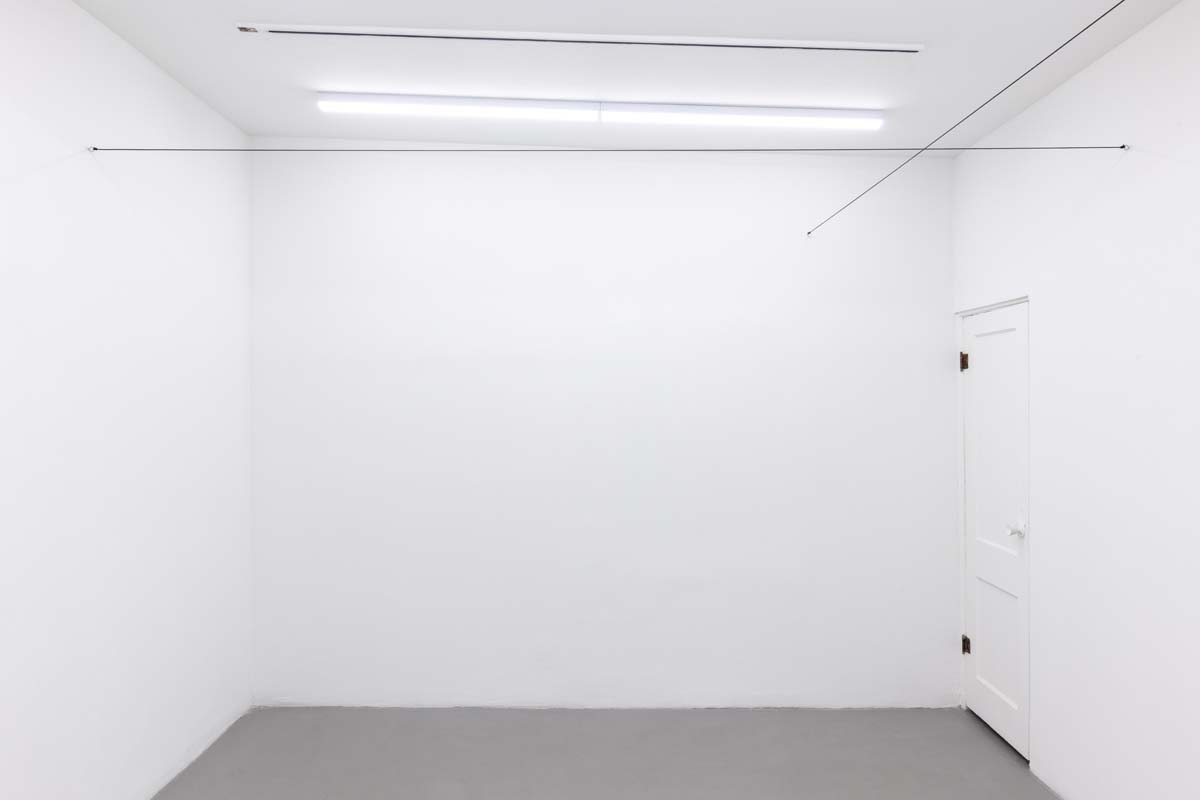
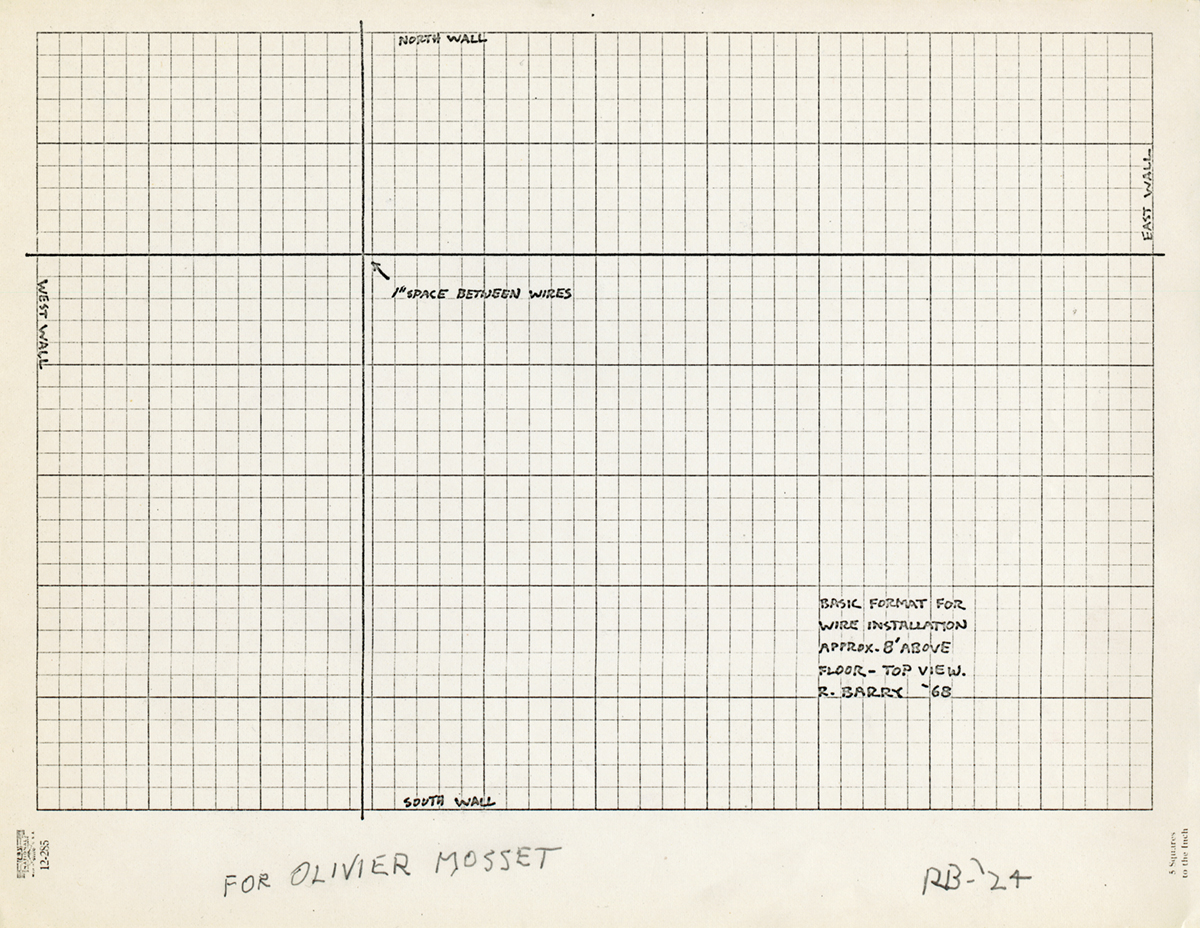
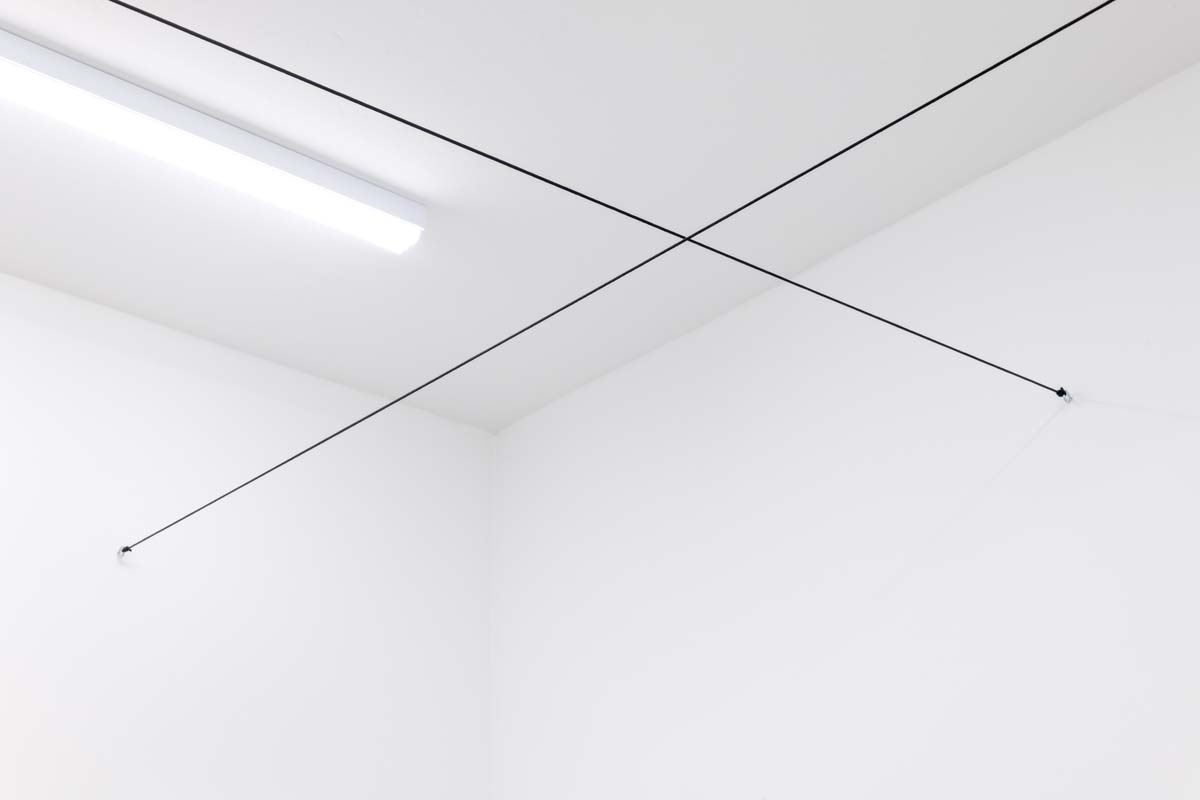
In one room, likely a small bedroom in the building’s earlier life, viewers can see Barry’s Wire Installation Approx. 8’ Feet Above Floor (1968). The piece consists of one taut black cord crossing the length of the room and another crossing its width, with a one-inch gap of vertical space between them. Typical of the era, the piece is also a diagram drawn onto a sheet of graph paper, a copy of which functions as the postcard announcement for this show and acts as the only scrap of informative text. (The paper iteration is on loan from the Swiss minimalist painter Olivier Mosset, who has long split his time between Tucson and New York City.) In 1968, Barry drafted many variations of similar work in wire or cord, some of which have been realized in gallery spaces and some of which, like a few that propose creating “a grid among randomly located trees in a forest,” seem to unfortunately exist only on paper.
The installation inherently calls attention to a space’s architectural features, physical dimensions, and lighting. It’s one thing to see a piece like this in an ornate kunsthalle—one can imagine these cords stretching several times longer in either direction across an echoing room—and it’s another to see it in a scrappy gallery on a stretch of busy semi-industrial road in Tucson. The effect of this shift in context is almost like seeing a chamber music quartet perform at a basement noise gig (in a good way).
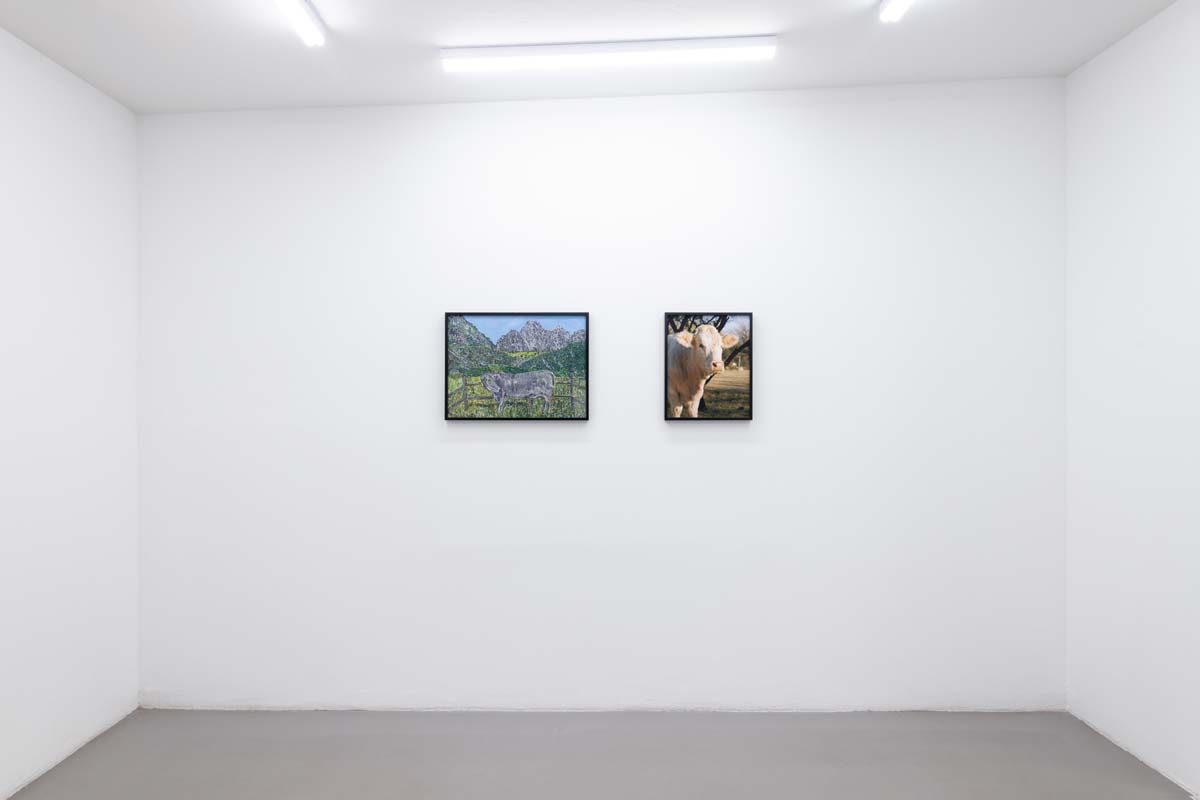
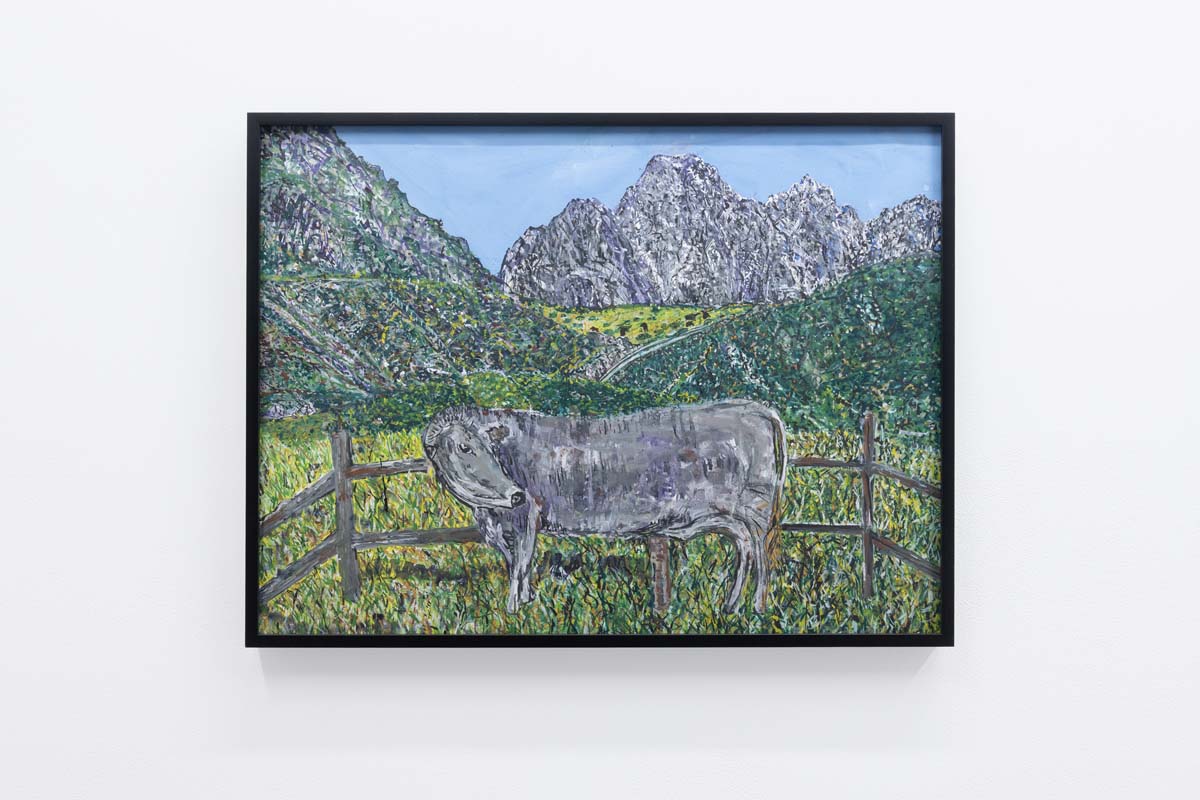
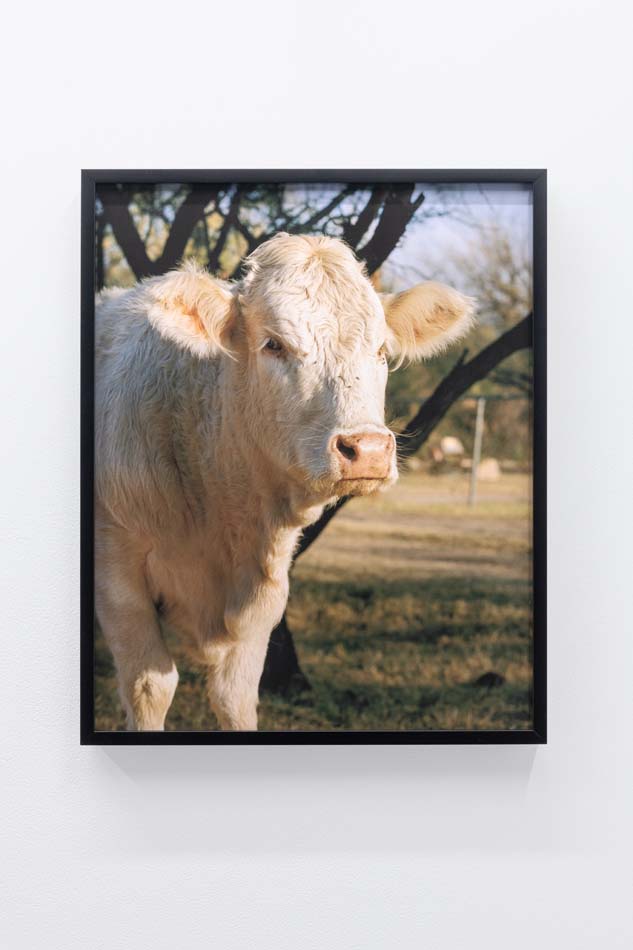
In the gallery’s other room, the viewer can see a pair of cows set close together along one wall. Araiza’s photograph Cow in Arivaca (2019) is a crisp bovine portrait, the animal’s shaggy blond head foregrounded in the frame as it glances nonchalantly at the viewer. Weyland’s painting Engadin 2 (2025) shows the elongated body of a boldly rendered cow fenced within a verdant field, the purple Alps looming in the background. These cows are fitting companions: one is pictured with such intense living detail that the viewer can easily count several flies dotting its face and beads of saliva hanging from its mouth, while the other is hazier and stranger, a depiction of a remembered dream of a cow; both are grounded in very specific locations.
What do these cows have in common with the black cords crossing one another in an otherwise empty room? The gallery itself provides no guidance. “In lieu of an exhibition title or explanatory text,” Everybody states, “we reference Barry: ‘All the necessary specific information is included in the work itself.’” There are no labels, no didactics, no catalogue. Some might see this, understandably, as a kind of curatorial cop-out, without any willingness to create a link, however foggy or vague, between the two parts of this exhibition. But I think it feels more like the tail end of a riddle or an overheard inside joke, which could exclude some viewers while feeling generative for others. Separating and elaborating these elements would easily make for two cohesive shows—the walls covered with dozens of paintings and photos of cows or the two rooms each holding a spatial intervention from the late 1960s—but as it is, the show feels experimental in the truest sense, where the open-endedness might be the objective.
Yet even if there isn’t a clear assist from the gallery, a viewer can find rhymes throughout the show. There are two cows, two wires. Both cows are looking off to the viewer’s right, towards the room housing the Barry piece. Standing directly beneath the intersecting point of Barry’s wires, the viewer can look straight through two separate doorways to see two cows looking back at them. It’s not nothing.