After decades of decline and political inaction at Great Salt Lake, Olafur Eliasson flies in with a temporary public art project. Can this art-world Hail Mary provoke positive change?
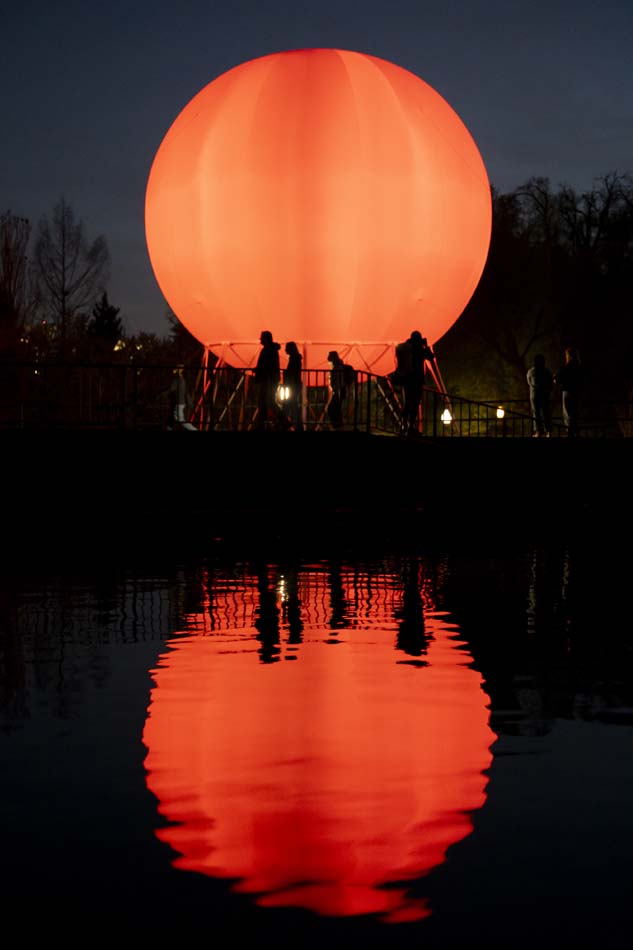
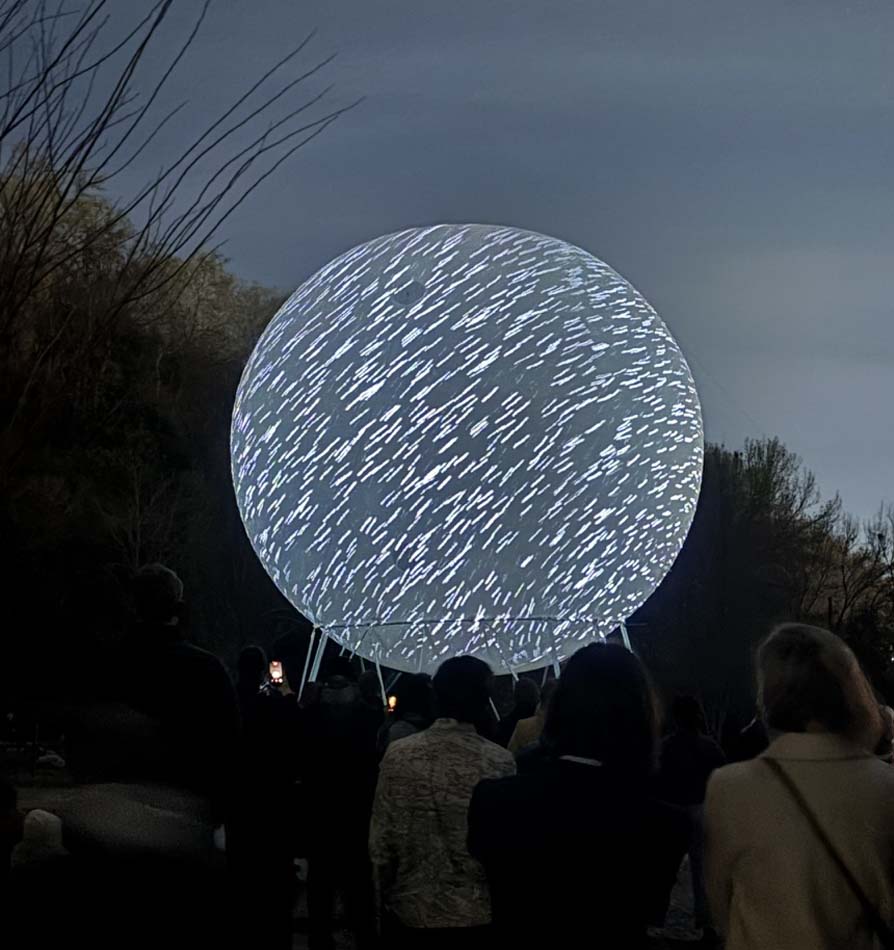
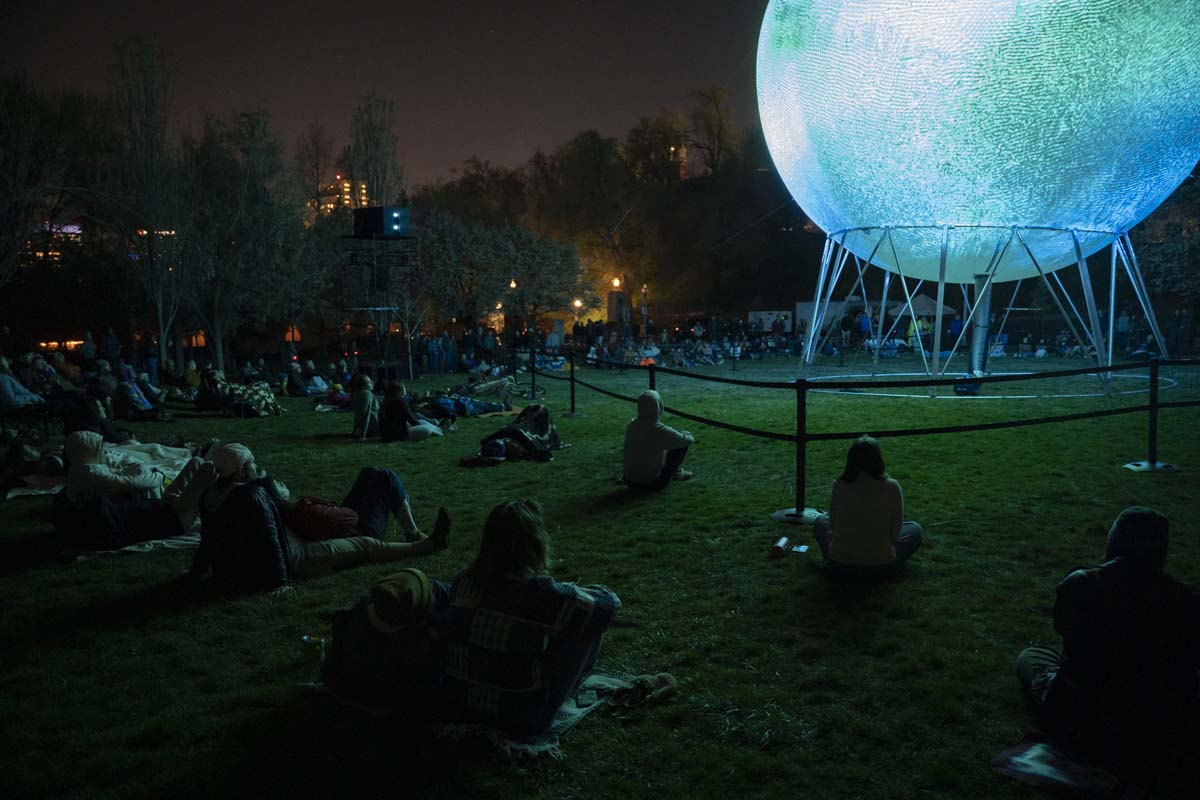
Experiencing Olafur Eliasson’s temporary Salt Lake City artwork—A symphony of disappearing sounds for the Great Salt Lake—was an immersion in spectacle. Our collective focus was trained on a thirty-foot sphere illuminated by a continual stream of visuals and sound (mixed by UK producer Koreless), in a thirty-minute program, timed to activate from dusk to dark. It was striking in its technical mastery. The sphere mimicked a planetary presence with abstracted visuals morphing from one to the next, evoking stars, prisms, crystals, and the occasional animal. Sounds sourced from Great Salt Lake were synced to a techno track, in some instances obscuring animal sounds while in other cases letting them dominate. The work pulled me in the more I could identify birdsong—signaling the disappearing sounds and impending losses of the Lake.
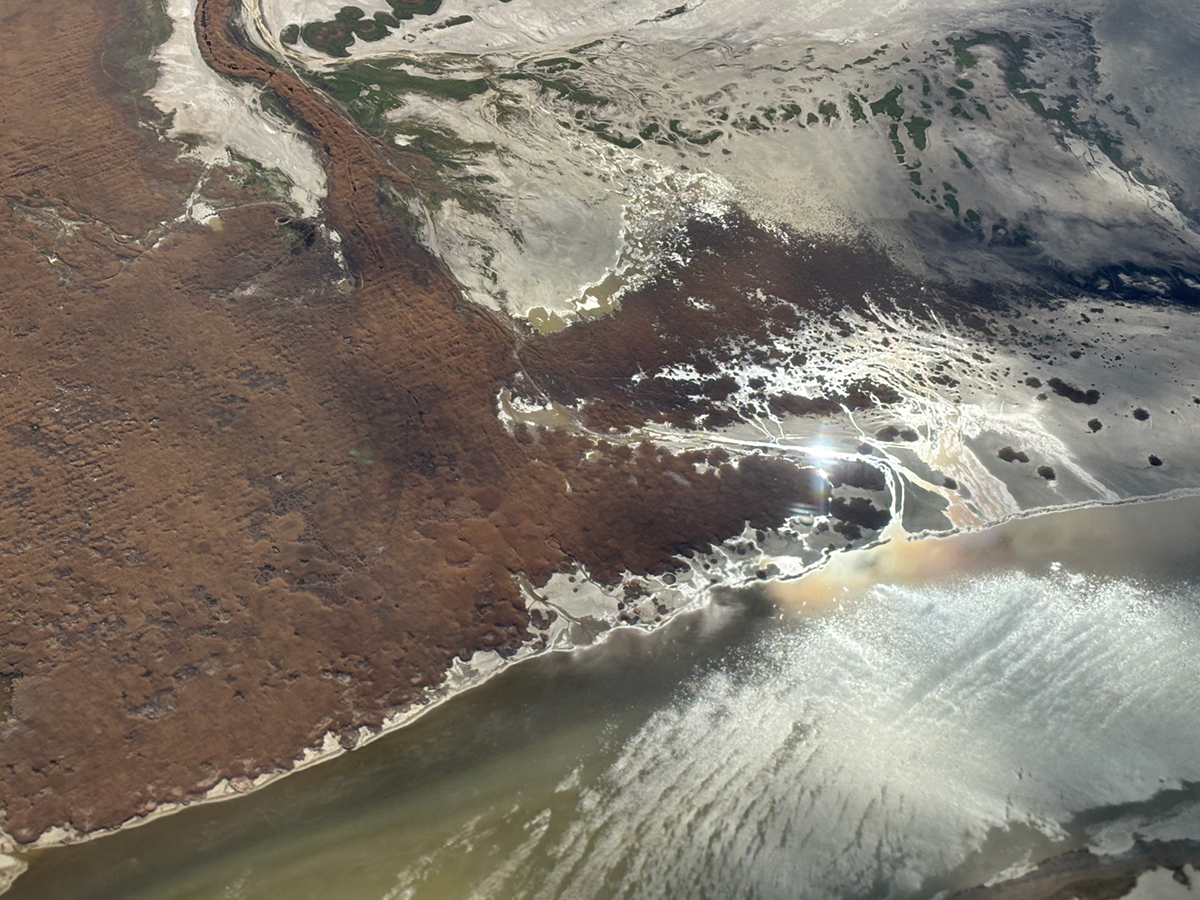
Eliasson’s work was not a realistic representation of the Lake, nor situated near it: it occupied a city park near the state capitol building, miles from the Lake. Rather, the piece served as a means to gather people to collectively face environmental decline. The Lake is now a significantly sapped, toxic space systematically altered by quiet human technological advances (diversions, irrigations, extractions) that have stripped the land of the water that makes the region whole.
While watching Eliasson’s work I was left wondering how public art—both geographically and materially divorced from its subject—could engender care for an environment that has been publicly degrading for decades. What are the ways of doing and the ways of seeing that could stop, or possibly even repair, this environmental collapse?
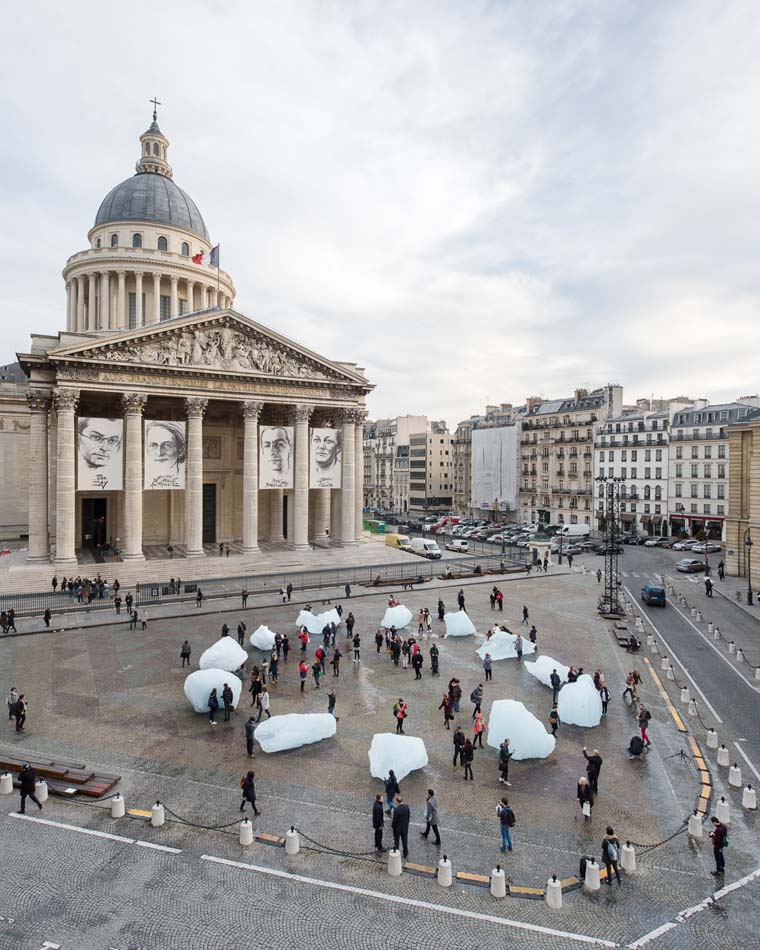
Eliasson’s work illuminated the dusk for ten nights, as the finale of the citywide public art initiative Wake the Great Salt Lake. The choice of the Danish-Icelandic artist to draw attention to the Lake’s situation ostensibly places Utah in an international spotlight. Eliasson holds global renown as an artist with a robust studio of assistants and specialists (think architects and engineers) and the means to work on oversized projects (in both meaning and size) to alert the public about the climate crisis. His temporary works of public art are designed to enhance public engagement, such as the iconic Ice Watch series, created with Minik Rosing, each composed of twelve blocks of Greenlandic ice transported to cities (Copenhagen, 2014; Paris, 2015; London, 2018) to melt on the streets amid climate summits.
Along with Ice Watch, A symphony… is simultaneously timely and past time, pointing to environmental catastrophes that have already occurred and are still active. The Lake itself is hurtling toward an alarming and precipitous decline, with bleak ecological and human health outcomes predicted. Multiple agencies have formed in Utah, each gauging the consequences based upon simple metrics: determining how toxic the Lake is to the ecosystem, and finding the means to get water back into the Lake. Yet despite mounting activism and multiple voices launching programs to direct attention to environmental issues, the failure to address Great Salt Lake’s decline is well documented, by historical sites and activist collectives.
The Lake’s situation is dire. SLC mayor Erin Mendenhall has messaged that the Lake is now at 36% of its capacity with 1,150 square miles of its shoreline reduced to dust, which holds heavy metals including arsenic and mercury. Ben Abbott, scientist and founder of Grow the Flow Utah, states that if there are no substantial interventions to add water to the Lake, its ecosystem could collapse by 2028. Utah Physicians for a Healthy Environment informs us that last winter was the warmest in Utah in over 100 years; with little snow melting into water to supply the Lake, its low levels will decline even further in the next few months.
Statistics like these are not new. As a scholar of the Great Salt Lake—and the art created on it or because of it—since 1995, this research became my vocation when I began teaching in 2006. Since then, I have incorporated these topics (and also Eliasson’s work) into art history survey courses along with newly created classes on environment, Land Art, and place. Land Art courses now provide a primer on ecologically and environmentally oriented art in response to the scientific challenges of collapsing ecosystems.
While watching Eliasson’s work I was left wondering how public art could engender care for an environment that has been publicly degrading for decades.
With this background, I was surprised and at first heartened to hear that, in 2025, the Utah Governor’s Office conducted a press conference, informing the public, “We will not let the Lake fail.”
But in many ways, they already have let the Lake fail. Last year it was at its third-lowest recorded level, exacerbating the spread of toxic dust. But at the conference, Governor Spencer J. Cox, introducing the Great Salt Lake 2034 Charter to make the Lake whole again, provided few details on process outside of highlighting the charter’s target year for restoring the Lake—which is when the Winter Olympics returns to Salt Lake City.
In advance of viewing Eliasson’s installation, I reached out to Cox, inquiring about the place of art in mitigating environmental degradation. Certainly, they knew of Wake the Great Salt Lake, which was well advertised, proffering thirteen temporary engagements of art across the city over two years. Cox’s office provided this response: “Utahns have always believed in the power of art to tell our story, and Wake the Lake reflects that tradition at its best. This project brought artists together with scientists and engineers to help people see and understand the Great Salt Lake in new ways. When we deepen that understanding, we inspire work that matters—and that’s how we build lasting stewardship for the lake.”
According to this statement, Wake the Great Salt Lake was successful in drawing attention to the Lake’s current condition. Drawing attention and deepening understanding are noble pursuits, and as an art historian, I firmly believe in the ability of art to bring situations to new light. But inspiration must be followed by action, especially when the public health of the state is at stake.
I met with Eliasson on the first day of his work’s activation to talk inspiration and action. Over coffee, Eliasson described the many ways he and his studio respond to today’s myriad environmental issues, such as adhering to the tenets of the 2015 Paris Agreement in a commitment to reduce impact on the climate crisis.
Eliasson, in response to Cox’s statement, evokes German statesman Otto von Bismarck: “‘Politics is the art of the possible,’ but art is the politics of the impossible.” This dichotomy exemplifies the pendulous discourse about the Great Salt Lake’s decline over the past quarter century. What is possible; what is impossible?
From our conversation, I found that Eliasson embraces possibility. Growing up in Iceland, he developed a close relationship to the land and, correlating the stark beauty of each region, feels a kinship to the landscape of the Great Salt Lake. Concerned with the loss of our relationship to nature, Eliasson promotes becoming sensitized to it—to engage in slowness, to become more attuned to place. Slowness becomes a tool to return to nature, to find value in the natural world.
During his public talk on March 25, Eliasson described different dimensions of perception, which are heightened through slowness, as “what we can see and therefore know about. What we can’t see but we still know exists. And what we can’t see and therefore don’t know about.”

Difference in perception is a key factor in activating our understanding of public art, Land Art, and spectacle. The sounds of Eliasson’s work in Salt Lake City were for the most part not of the Lake; the digital vernacular of these sounds seemed to represent the present more than the past, the technological rather than the natural. Eliasson’s comments on perception—which satisfied my fixation with phenomenological experience—may be lost on those who process across different realms. While I felt most sounds did not harken to the Lake, others may have heard the opposite.
Along with perception, Eliasson and I discussed the importance of contemporary strains of psychology to his work. Foremost is the writing of Steffi Bednarek and her book Climate, Psychology, and Change: Reimagining Psychotherapy in an Era of Global Disruption and Climate Anxiety (2024). Bednarek addresses today’s climate crisis through the lenses of trauma, power, capitalism, and politics. Eliasson summarizes the bright light she shines, stating “people are not [responding to climate change] despite [the fact that] they are given everything they need to know they have access to. […] They don’t have time. They don’t have money. They don’t have the resources. They don’t feel empowered. But besides that, […] there is a loss of relationship to nature, a trauma.”
There is a loss of relationship to nature, a trauma.
Through public art however, spectators may have found a way to engage. According to Andrew Shaw, lead of Wake the Great Salt Lake, approximately 5,000 attended the work on its final night, a major increase from the first night, which drew an estimated 1,100.
Eliasson espouses engaging with the entirety of the Great Salt Lake as a means of knowing it: stopping the car, walking away from the road, and taking in “the void” despite the discomfort of it. He provides an antidote to the deep-rooted fear of being exposed to spaces we perceive to be empty, barren, devoid of life. “If you slow down, you realize, oh, it’s not a void. It’s full of things,” he says. “Nowhere, as we learned, is not nowhere. It is now here.”
Eliasson’s use of “nowhere” references artist Barnett Newman, who spoke of the sense of place within his paintings as “now; here.” Through his stature, Eliasson effectively moves the Lake’s profile from “nowhere” to “now here,” from a place in Utah to a platform of international significance.
Two weeks after seeing Eliasson’s work, I was back in Nevada and met Caroline Tracey, author of Salt Lakes: An Unnatural History (2026). Salt lakes around the world are in decline, a result of climate change and human intervention. Did Tracey hold hope for water to return to these lakes? “It would require a lot of political will to redistribute water rights,” she states. “[Great Salt Lake] is part of the economic identity of the place,” she continues, acknowledging that we’re now at the point where looking “in a different direction,” such as reevaluating irrigation, might offer benefits to the Lake.
Amidst these practical considerations, I am left asking: can art truly provide this different direction to build stewardship? Felicia Baca, executive director of SLC Arts Council, tells me that Eliasson’s work won’t end on April 4, but will continue to forge new connections as the chorus of those concerned about the Lake grows stronger. Eliasson’s footprint in SLC encompassed local artists, public policymakers, educators, scientists, activists, public utility agencies, funders, and Indigenous representatives. As Baca expresses, the public “can imagine possibilities through [Eliasson’s] approachable work to a sense of being interconnected. We want our home to be in good repair and want to live healthy lives.”
Eliasson left Utah without a public action plan to heal the Lake. Amidst the numbers and metrics from the agencies involved in Wake the Great Salt Lake, Eliasson’s work is now past, relegated to the realm of online platforms. Each day, though, brings another talking point on possible fixes and the Lake’s demise.
It may be easier to accept the last trickle of water than face another year of activism with no positive outcome.
It may just be that “art is the politics of the impossible,” but I would feel more optimistic if art activism wasn’t the main discourse driving changes to heal the Lake. With multiple art projects enacted in the last decade, it has certainly been dominant. Continual environmental collapse can lead to malaise. If the Lake does reach a new low level this year, the collective may come to believe that it’s too late to readjust habitual ways of being. It may be easier to accept the last trickle of water than face another year of activism with no positive outcome.
I hope I’m wrong. If it’s up to art, I hope Eliasson’s work is successful in changing minds and focusing on the here and now to heal the Lake—securing the health of humans and ecosystems for now and the future.
While experiencing A symphony… I felt the “here” of it all but initially felt detached from the crowd, even though I was with friends. The communal experience began to grow, though, and the eventual notes of birdsong drew into the collective and the embodied space of art.