In Paula Castillo’s three new public artworks across downtown Denver, cultural fusion is an optimistic and ideologically risky proposition.
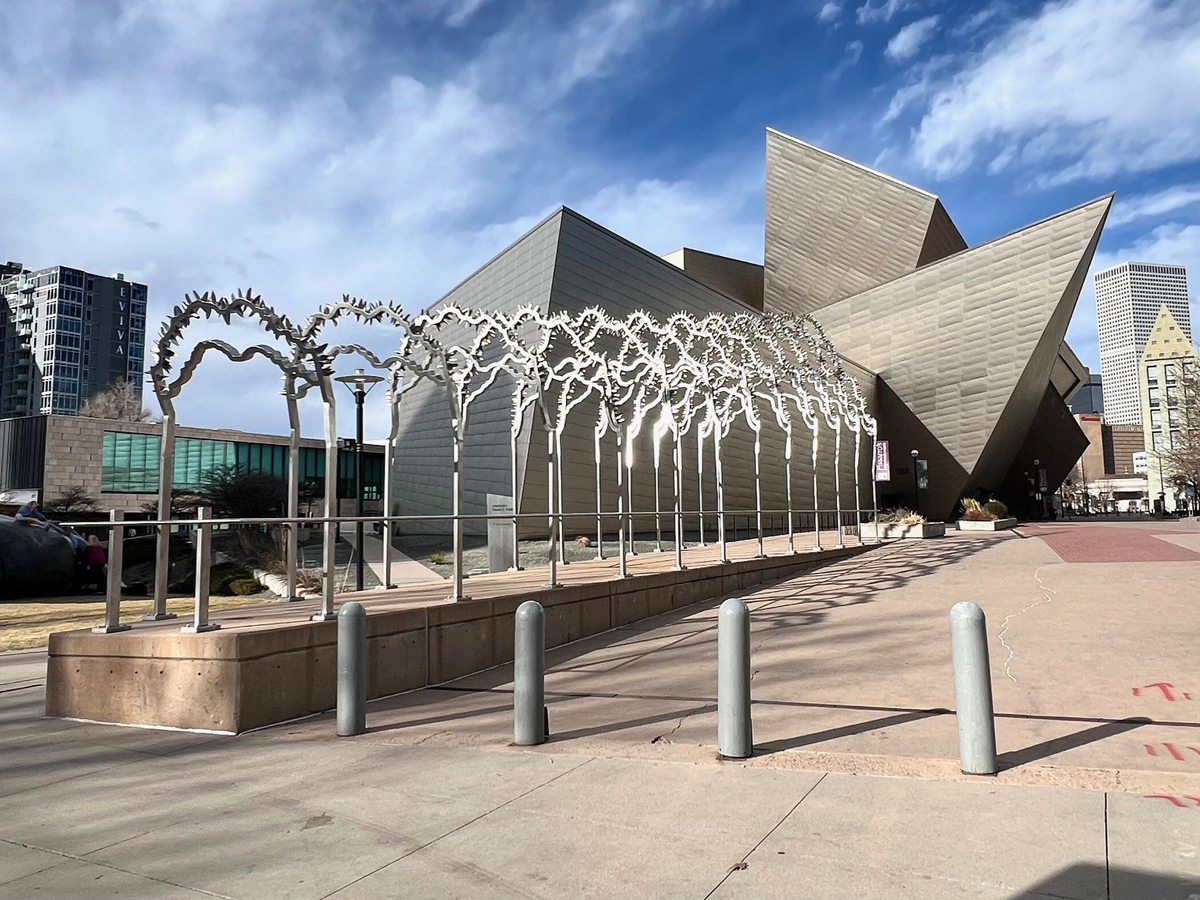
Along the south side of the Denver Art Museum’s Hamilton Building, the incrementally ascending, cantilevered arches of Paula Castillo’s Trestle greet visitors and passersby. As the sun reflects off its stainless-steel surface, the gleaming silver sculpture acts as a portal of light beckoning us to a seemingly mystical realm of art.
In 2023, the City of Denver selected the New Mexico–based artist to design “three iconic sculptures for the shared Denver Art Museum and Denver Central Library Campus.” Over the next several years, Castillo designed the works, oversaw their fabrication, and installed them to her specifications, officially unveiling the works in October 2025. To this extent, Trestle welcomes viewers not just to the museum and its holdings, but to the other Castillo sculptures located on the downtown campus. They are titled Glyph and Equis.
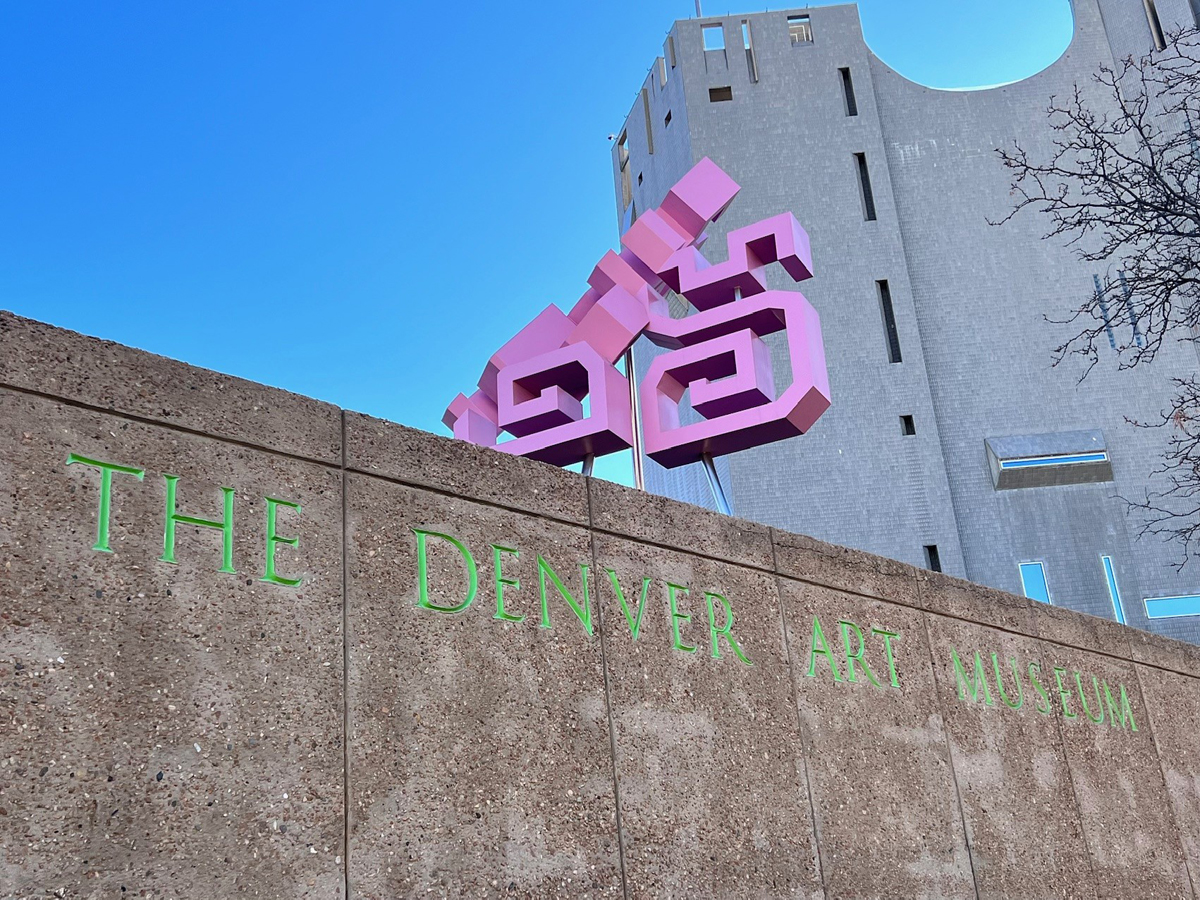
Glyph is a bright pink cluster of interconnected lines pivoted across different axes. The artwork sits atop three steel rods, elevating the sculpture so that it crests over the northwest wall in front of the Denver Art Museum’s Ponti Building.
More than random abstraction, the sculpture’s linework is, in fact, a series of xicalcoliuhqui. The xicalcoliuhqui is a Mesoamerican motif commonly found in art and architecture of Pre-Columbian Indigenous populations, including the Pueblo tribes that inhabited Colorado. The symbol, which appears as a set of linked hooks or spirals, has no definitive meaning. Rather, it is a multifarious inscription that has been associated with water, waves, clouds, lightning, serpents, and various philosophical concepts.
When European colonizers arrived in the Americas, they noticed that the xicalcoliuhqui symbol bore an uncanny resemblance to the ancient Greek key meander. Like the xicalcoliuhqui, a meander is a decorative element composed of interlocking, squared spirals often found in the architecture and artworks of ancient Greece.
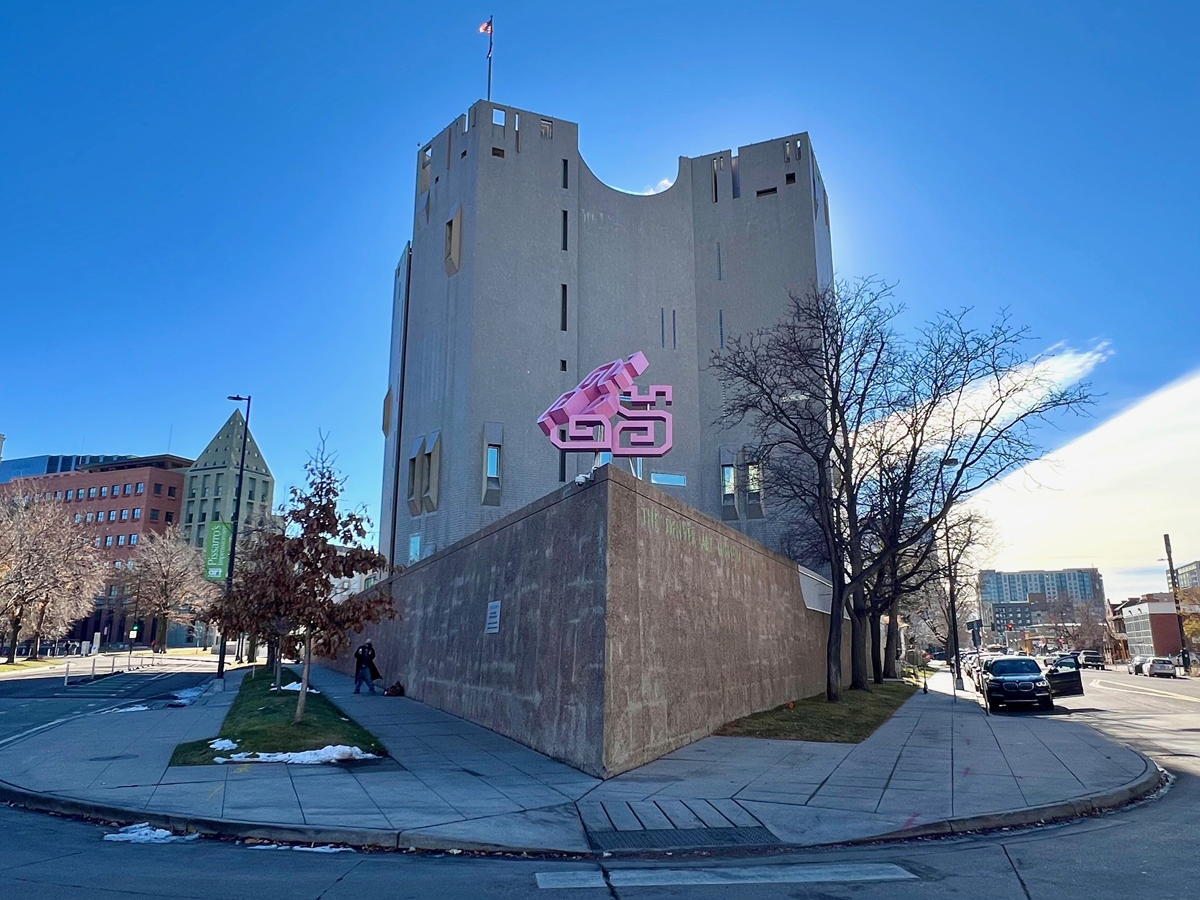
By pivoting its linework across multiple axes, Glyph conceptually mirrors the collapse of multiple geographic and cultural differences. Different orientations offer us different perspectives of the same symbol within a single artifact. In doing so, Castillo envisions her sculpture as an “opportunity to rethink what it means to belong and be a healthy community in the American 21st century.” Given how divisive our country has become over the past decade, the artist understands that “this conversation of inclusion feels essential in this historical community space of Denver.”
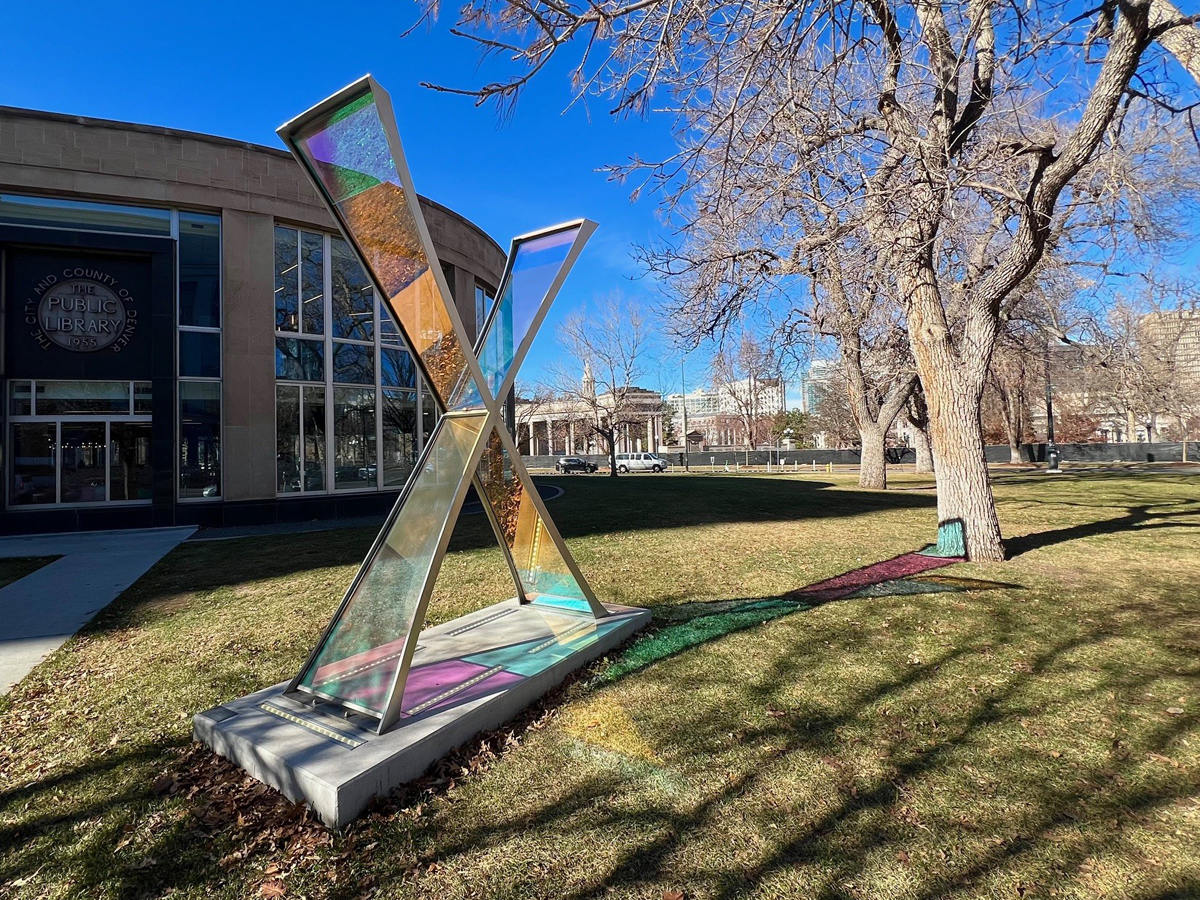
Castillo’s sculpture Equis addresses similar concepts, but through a different aesthetic and material framework. Fashioned into the shape of a large “X” and installed outside the Denver Public Library’s main branch on South Broadway Street, Equis contains a series of dichroic glass panels housed within stainless steel frames.
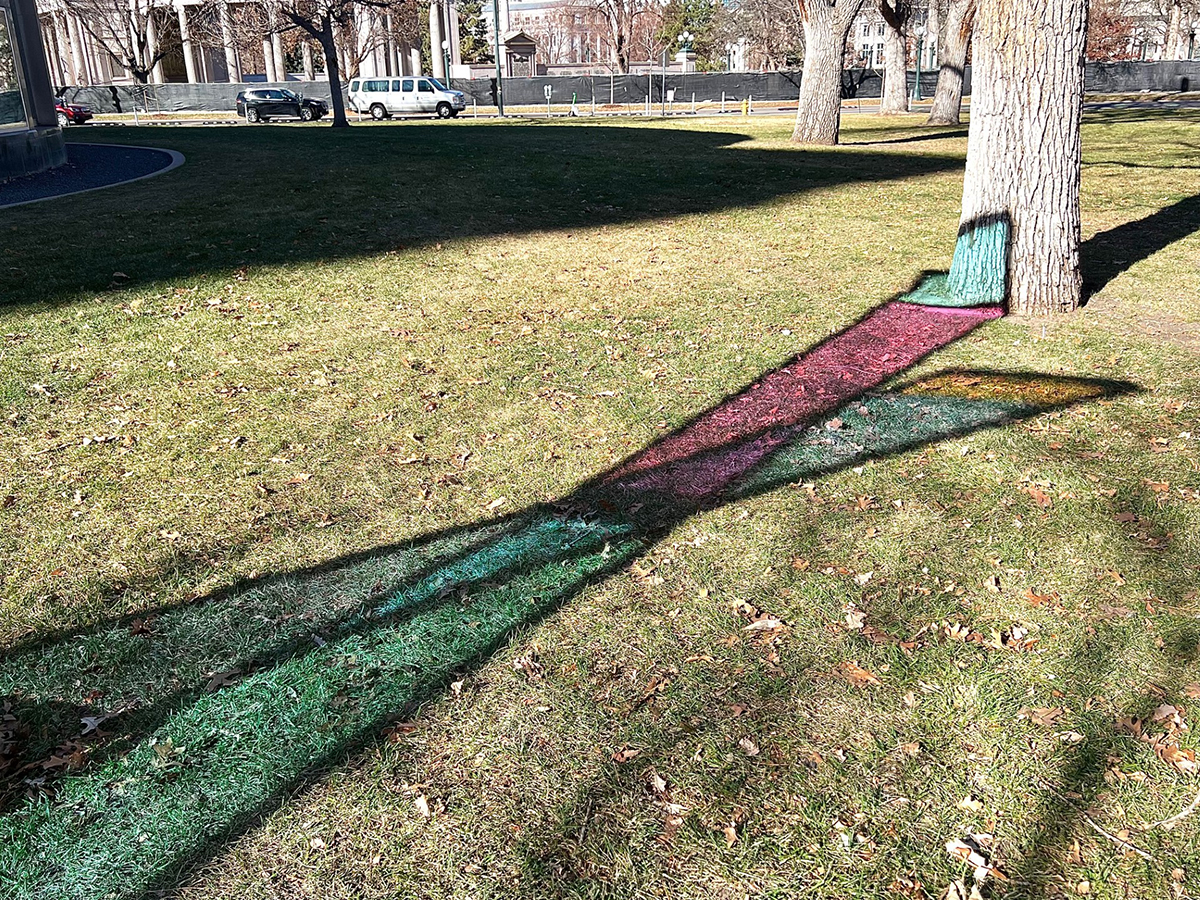
Dichroic glass is manufactured through a process that fuses many thin layers of metal oxides. These fused layers result in a glass surface that displays different colors based upon lighting conditions and one’s position relative to that light. Thus, as one moves around Equis or views it at different times of day, the color of the piece and the shadows that it casts will change with each visit.
If the viewer refuses to lose sight of history’s tumult, these sculptures can… offer paths toward imagining more equitable and integrated futures.
While she studied the “Uto-Aztecan Nahuatl language, [and] learned to pronounce the word Xicalcoliuhqui,” Castillo discovered that the “Nahuatl ‘sh’ sound was equivalent to the Latin X of the 16th century.” The “X,” then, linguistically tethers European and Indigenous cultures to one another. The artist goes on to note that “the X, a mystical and historical symbol, fittingly translates to ‘all are equal’ in Spanish, encapsulating the beacon’s profound message of inclusivity and equality.” Like Glyph, Equis highlights the intersections between disparate cultures, as opposed to foregrounding their differences. The glass housed within the artwork may continually change color, based upon viewer and viewing time; but such differences remain fused within an otherwise singular object.
Focusing on the linguistic and aesthetic resonances between different cultures fosters an affirmative position and outlook when assessing the confluence of disparate countries, nationalities, races, and ethnic backgrounds. Such a positivistic attitude is undoubtedly necessary for productive relationships across diverse communities. And certainly, cultural intersectionality in art (and other discourses as well) should be promoted and championed if we want to create a beneficent future wherein different communities and identities can thrive in full expression of themselves.
But it is also important to approach such ideological stances and the artworks embodying them with caution. Gloria Anzaldúa, an icon of transcultural identity and consciousness, argued in Borderlands / La Frontera that “certain joys” and “exhilaration” develop in spaces where different communities co-exist; and that intermingling contributes to the “further evolution of humankind.” But she was quick to note that such spaces were “not a comfortable territory to live in.” They were, in fact, riddled with “contradictions,” resulting in “hatred, anger, and exploitation.”
Jahan Ramazani echoes these sentiments in his book The Hybrid Muse: Postcolonial Poetry in English when writing about cultural and aesthetic hybridity. He warns that such interweaving “can be misleading if it muffles the power differences between culture or oversimplifies multilayered deposits within any single culture.”
Similarly, in his essay “Tracing Hybridity in Theory,” Nikos Papastergiadis contends “that the preoccupation with hybridity… has tended to gloss over persistent social divisions,” opting instead for “more cheerful populist claims” that attempt to conceal “white supremacist ideologies.”
This is all to say that linguistic and aesthetic motifs that highlight cross-cultural resonances in Paula Castillo’s Glyph and Equis should be validated and amplified. They are ideas and behaviors that will ultimately ameliorate social divisions and distrust. But we should not let such hybrid spaces obscure historical context and asymmetrical power relationships from which they derive. If the viewer refuses to lose sight of history’s tumult, these sculptures can offer conceptual and material paths toward imagining more equitable and integrated futures, while simultaneously reminding us with what ease seemingly good-hearted efforts can re-establish or unwittingly solidify cultural divisions and oppression.