At the unofficial wake of a legendary art magazine, a SWC editor weighs the real-world purpose of arts journalism.

Is a funeral about mourning the dead, or toeing the line of your own oblivion?
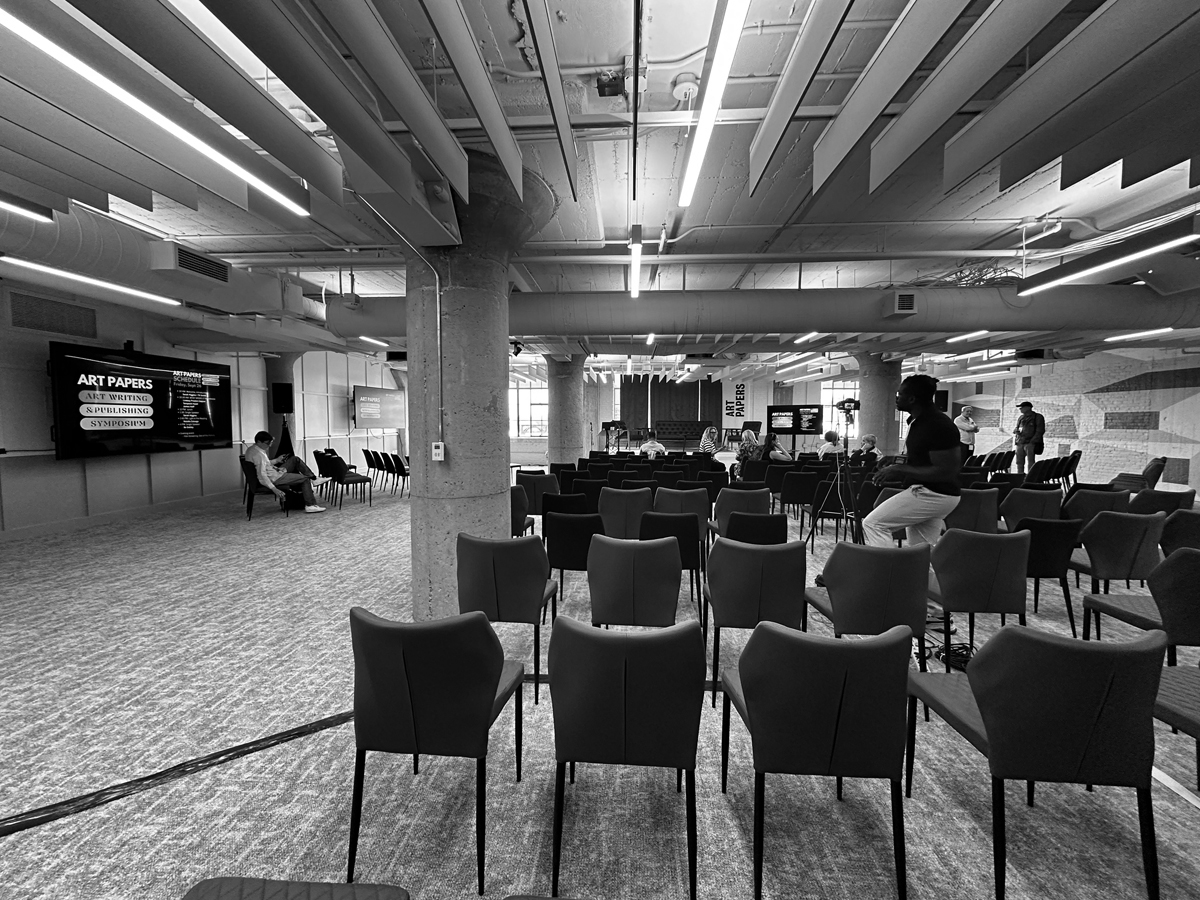
When an art magazine dies other mags show up to grieve it. There I was with our publisher Lauren Tresp and a coast-to-coast huddle of other regional arts publishers and editors, bleary-eyed in the florescence of an Atlanta conference room. We sat shoulder-to-shoulder with CARLA (from Los Angeles), Glasstire (Texas), Boston Art Review (Beantown and its environs), and other publications.
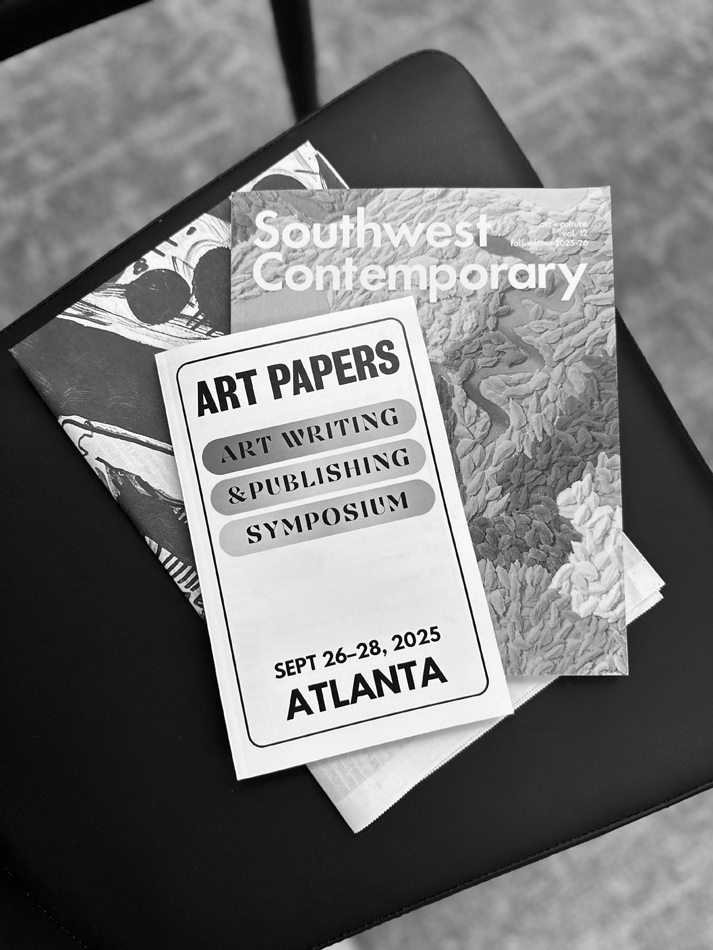
The deceased (or near-deceased) was Art Papers (1976-2026), an Atlanta-based print magazine that will self-immolate on its fiftieth birthday next year. Its final phase is a three-year project called Fire Ecology, wherein the staff acts as “death doulas for the old [and] midwives for the birth of something new.”
Even as we studied Art Papers as a cautionary tale, I worried we were actually dominoes in a chain.
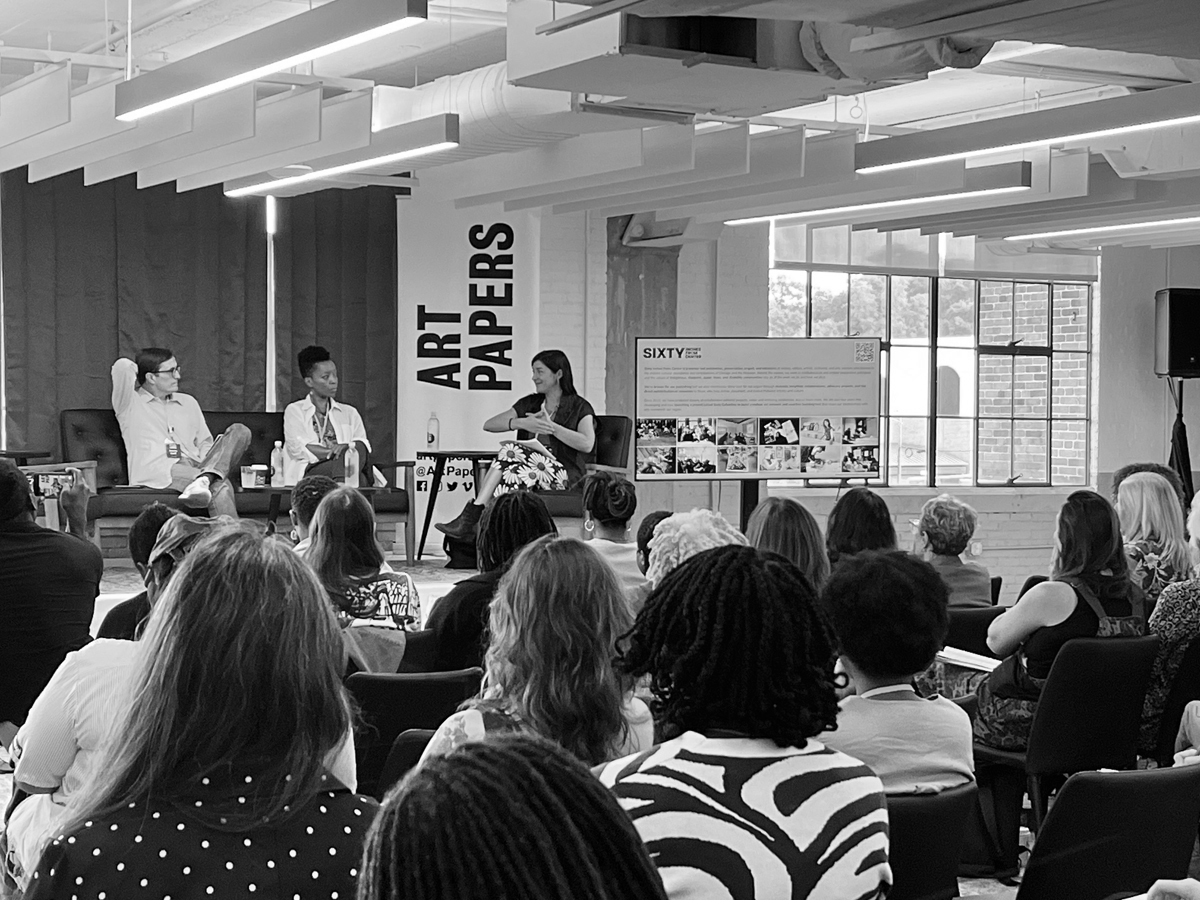
That quote is from Sarah Higgins, the executive and artistic director of Art Papers, who spoke at the late-September event—branded not as a wake but an art writing and publishing symposium. The capstone summit aimed to connect and uplift those of us who were soldiering on, but I was more attuned to its breast-beating existential rhythm. Even as we studied Art Papers as a cautionary tale, I worried we were actually dominoes in a chain.
This is sacrilege as an arts editor, but our quasi-apocalyptic setting emboldened me to ask: why write and read about art at the end of the world? Or: does this dire moment in human history really call for art writing?
Grappling with questions like these has been Higgins’s job since 2023, when she and her team decided to sunset Art Papers. By the time we arrived in Atlanta, they had a year and a half of reflections to share. For them, as Higgins tells me later, the closure was “the context, not the headline.” Fire Ecology, and the symposium it produced, had become “a pretext to bring the community together, to constitute us as a community,” not a funeral procession.
But as Higgins traced the institution’s half-century lifespan, through the expansion and slow deflation of public arts funding, through culture wars and relentless capital campaigns—it became harder to imagine that what was happening to Art Papers wasn’t a dirge for all of us.
If the world feels like it’s ending right now, perhaps it’s because multiple safety nets… are fraying at once.
“The more I looked into it,” Higgins tells me, “the more I was like, well, no wonder it’s breaking everywhere. This isn’t people making bad decisions or not being innovative enough… this is in the bones of what these spaces are.” What ultimately hemmed Art Papers, she argued, was a tangle of structural contradictions: grant rules that punished experimentalism, donor expectations that pushed against real substance, and more broadly, the curdling of certain ideas about the very shape of society.
The same social contract that (partially) underwrites arts organizations has also provided a measure of housing assistance, medical and nutritional aid, and due process—all of which are now imperiled. Higgins mentions that her partner works for a legal-aid nonprofit that serves asylum seekers and survivors of violence, an organization that recently had its federal funding “yoinked all at once.”
If the world feels like it’s ending right now, perhaps it’s because multiple safety nets, and the ethical framework that surrounded them, are fraying (or being intentionally razed) simultaneously.
I’m not arguing for a return to 20th-century societal structures—the political pendulum that formed inside them led to our present, after all. My offering as an arts editor is this: we must deeply acknowledge that the microcosm of the art community directly reflects the larger world in addition to reflecting on it.
If we want the macrocosm to improve, if we want old ideas and institutions outside of the arts to reform or make way for something new, then we can be a concrete laboratory for that ethos. What if we reimagined art’s symbolic heft—often called a soft power—as a force for literally rearranging society, starting with our tiny slice of it? (If this sounds fantastical, consider recent funding cuts and censorship controversies as clear signs that those in power understand our potential.)
In my opinion, that is an art community that justifies itself in our present moment.
Where does this leave art writers and readers? As our publisher Lauren Tresp describes it, verified information forms a toolkit—a hammer, wedge, and lever—for structural transformation. Facts, context, and perspective can apply phenomenal force.
Whatever you care about most in the world, you should care about journalism on that topic.
“Whatever you care about most in the world, you should care about journalism on that topic,” Tresp tells me. “It’s a direct relationship between the health of our society… and the actual information that we have to act on in the world.” The matter, the stuff, of these tools is the storytelling, but all that gathered knowledge doesn’t activate until you, the reader, pick it up. Our fates are tied.
Tresp is pragmatic in her vision: she doesn’t describe Southwest Contemporary as a glossy luxury object but a piece of civic infrastructure. A regional art magazine is, at best, a tiny social safety net: a way to circulate information, share survival tools and strategies, and keep artists and audiences in relation with each other and the larger world. “Art is made in real life,” Tresp says.
One of the most compelling frameworks we brought home from Atlanta came from critic Siddhartha Mitter, who showed a simple triangle answering the question: who do we write for? One point was “the public,” another was “the field” (artists, curators, scholars), and the third was “the future.” That last corner sounds soft and poetic, unless you start to believe that the world could rest on its point.
Editor’s Note: This project was supported in part by a grant from the Denver Theatre District, with additional funding provided by Understudy Art Incubator.