Desperate times call for exceptional reads. Pick up an ode to “bad” writing, a novel set in the West Bank, and more 2025 book picks by the Southwest Contemporary team.

Lauren Tresp, publisher
The Only Good Indians
by Stephen Graham Jones, Saga Press, 2020
In an 1886 lecture, Theodore Roosevelt is quoted as saying, “The only good Indians are the dead Indians.” Stephen Graham Jones’s (Blackfeet Nation) horror novel invokes this egregious view in its title before taking readers along with four Blackfeet men in Montana as they are stalked by a righteous, violent spirit. While Elk Head Woman exacts bloody vengeance (and somehow the narrative is also threaded with comedy), Jones further complicates what constitutes a “good Indian,” not only from a racist white perspective, but also within the Indigenous community itself.
Bad Writing
by Travis Jeppesen, Sternberg Press, 2019
Travis Jeppesen really took me down a peg when he deplores the devolution of art criticism from literary art form to “‘mere’ journalism.” Oof. In Bad Writing, he calls out “zombie criticism” and makes a case for reframing art criticism as a kind of art object itself; for a kind of “Bad” writing that resists easy consumption and dismissal. Perhaps disruptive, lawless artwork, artwork that refuses the convenience of labels and well-defined movements, cannot be well-served by writing that abides by the rules of clarity and order, and instead calls for a more evocative vehicle.
The Hundred Thousand Kingdoms
by N.K. Jemisin, Orbit Books, 2010
I’m deplorably late to the work of N.K. Jemisin, a prolific fantasy and sci-fi writer. But I’m glad I started with her debut novel, because I’m officially along for the ride. The Hundred Thousand Kingdoms is Game of Thrones-esque in form: epic fantasy world, palace intrigue, a battle over succession—but the comparisons stop there. Jemisin’s nuanced world-building involves weaponized, enslaved demigods, a monotheistic society in decay, and a young woman who manages to make change through acts of kindness (can you imagine?).

Jordan Eddy, editorial director
Against Pride Month During a Fucking Genocide: A Manifesto
by Be Oakley, Genderfail, 2024
If you felt a burst of shame reading the title of this manifesto, I urge you to pick it up. If that feeling was blurred by defiance, more reason to read. “Any good manifesto should be hated for the demands it asks of those who have already lost so much,” asserts the prelude. Using an all-caps font adapted from pro-Palestine protest posters, Be Oakley provokes and galvanizes the full, fragmented sweep of the queer community, often in the same breath.
An Indigenous Present
by Jeffrey Gibson et al, BIG NDN Press, 2023
I first dove into An Indigenous Present on a date at a bookstore, which confirmed the momentous volume’s heft: we were so immersed that our arms got tired. This book is a sculptural and interpretive marker of a forceful contemporary movement. Edited by artist Jeffrey Gibson (Cherokee and Mississippi Choctaw) in a stretch when his own career was skyrocketing, it portrays a national network of emerging and established Indigenous artists, musicians, and writers who have defined American culture’s front edge for far longer than the critical establishment was even aware of it.
The Flamethrowers
by Rachel Kushner, Scribner, 2013
The opening passage of The Flamethrowers sends its protagonist hurtling on a motorcycle through a particular time (the 1970s) and place (the Nevada salt flats). “Reno” is a young artist from Nevada trying to crash the New York scene, but in this moment she hovers above it all, breaking the women’s land speed record. Privileged men circling Reno witness her powers and offer piston-like opportunities that yank her across the world and spit her into political peril. This social novel masquerading as a thriller charts an era when the culture went full throttle and everyone lost control—but to varying degrees that still float specific groups to the top.
Natalie Hegert, arts editor
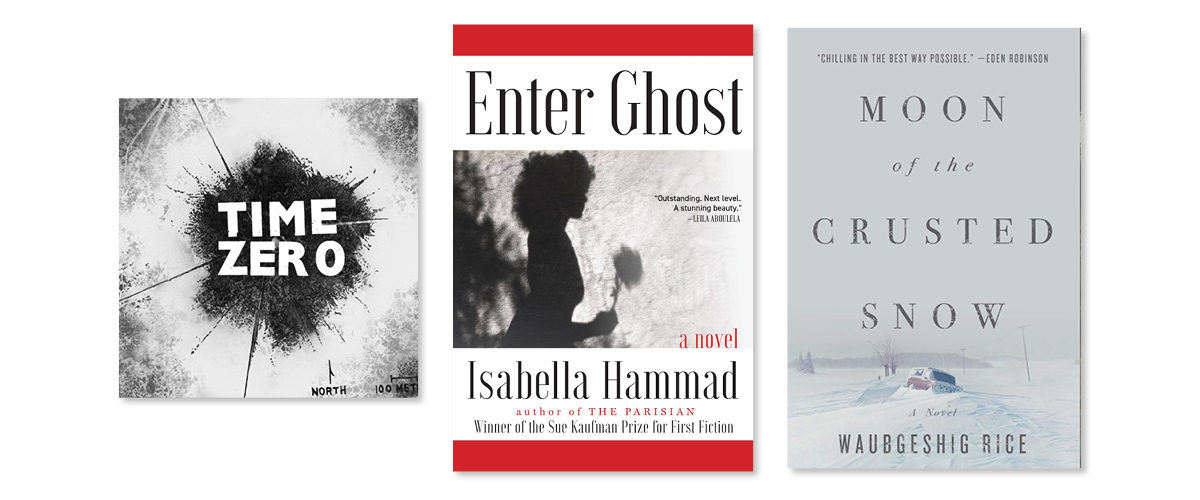
Time Zero
by Sean J Patrick Carney, podcast, 2025
A prodigious effort by author (and SWC contributor) Sean J Patrick Carney, Time Zero could easily be a book. Instead, it’s a podcast: an immersive, magnetic, and galvanizing one. Carney interweaves the voices of artists, activists, and authors on the frontlines of the anti-nuclear movement—like Mallery Quetawki and Shayla Blatchford—with a haunting soundtrack punctuated by field recordings, movie clips, video art, government PSAs, and other sources. The tone can be alarmist at times, but serves as a counter to the total and insidious normalization of nuclear technologies.
Enter Ghost
by Isabella Hammad, Grove Atlantic, 2023
Sonia Nasir returns to Palestine to take a break from her acting career in London, and finds herself, somewhat reluctantly, cast in a production of Hamlet to be staged in the West Bank. Grounded by Sonia’s personal story, the ensuing narrative delves into the ghosts of the past, political realities of the present, and the pursuit of art under occupation. Isabella Hammad’s vivid prose navigates nuance with a refreshing candor. I loved listening to the audiobook, narrated by Nadia Albina.
Moon of the Crusted Snow
by Waubgeshig Rice, ECW Press, 2018
When the apocalypse arrives at a tight-knit Anishinaabe community in the remote reaches of Canada, it’s just an inconvenience—at first. The internet goes out, then the phones, then the electricity. It’s when suspicious strangers start appearing from the south that the scale of the catastrophe starts to become clear. With a generous helping of Anishinaabemowin phrases and folklore, Waubgeshig Rice’s (Anishinaabe, Wasauksing First Nation) novel is a pragmatic portrayal of Indigenous ingenuity and an important reminder of the fragility of modern systems. I’m looking forward to digging into the sequel.
Blake Osmond, director of business development
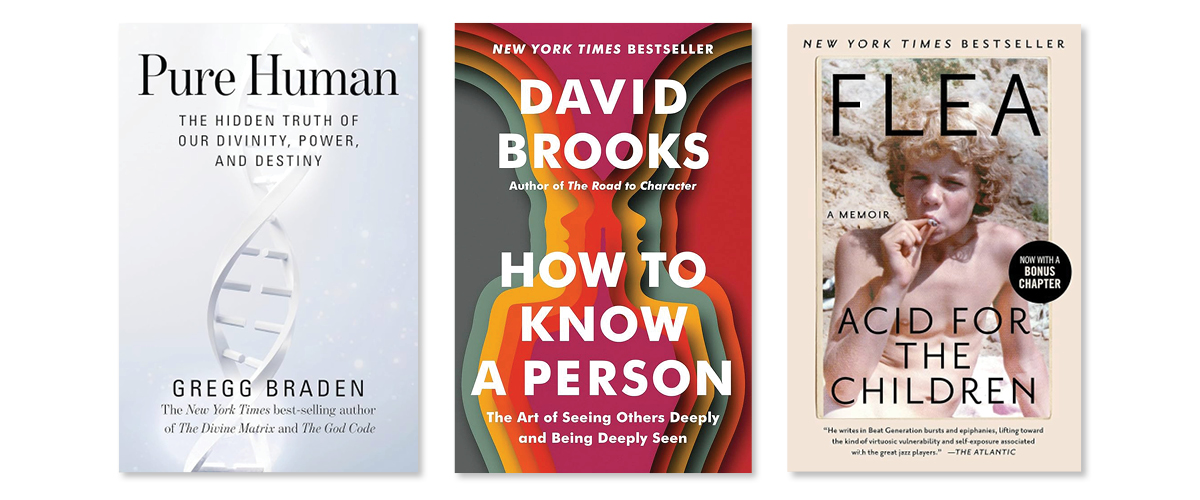
Pure Human
by Gregg Braden, Hay House, 2025
Pure Human raises a massive question: will computers eventually outpace or replace the unique and critical components of our humanness? Braden points out that within a single generation we could potentially devolve into a cyborgian species, embedded with computer chips that limit our ability to think and love. If we continue to travel down this path of a computer-run world, will we lose our capacity for emotion, empathy, intimacy, and forgiveness—core components that make our lives both beautiful and worthwhile, yet also tragic and painful? Pure Human directly confronts a tightly controlled, potentially romanticized AI world with bracing humanity.
How to Know a Person: The Art of Seeing Others and Being Deeply Seen
by David Brooks, Random House, 2023
I read this book back in February, and I cannot stop thinking about it. In daily interactions with other people, I find myself following its tenets by explicitly asking how I can make them feel valued, heard, and understood. At its core, the book offers an almost karmic solution for those of us who tend to feel awkward or uncomfortable around others. For this introvert, How to Know a Person has been invaluable to me in shaping how I approach others in hopes of building deeper, more meaningful connections.
Acid For The Children
by Flea, Grand Central Publishing, 2019
Flea of the Red Hot Chili Peppers is perhaps one of the most captivating, creative, dynamic, and influential electric bass players of the 20th century. In this raw memoir, he lets every thought land on the page. From childhood to adulthood, Sydney to New York, and New York to Los Angeles, the chapters are filled with adventure, humor, humility, passion, grit, and everything in between. The book’s most electrifying passage comes when Flea discovers music as his calling, unlocking his most authentic self.

Jen Turner, intern
Brightly Shining
by Ingvild H. Rishøi, Grove Atlantic, 2024
If you liked Claire Keegan’s Small Things Like These, I have hunch you’ll love this book. Ingvild Rishøi’s clear-cut prose about the family dynamics between two sisters and their dad will knock you down but bring you right back up. A perfect read for the holiday season.
The Great Mental Models Series
by Shane Parrish and Rhiannon Beaubian, Penguin Random House, 2024
In this frenzied AI landscape it’s probably good to have some solid concepts—Occam’s Razor, Second Order Thinking—stored on our human hard drives. Parrish and Beaubian’s four volumes range from General Thinking Concepts to Systems to Art and beyond. I’ll leave you with this: “The map is not the territory.”
With My Back To The World
by Victoria Chang, Farrar, Straus & Giroux, 2024
I didn’t think I could be a bigger fan of Agnes Martin’s work but then I read Victoria Chang’s poetry. The poems stand alone from Martin’s work and at the same time it feels like they are holding hands. And the illustrations Chang made to accompany each piece are equally evocative. Added bonus: the book also features poems based on On Kawara’s Today series.