Before a recent fall from grace, César Chávez was a rare Latino hero in public art. Now, arts leaders are asking how to de-center an icon without obscuring entire histories.
Artist Zarco Guerrero has vivid memories of meeting César Chávez (1927-1993) while attending Westwood High School in Mesa, Arizona, and immediately feeling a powerful connection to the labor leader, whose concept of art as service would become a driving force within Guerrero’s creative practice. “I decided to be in service to the movement,” the Mesa-based artist recalls of that life-changing moment in the late 1960s, during the heyday of the United Farm Workers union and the broader farm worker fight for civil rights.
“In high school we never had any positive role models, and everything in the media portrayed us as gangsters or pimps or drug dealers,” explains Guerrero, referencing his Chicano heritage. “César showed up on the scene—he was from Arizona, of Indigenous descent, and fluid in both Spanish and English. I thought ‘this is the kind of person we need to look at and we want to be.’”
This whole thing of him being exposed has broken our hearts. It calls into question what we should do now and what we should think.
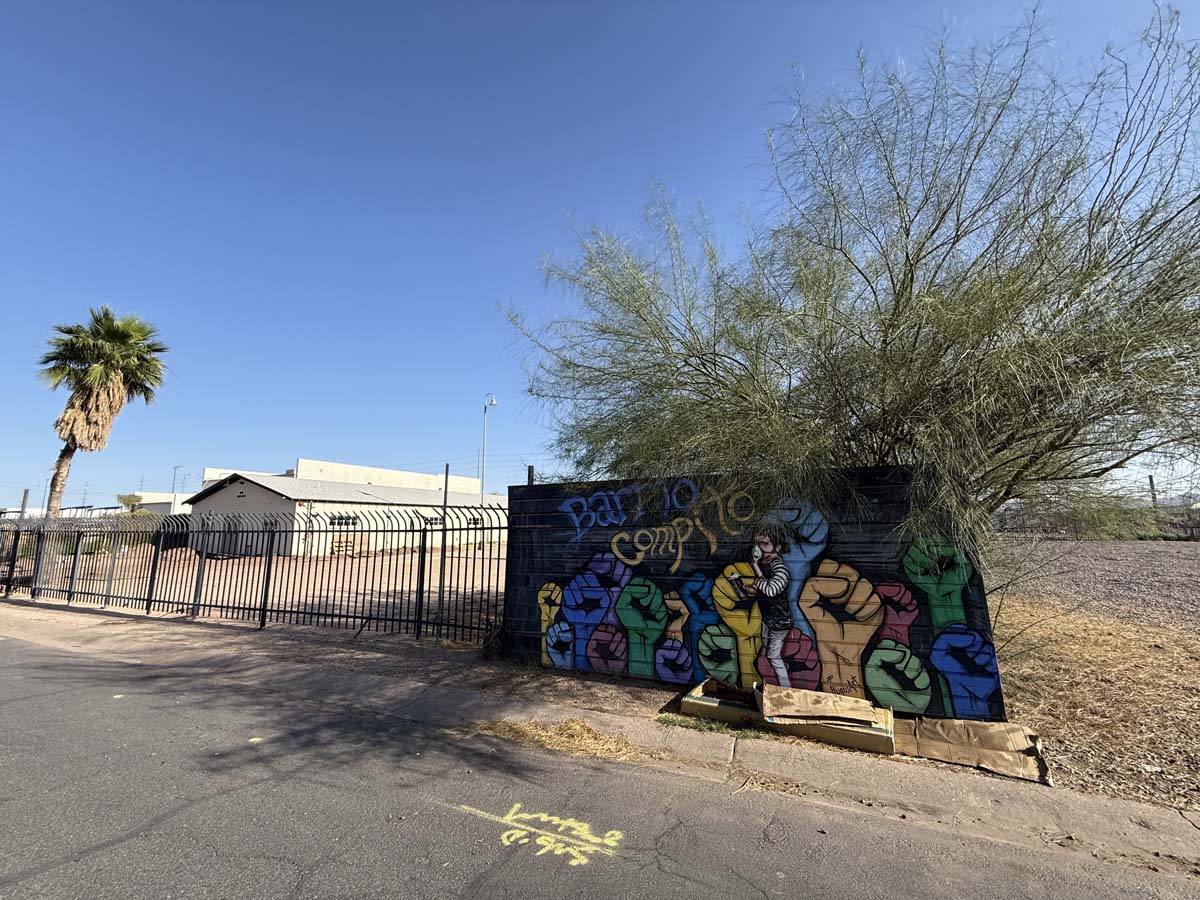
Several of his friends and the woman he’d go on to marry were active in the cause as well, inspired by Chávez’s call for social justice, nonviolence, and service to others. “I was there when they carried him out on a stretcher,” says Guerrero, recalling the day Chávez broke a twenty-four-day fast at Santa Rita Hall in Phoenix’s Barrio Campito.
Zarco and Carmen Guerrero went on to found Cultural Coalition, a grassroots group that’s still elevating ancestral knowledge and practices through artistic cultural preservation. At the time, they couldn’t have imagined that one of their heroes would be accused of sexual abuse, or foreseen that just one day after performing a tribute to Chávez, they’d learn of the New York Times article detailing a “pervasive pattern” of abuse involving at least a dozen women and girls, including Dolores Huerta, a co-founder with Chávez of United Farm Workers.
“This whole thing of him being exposed has broken our hearts,” Zarco says of the moment he and Carmen heard the allegations and saw the swift calls on social media to erase Chávez’s legacy. “It calls into question what we should do now and what we should think.” Zarco is closely following the national controversy over what should become of murals and other artworks depicting Chávez because one of his own sculptures, an eight-foot-tall likeness of Chávez, anchors a plaza in a Phoenix park.
Artists and communities across the Southwest and beyond have been questioning the way forward for artworks that depict or draw inspiration from César Chávez’s life and work, even as Chicano, Hispanic, and Latino community members face both historical and contemporary manifestations of creative and cultural erasure—from censorship to ICE roundups.
The news about Chávez hit hard, and swift action followed. Statues got covered or removed. Mural imagery was changed or painted over. But there’s a palpable tension between the impulse to remove references to Chávez and the drive to center the efforts of so many others in the civic spaces where Latino/a/x monuments are already scarce. Conversations about cultural representation are ongoing, and the decision-making process is still unfolding for many public artworks in the region.
Chávez is one of the only consistent icons that many Latinos have had to look up to their entire lives.
“What we’re seeing now throughout the Southwest is grappling with the hard truth of what’s next,” says Sehila Mota Casper, executive director of Latinos in Heritage Conservation, a nonprofit founded in 2014 that focuses on “the preservation of Latinx places, stories, and cultural heritage in the United States.”
“Chávez is one of the only consistent icons that many Latinos have had to look up to their entire lives,” Casper explains. “We all can see a piece of our history in the farm workers movement, and the iconography for the movement became César Chávez’s face.”
Casper notes that many of the people who knew or marched with Chávez, including artists, are still alive.
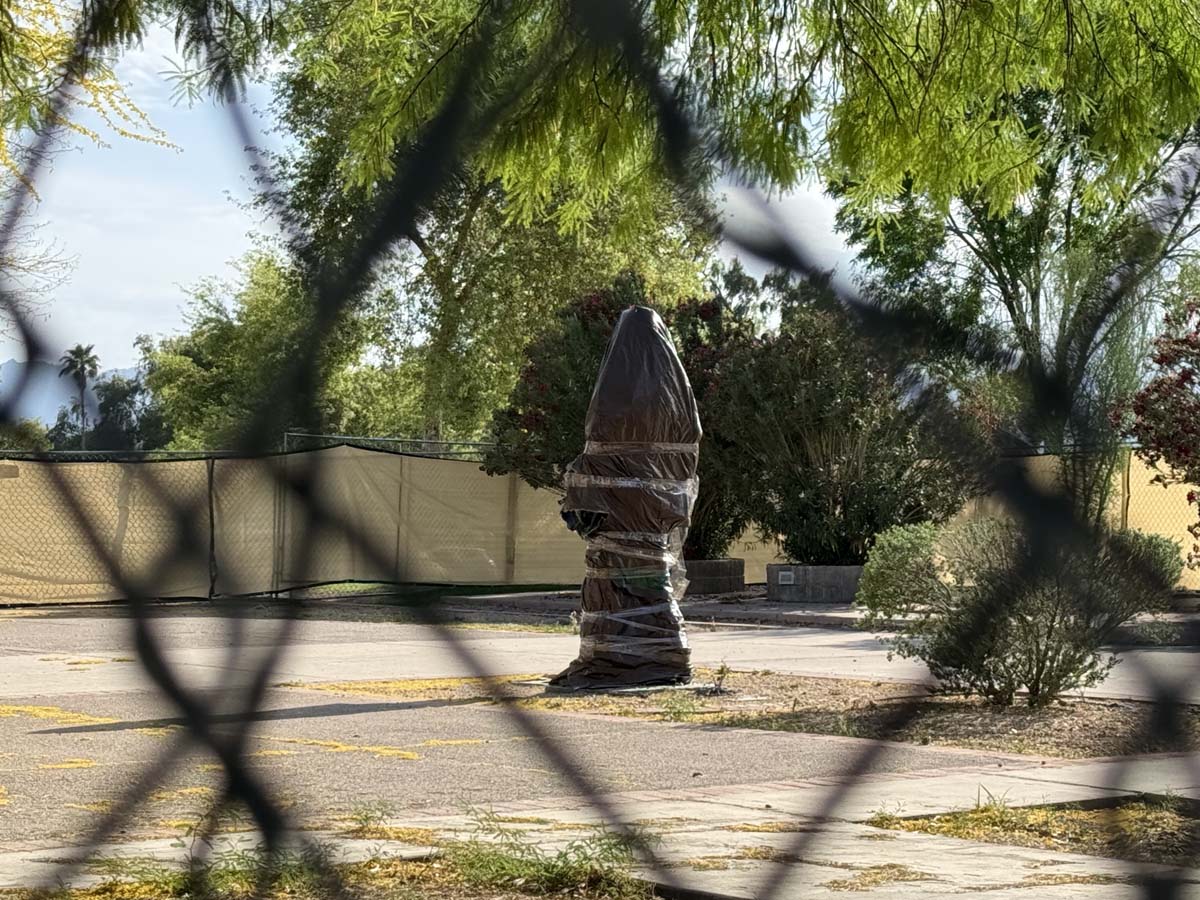
Public artworks bearing his likeness, such as a bronze and marble sculpture by Colorado-based artist Emanuel Martinez, stand throughout the Southwest. In the aftermath of the allegations, the city of Denver had Martinez’s bust of Chávez removed from a public park. In Phoenix, Zarco Guerrero’s Chávez sculpture surrounded by four low-relief sculptures by Martín Moreno was covered and fenced in at the artist’s request to discourage vandalism as the city weighs the artwork’s fate. At this point, the City of Phoenix Arts and Culture Commission is recommending that Guerrero’s sculpture be replaced by a new work that would be conceived with community input, but the commission notes that it could be two years before that new artwork is installed. Early concepts Guerrero has considered include creating a male and female farm worker standing side by side, holding the implements of their trade.
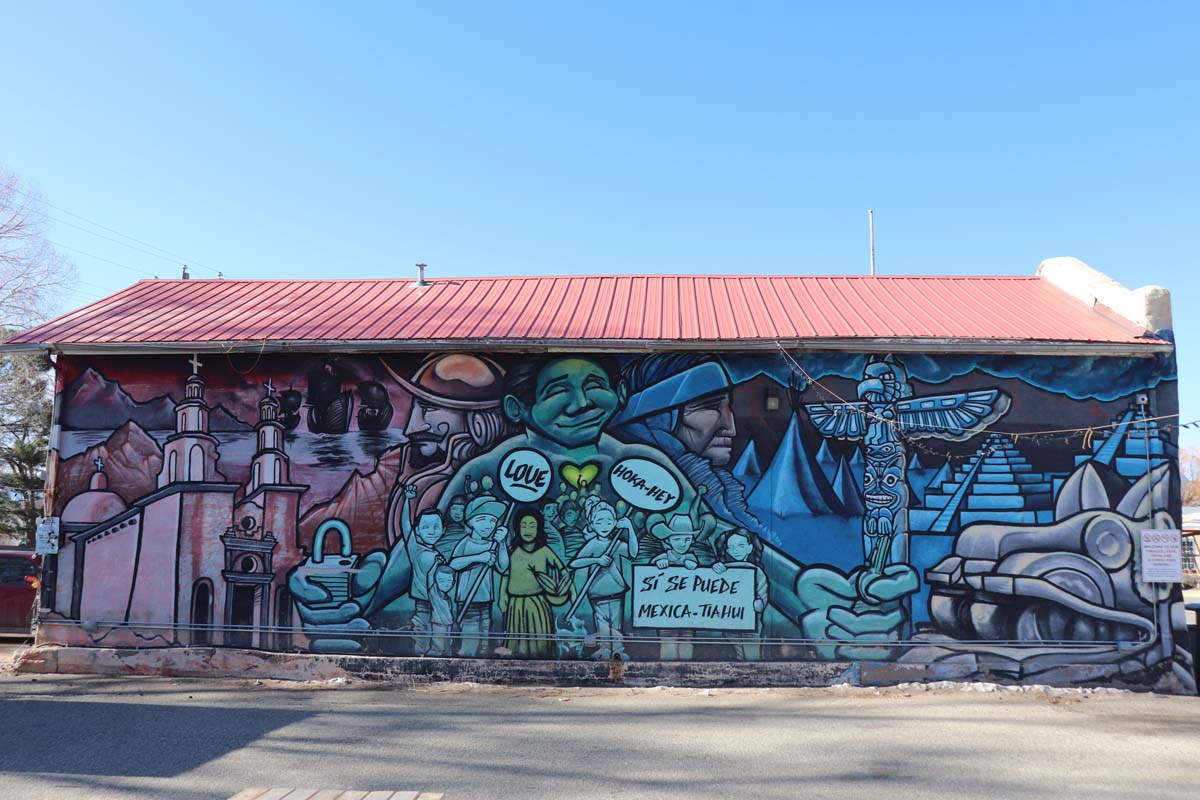
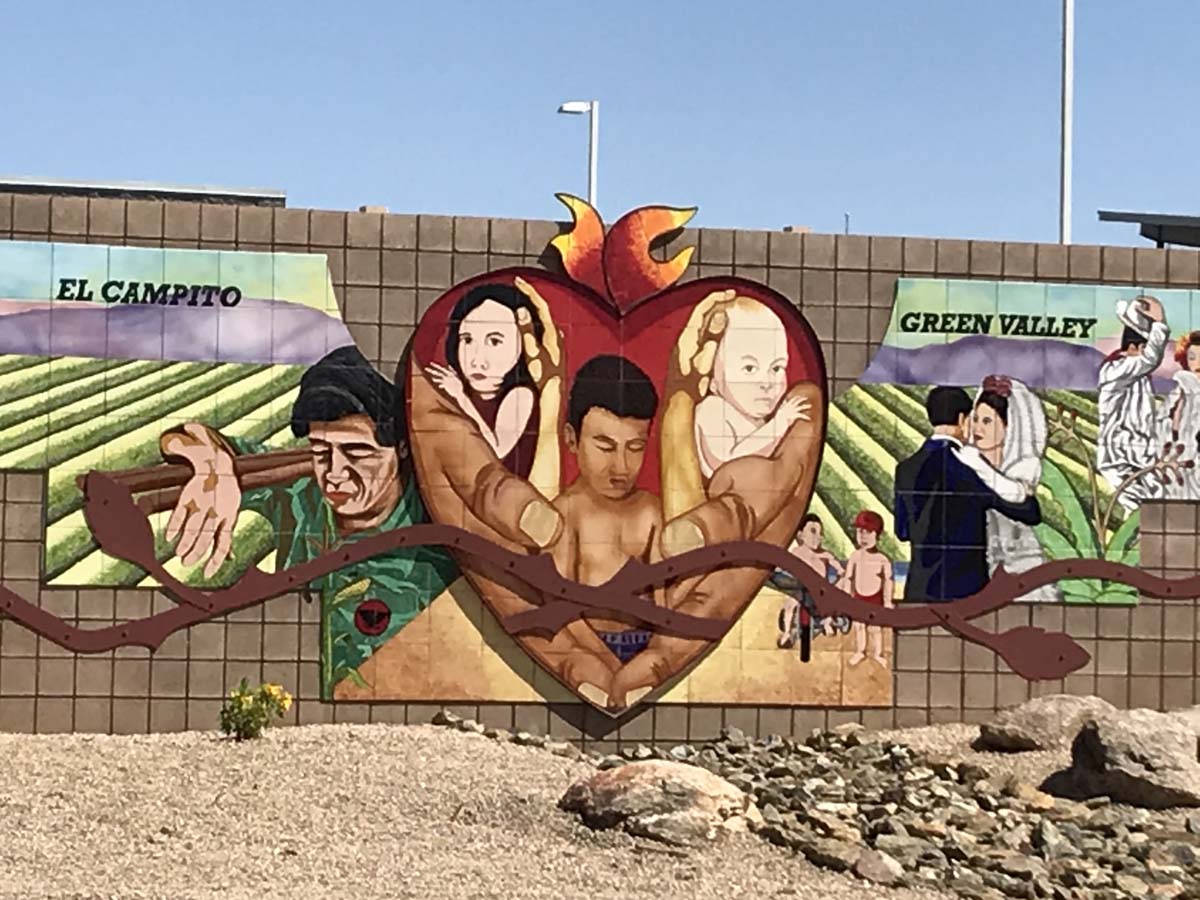
Meanwhile, murals bearing Chávez’s image are prevalent in the region, including several created in historic barrios. Casper says, “The way that Latinos express ourselves, murals and artworks are critical and have been at the forefront of all of the humanities since Aztec, Mayan, and Pre-Columbian times, and so murals carry down so much tradition for us.”
“Especially for Latinos, [murals are] a very informal way of documenting our history, of documenting our identity and experiences,” she adds. Thus, LHC is advocating for community-led conversations about how these murals are treated. At the same time, they’re supporting other mural restoration efforts, including the Chicano/a Murals of Colorado project that’s working with local communities on several artworks in Southern Colorado and New Mexico, including Jodie Herrera’s Dolores Huerta, painted in Albuquerque in 2017.
Some communities may choose to paint over a single section of a mural, for example, while others could decide to replace existing murals with new ones that reflect the community’s contemporary identity, Casper says.
In Denver’s Westwood neighborhood, artists who painted over a mural of Chávez at a local restaurant have been working with the community to conceive a new mural design that’s scheduled to be painted on Cinco de Mayo. In downtown Phoenix, artist José Andrés Girón says he plans to leave the Chávez and Huerta portion of the Arizona Latino Arts and Cultural Center’s lengthy exterior mural highlighting numerous Latinos in place because “you can’t erase history.”
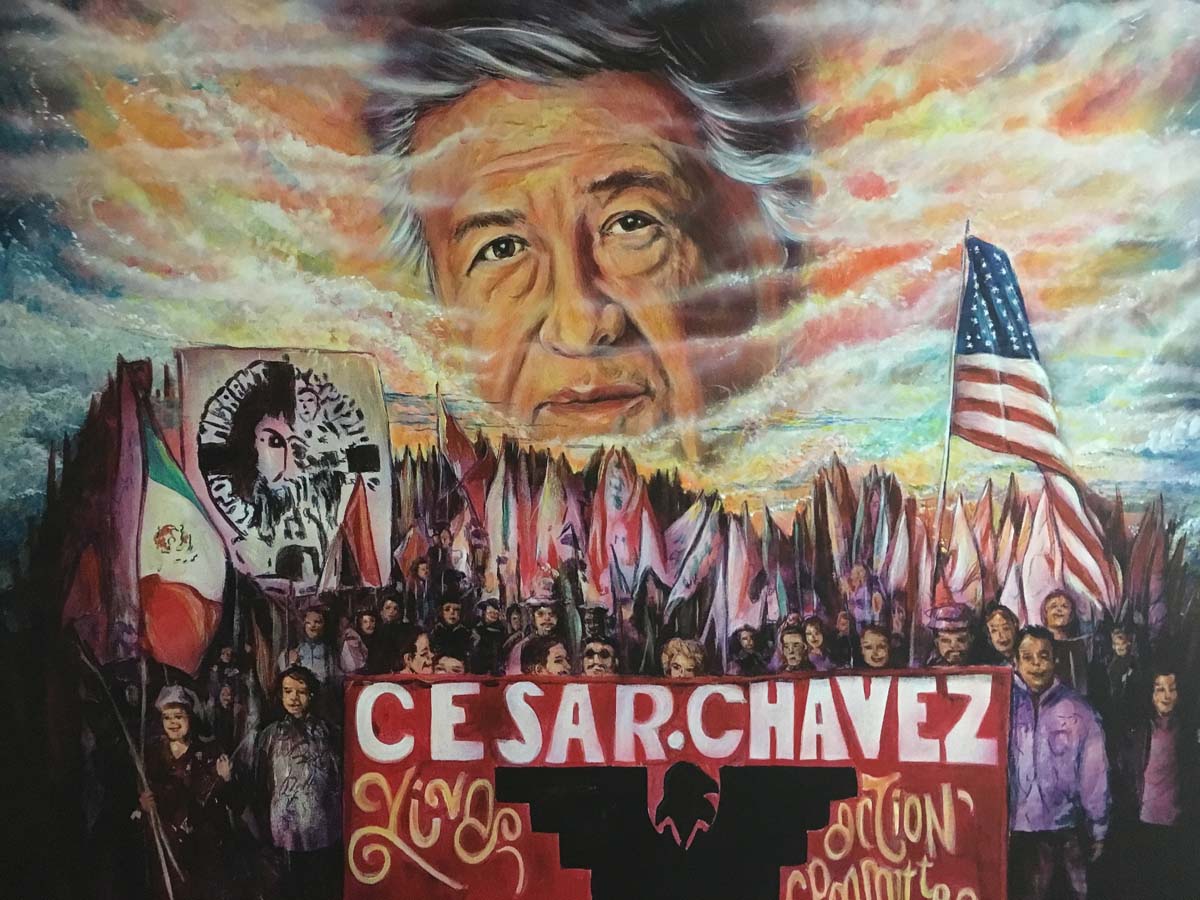
Either way, the process can take time. And it’s taking place within the context of attempts to erase Latino culture both present and past.
Statistics from Latinos in Heritage Conservation’s Latinx Preservation Toolkit released in 2025 underscore the magnitude of the problem. “Latinxs make up nearly one-in-five people in the U.S.” yet “less than 1% of sites listed in the National Register of Historic Places represent Latinx history,” according to that report.
My biggest concern in this whole situation has been the knee-jerk reaction that has happened. The decisions have to be led by Latinos.
One of many LHC initiatives aimed at countering that erasure was the release of its inaugural national list of endangered Latinx landmarks in 2025, which drew attention to thirteen places that “carry the weight of resilience, community, and survival.” A mural on that list included an image of Chávez, making it one of many artworks that will be part of these conversations moving forward.
“My biggest concern in this whole situation has been the knee-jerk reaction that has happened,” says Casper, who lives in Texas. Unlike California and other states that changed the March 31 holiday originally called César Chávez Day to Farmworkers Day, Texas Governor Greg Abbott decided to nix the holiday altogether.
That’s exactly the type of action Casper wants to head off in the future. “The decisions have to be led by Latinos. It’s our history and it’s our artwork.”
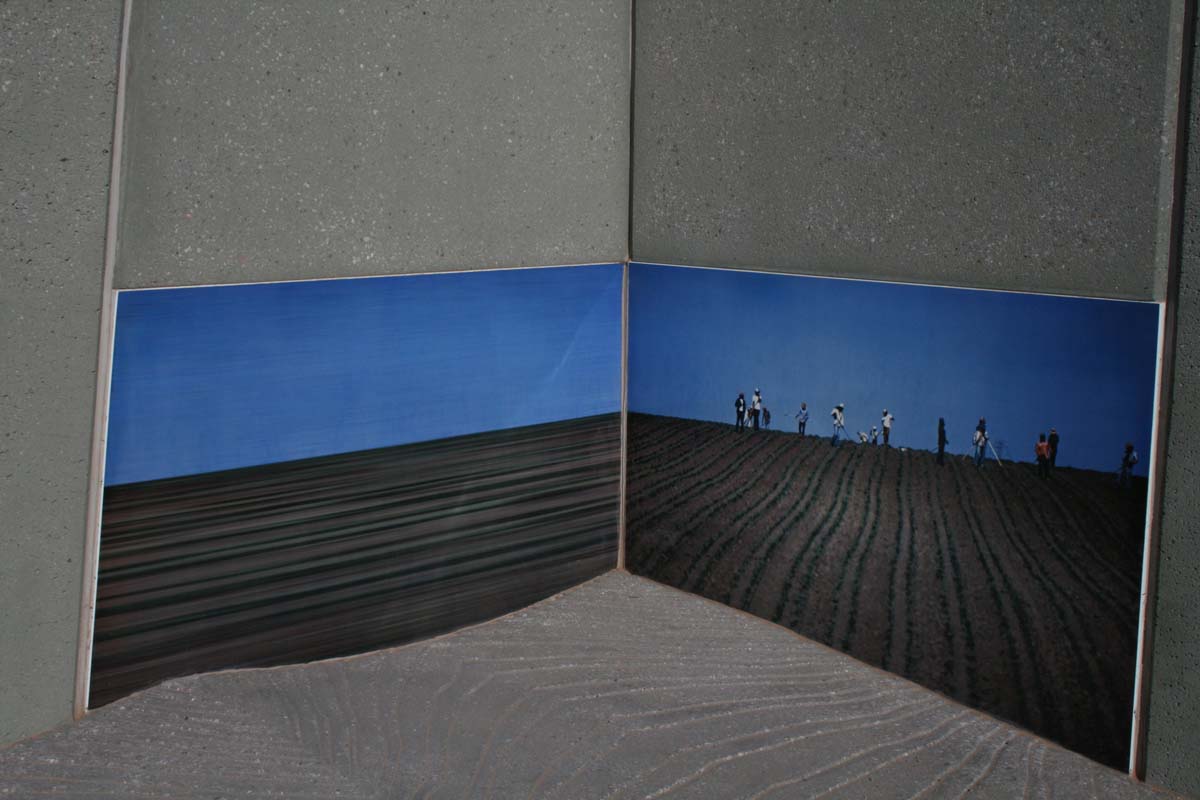
Paula Castillo, a New Mexico–based artist who was commissioned by the City of Albuquerque to create a 2009 tribute to Chávez notes that her installation was always designed to honor farm workers. Rather than including Chávez’s image, she incorporated imagery of farm workers in the field, the United Farm Workers stylized eagle, and the phrase sí se puede, as well as the Virgin of Guadalupe figure that’s a cultural, social, and political touchstone for Latino communities.
“After I did research into César Chávez, it was the people themselves that moved me the most,” she recalls of conceiving her design. “It’s really a tribute to the gente who inspired that movement,” Castillo says of her piece.
It’s so sad to see something so meaningful in my community become so painful. [It’s] almost like a cannibalistic trauma.
Looking back on the dedication ceremony, Castillo recalls that “there was pushback from people who didn’t want Albuquerque to be seen as a Chicano space and expression.” She recalls having a similar experience during time spent in Denver, saying “there are people who made Denver who’ve never been acknowledged.”
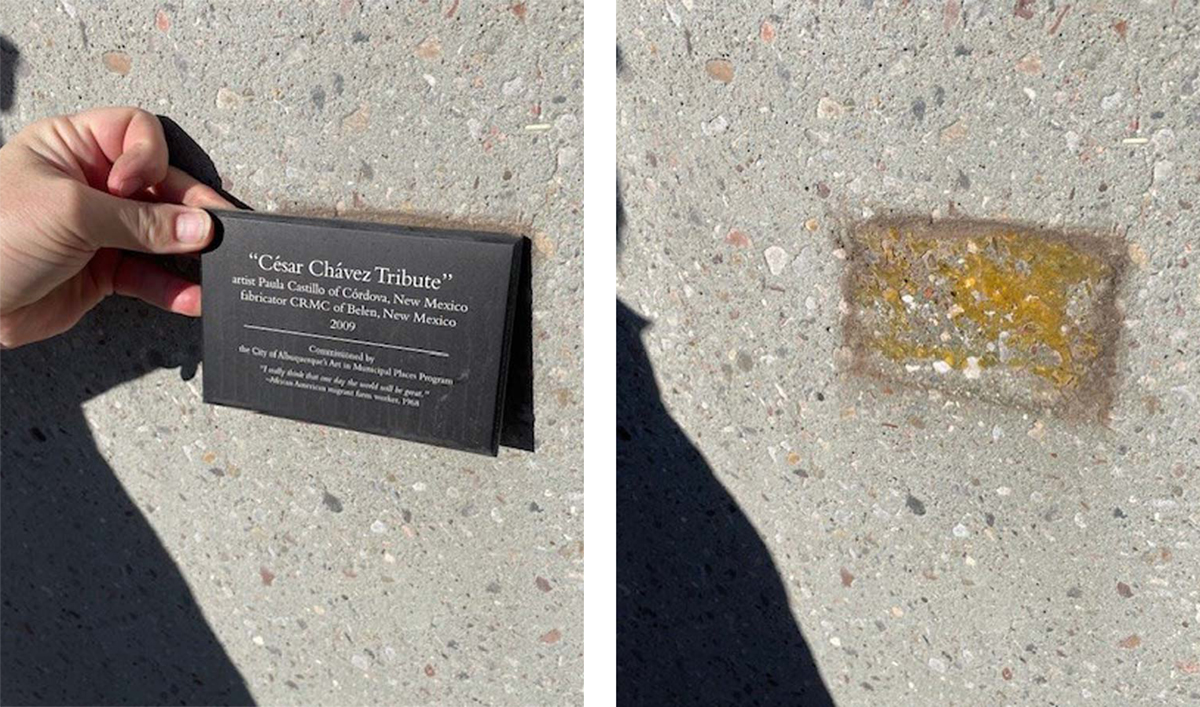
Over the years, the portion of her L-shaped concrete installation featuring seven pillars bearing seven Guadalupe figures has become “a place of community shrine making,” according to Castillo, who says it’s one of many reasons she’s glad that the installation will remain in place. The only modification, made by the city at her request, has been replacing a small bronze plate to reflect the change in the artwork’s title from César Chávez Tribute to To Farmworkers and Their Labor.
“It’s so sad to see something so meaningful in my community become so painful. There’s trauma in that movement, almost like a cannibalistic trauma,” Castillo says of the recent allegations and their impact. “I’m thinking about all the people whose children and grandchildren are named César, including a little six-year-old I talked to recently.”
At the same time, she’s mindful of the intersection between the recent allegations and wider historical and contemporary contexts. “It’s painful to juxtapose that trauma with the recent challenges that this community continues to face in the larger American community, including in Minneapolis and LA over the winter,” reflects Castillo. “This administration led with the idea that they’re ancillary to the development of our communities, when they’re so integral to the development of the Southwest,” referring to actions of the federal government.
Likewise, Guerrero predicts that some politicians will use the allegations against Chávez to further anti-immigrant policies and foment fear of people with brown skin, an expectation informed by his own protests against Arizona’s controversial SB 1070, the “show me your papers” law passed in 2010 but largely gutted since then. “I see this whole process as a way to disempower and humiliate us, which is exactly what we need to be fighting against.”
We recognize that this very single-person commemoration was detrimental to the movement… it was a really big lesson learned.
Moving forward, it’s too soon to know which artworks will be modified, removed, retitled, or otherwise changed. Nonetheless, it’s clear that the allegations against Chávez have shifted some fundamental assumptions.
“We’re just beginning to face this harsh reality, a history that we didn’t even know was there, a history that just automatically switched in a day for us, and we’re grappling with that,” says Latinx preservation advocate Casper.
For Casper, the allegations against Chávez have served as a cautionary tale. “We recognize that this very single-person commemoration was detrimental to the movement, and for me as a historian, as a preservationist, it was a really big lesson learned.” She adds, “We are advocating for everything to continue to recognize the farm workers movement and to recognize all of those thousands of individuals.”
“Let’s pause and let [the] community speak and let them lead where we go from here,” urges Casper. “The biggest thing I would say is that this has to be community led.”