The “largest art installation in the world” covers the land in Texas once shared by bison, Comanche, and their horses. As a memorial, it represents but does little to repair.
One Sunday morning in Seminole, Texas, a pickup truck pulled up beside me in the empty parking lot of the Gaines County Museum. A man in a cowboy hat with the air of a small-town sheriff rolled down his window and called out to me: “Everything alright, ma’am?”
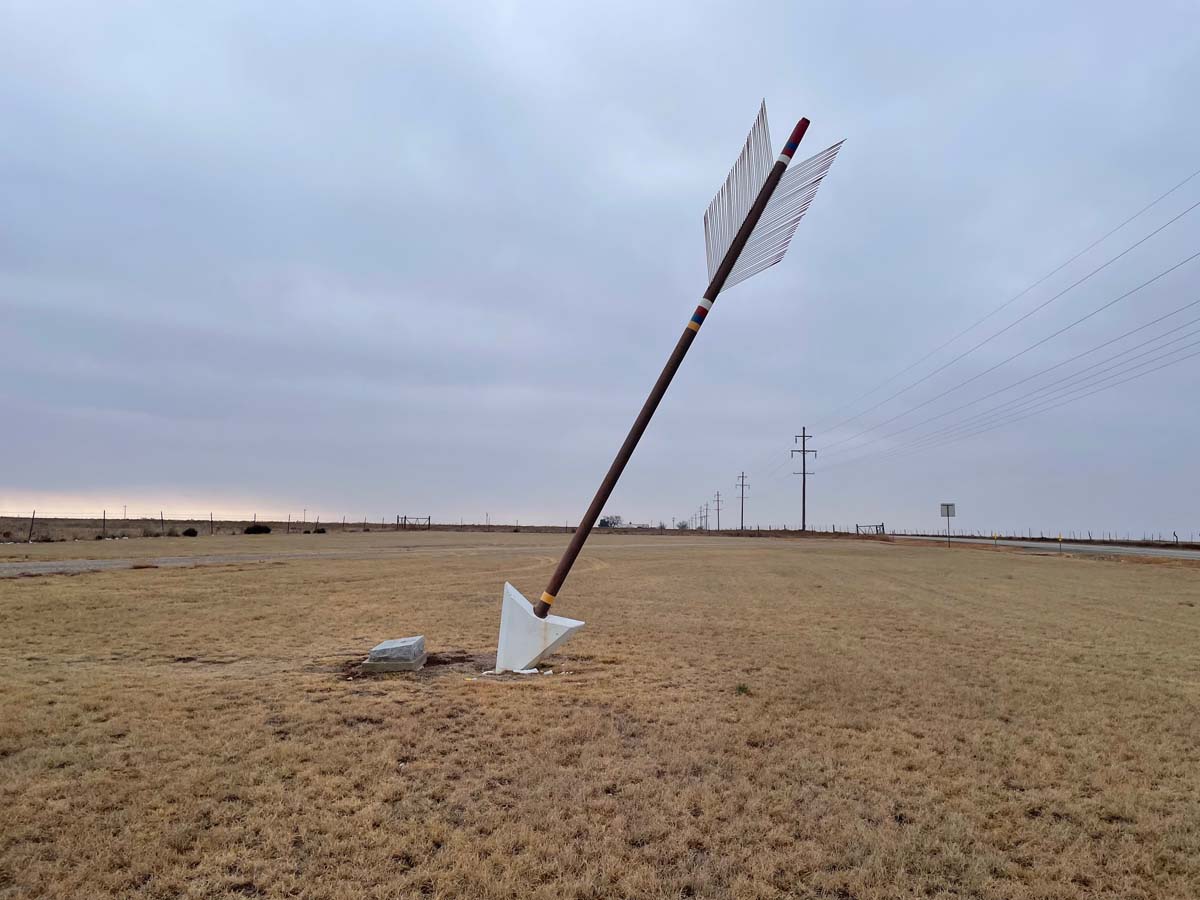
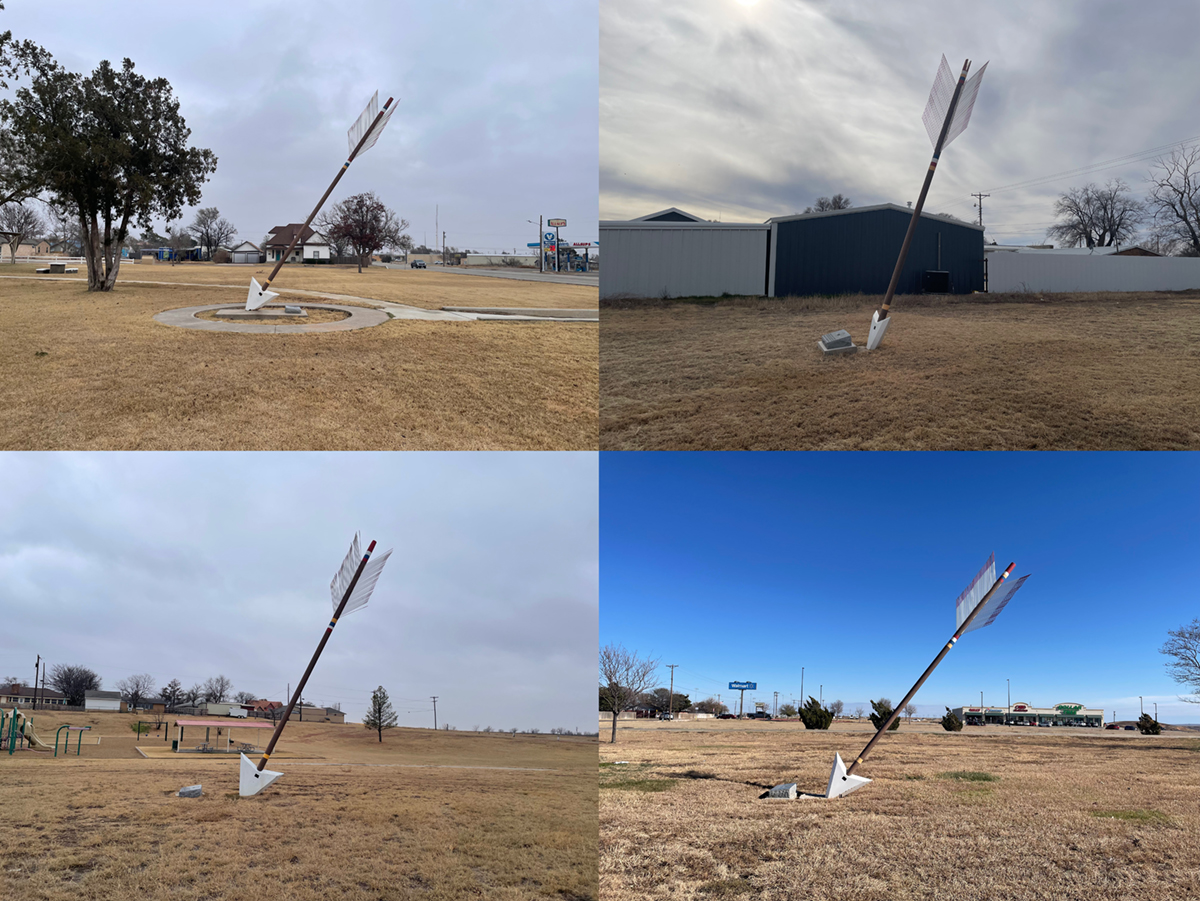
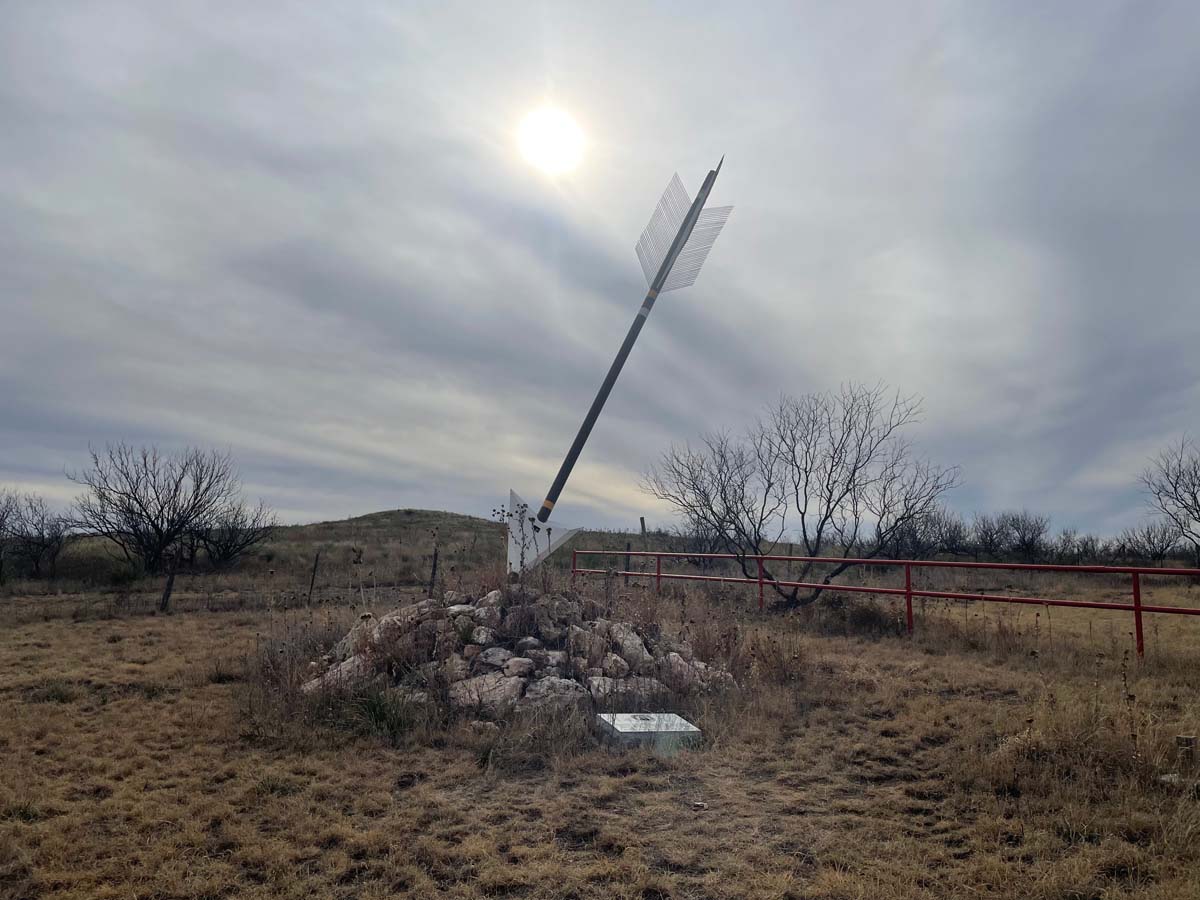
I had my phone out and was snapping a photo of the public artwork at the front of the parking lot: a twenty-two-foot-tall arrow emerging diagonally from the ground, a marker dedicated to the memory and legacy of Quanah Parker, the “last” Comanche chief. I glanced around at the quiet street, the closed museum, and my old car parked by the arrow—I must have looked like a stranded motorist. A much more likely scenario than someone pulling to the side of the road to take a picture of one of the arrows on the Quanah Parker Trail. After all, it’s hardly unique. There are more than eighty identical arrows, spread across fifty-two counties of the Texas Panhandle, indicating the historic range of the Comanche before the tribe was forced onto reservations in Oklahoma in 1875.
“I’m fine, thanks!” I called out.
The arrows were all created by Charles A. Smith, a cotton gin operator, sculptor, and resident of New Home, Texas, a one-horse town surrounded by cotton fields dotted with McMansions. Between 2011 and 2016, at the behest of the Texas Historical Commission, Smith crafted and installed the arrows across the region in what has been described as “the largest art installation in the world.” Smith passed away in 2018.
The arrows pierce a landscape that bears little resemblance to the world of Comanchería, where bison roamed and bands of Comanche ranged across the near-featureless plain and extensive canyon systems. Now, Ford F-150s go screaming down country roads and the land is parceled up Jeffersonian grid–style, dominated by monoculture, oil drills, and ranches roped off by miles of barbed wire.
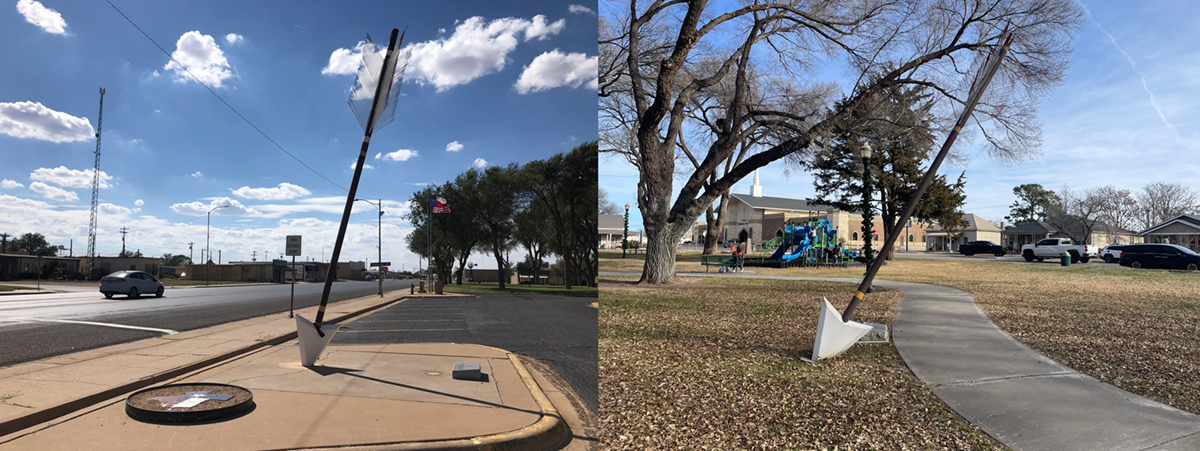
One finds the arrows in city parks, at historical museums, chambers of commerce, and on roadsides. A few are located on private land, marking significant places in Parker’s life.
The story of Quanah Parker has uniquely captured the imagination of many Texans, symbolizing the tipping point between two different worlds (or as Comanche author Paul Chaat Smith poses the question, “patriot or sellout?”).
At the National Ranching Heritage Center in Lubbock, Texas, the exhibition The Last Chief, the First Statesman (2025-28) summarizes this duality of Parker’s life, how he negotiated between the Indigenous world and the encroach of American settler colonization. To ensure the survival of the Comanche, the exhibition didactics emphasize, Parker surrendered and led his people onto the reservation—adopting settler farming and ranching while maintaining Indigenous cultural and religious practices. The exhibition stops short of calling the efforts to starve and displace the Comanche a genocide, but it absolutely was. Outside the NRHC, there’s an arrow.
The story of Quanah Parker has uniquely captured the imagination of many Texans, symbolizing the tipping point between two different worlds.
Another arrow is located in Lubbock, in MacKenzie Park, whose namesake, Ranald MacKenzie, notoriously ordered his troops to capture and murder the Comanche’s horses, over a thousand of them—an act of unimaginable cruelty against their kin still mourned to this day.
The Quanah Parker Trail arrows point—to the land and to history—where there had been no markers before. They strike me as the art equivalent of a land acknowledgment, a public work befitting the optimistic Obama era of truth and reconciliation. They represent but do little to repair.
Even so, I find it hard to imagine something like this, on this scale and so widely accepted, finding traction today. In a moment of erasure, visibility does matter. But they also point to the need to do the more complex work—to acknowledge harm and loss, and move toward restoration and reparation to the people as well as to the land.
Near Tule Canyon, where the massacre of horses took place, there’s a historical marker, and an arrow. There was broken glass at the base of it.