How can art plumb the depths of an aquifer? Abby Flanagan’s exhibition design in To Move Through Stone activates the peripheries to visualize the intangible flows of an ecological system.
Abby Flanagan: To Move Through Stone
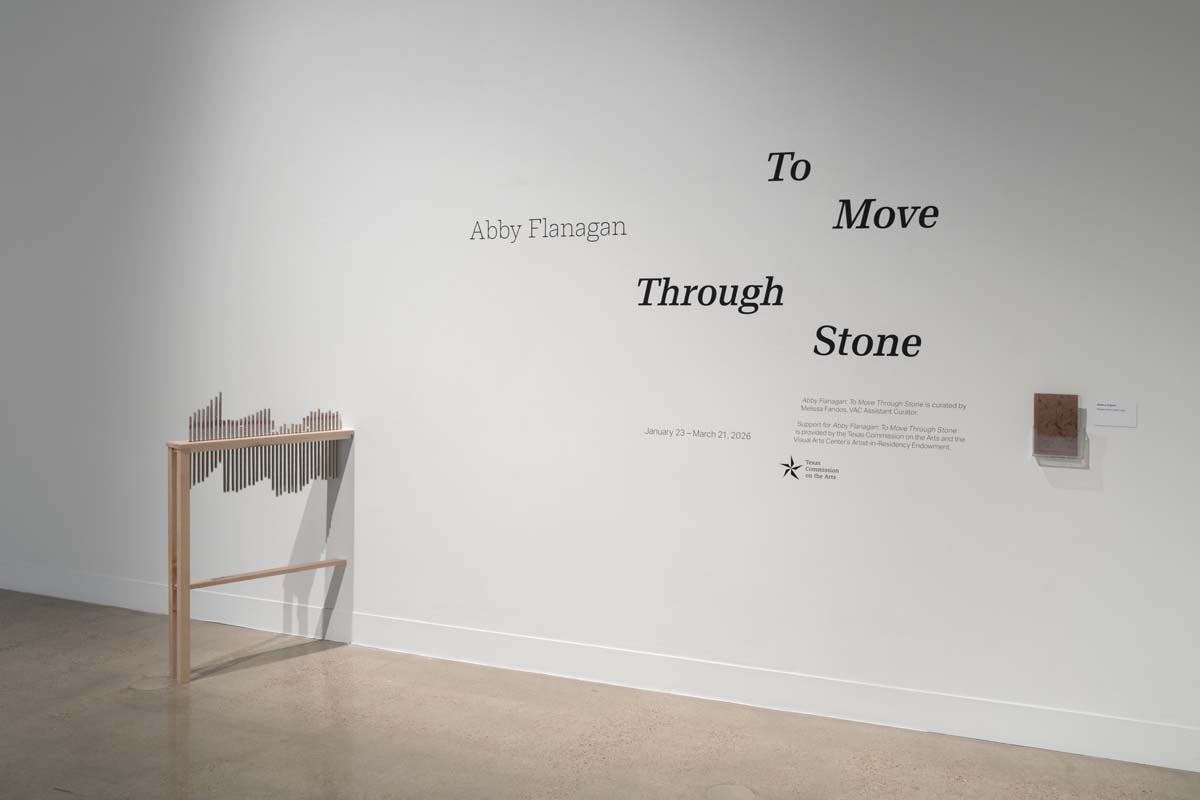
January 23 – March 21, 2026
Visual Arts Center, Austin
The gallery is relatively empty, or that’s how it seems at first. Then, after a minute or two of stillness, I slowly notice that feeling that I associate with being outside and staring off into space. It’s the feeling of my eyeballs uncentering their focus on the obvious, and recentering on the minuscule, the peripheral, the contingent. It’s the type of vision that happens after I stare at grass for long enough to notice a stream of ants entering and exiting an opening in the ground; after I stare at some overgrown trees long enough to notice that there are squirrels talking to one another.
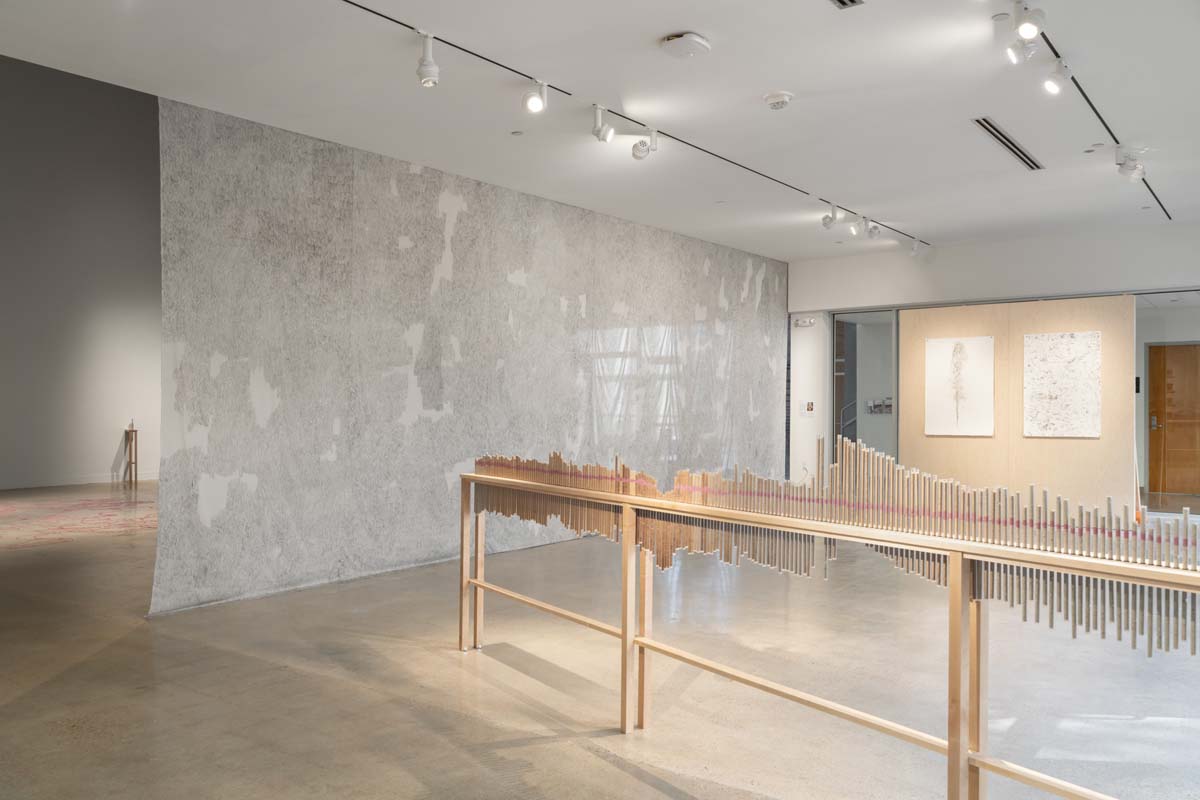
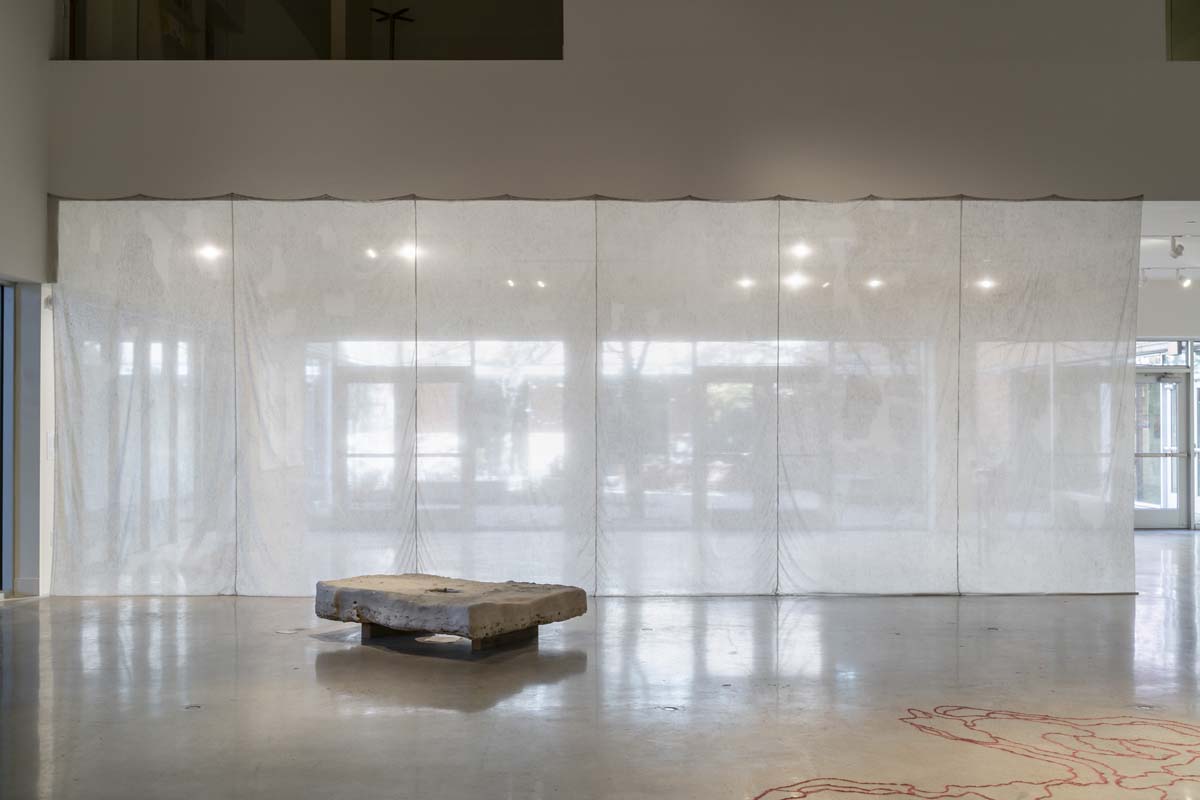
Abby Flanagan’s solo exhibition, To Move Through Stone, uncenters vision. It features gaps, long distances, iterations, and hidden parts. In that way, it is not only an exhibition about the Edwards Aquifer, it is an exhibition shaped like Edwards Aquifer.
The Edwards Aquifer is a naturally occurring limestone reservoir in South-Central Texas. As an invaluable spiritual site for Indigenous people and as the primary source of drinking water for millions of Texans, its conservation is critical. Contamination, drought, and the overwhelming use of concrete pavement threatens the Aquifer, its water, and the endangered aquatic creatures who live in it.
The Edwards Aquifer is not a tank of water underground, but geological maps of the region will often depict it as one. Such depictions may abide by the quick visualization our attention spans demand, but they run the risk of oversimplifying the Aquifer, its histories, and its vulnerabilities. This super porous rock and its complex network of connected orifices and tiny caverns exist without regard for human comprehension. Driving down Austin’s Loop 1 highway, I see signs that read “ENTERING EDWARDS AQUIFER RECHARGE AREA.” And this is one of the only ways to visualize the Aquifer—in parts: a sign on the highway, a hole in the ground, an exhibition. It’s difficult to regulate and protect that which we don’t have the capacity to see in full, which is to say that any understanding of the Aquifer necessitates using the imagination.
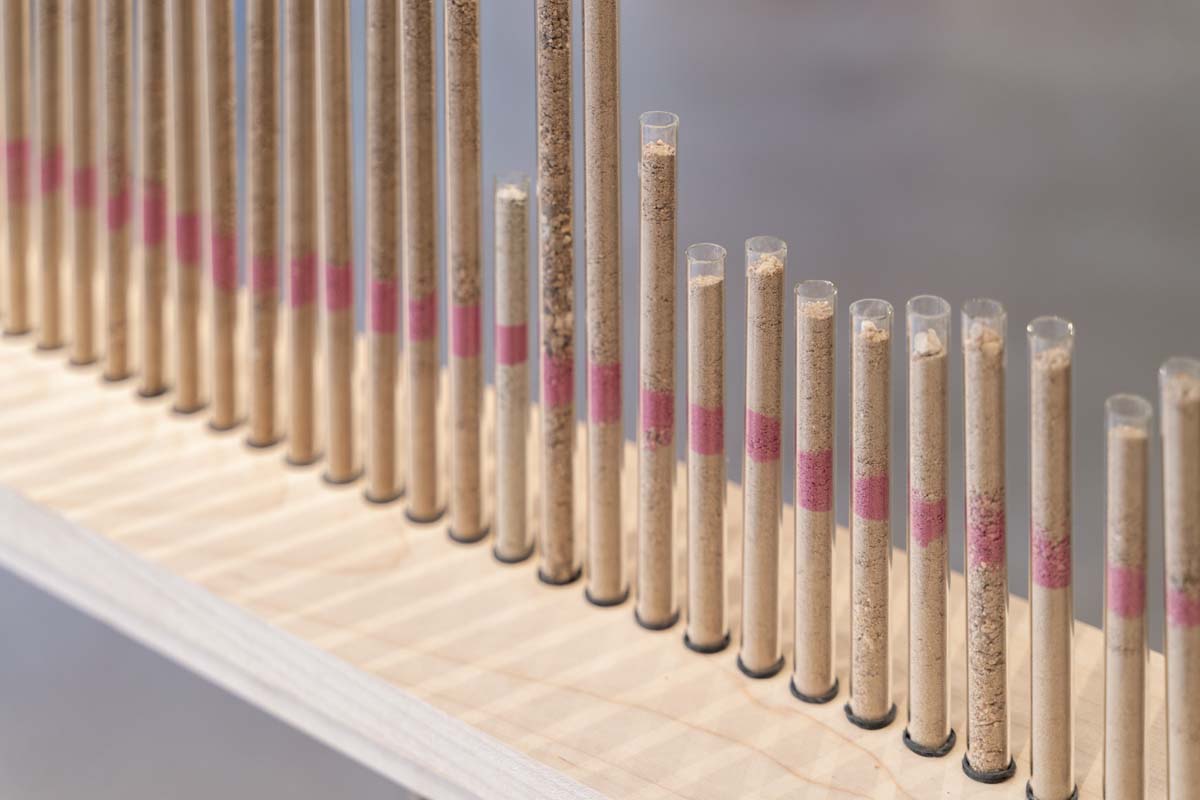
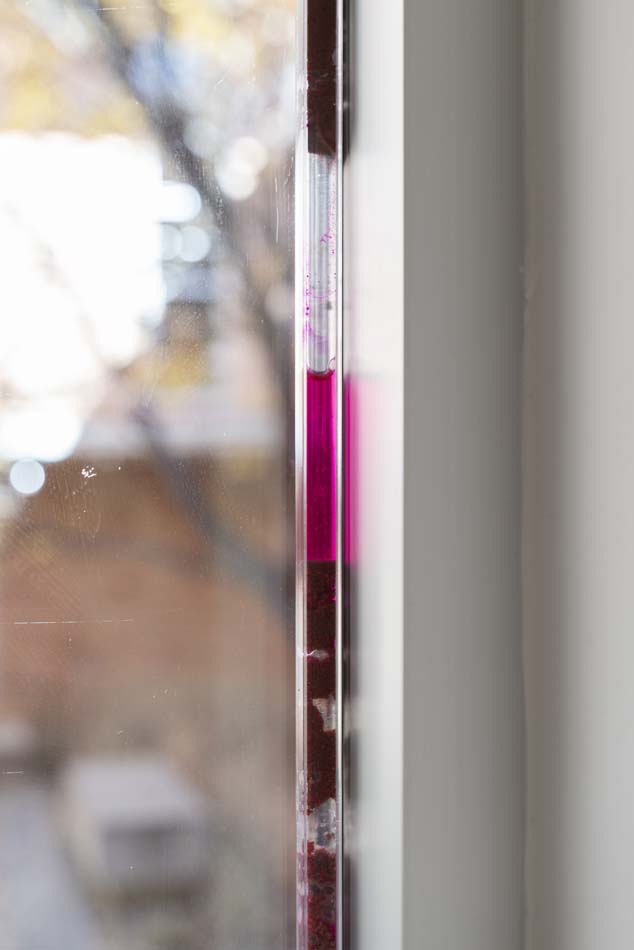
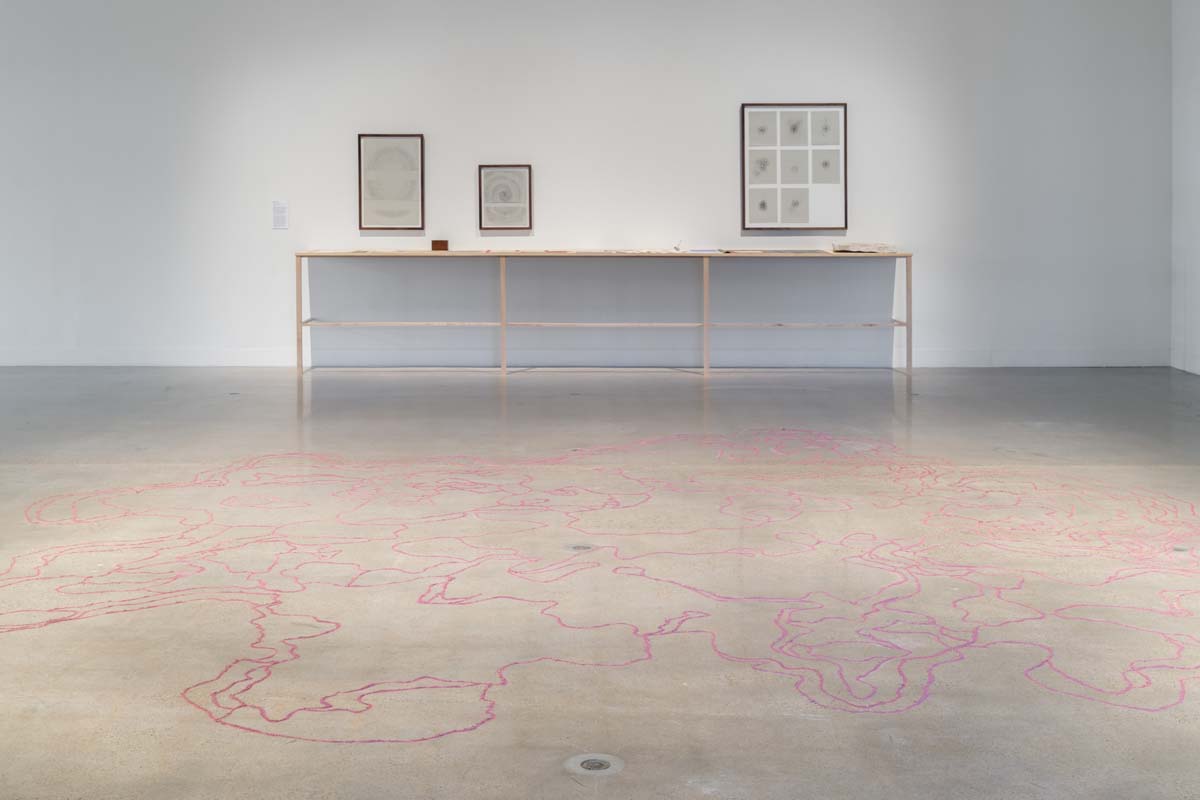
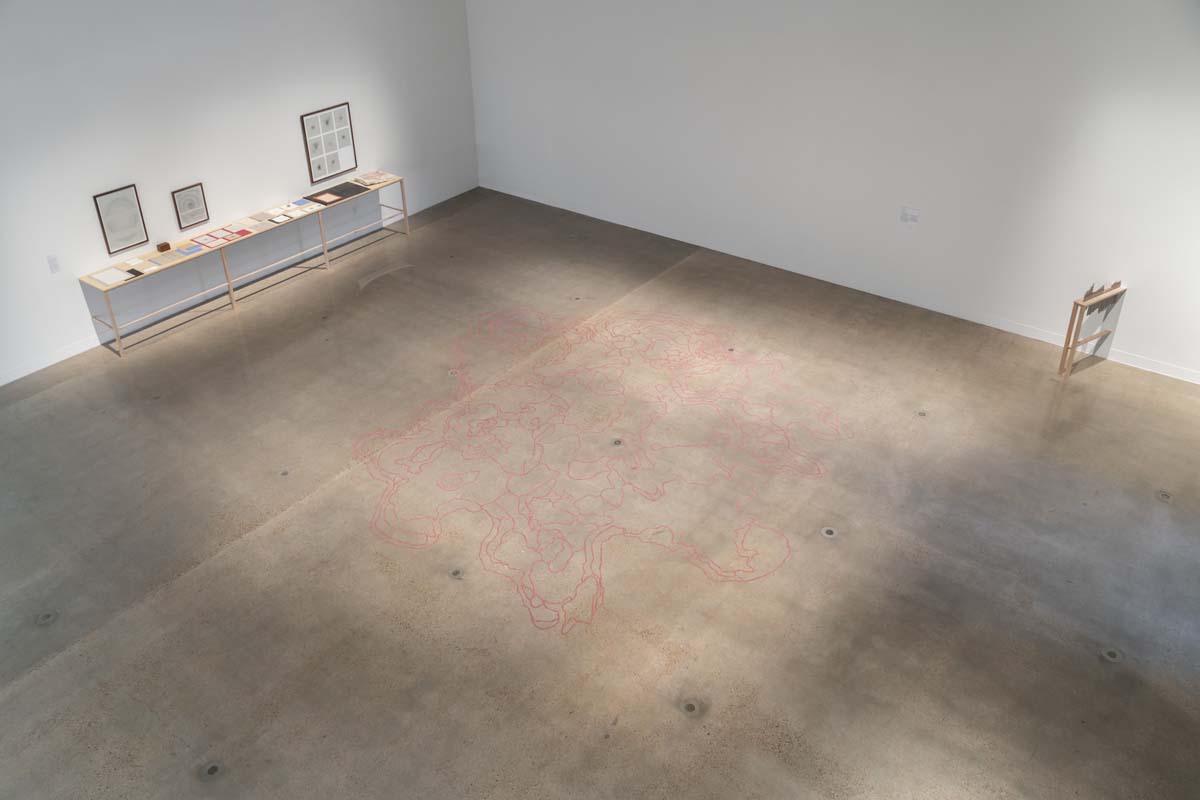
The hydrogeologists who study the Aquifer experience the same problem of visualization, and they have developed interesting tools to work through it. They use a hot pink liquid called rhodamine dye, which Flanagan repurposes all throughout the works in the exhibition. Hydrogeologists use it to measure the distance between cause and effect, pouring it into one area of an aquifer’s waters and locating it down the line. In tract (aquifer) (2026), plastic polycarbonate tubes filled with the liquid dye and clusters of dye-soaked sediment sit pressure-fitted into the upper window frames of the gallery. The color is a simple machine of attention. It calls the eye to not only the window itself, but to the latent existence of the viewer’s periphery. When work is installed in this way, the entire exhibition’s perimeter is called into question.
It calibrates the viewer’s senses to tolerate the inconclusive more than it teaches the viewer a lesson about the environment.
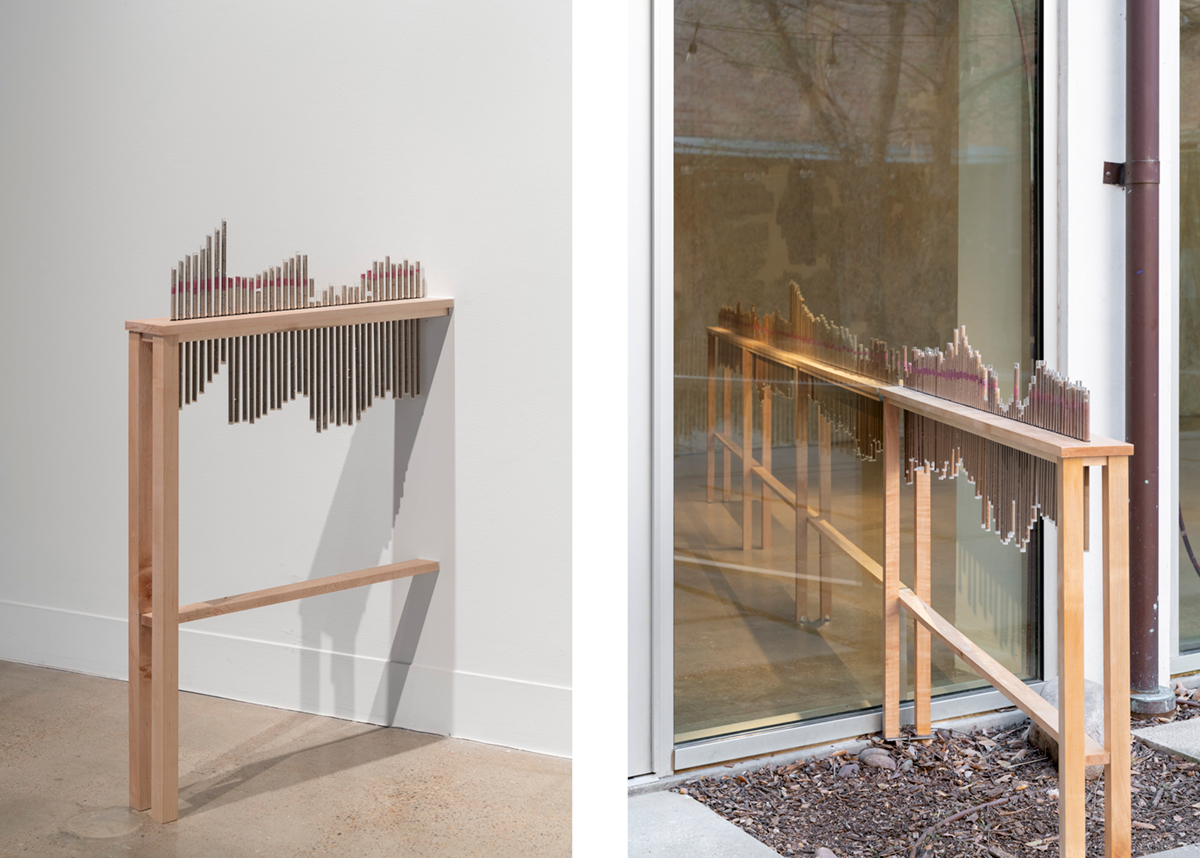
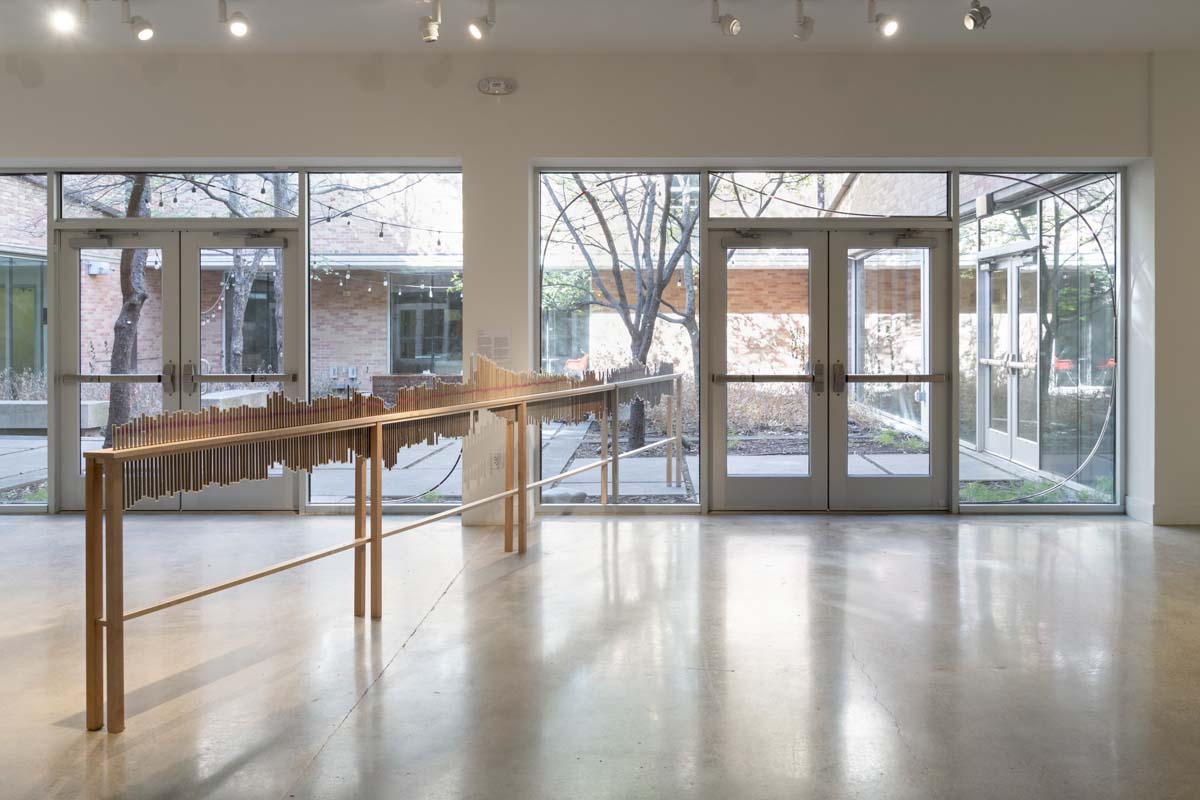
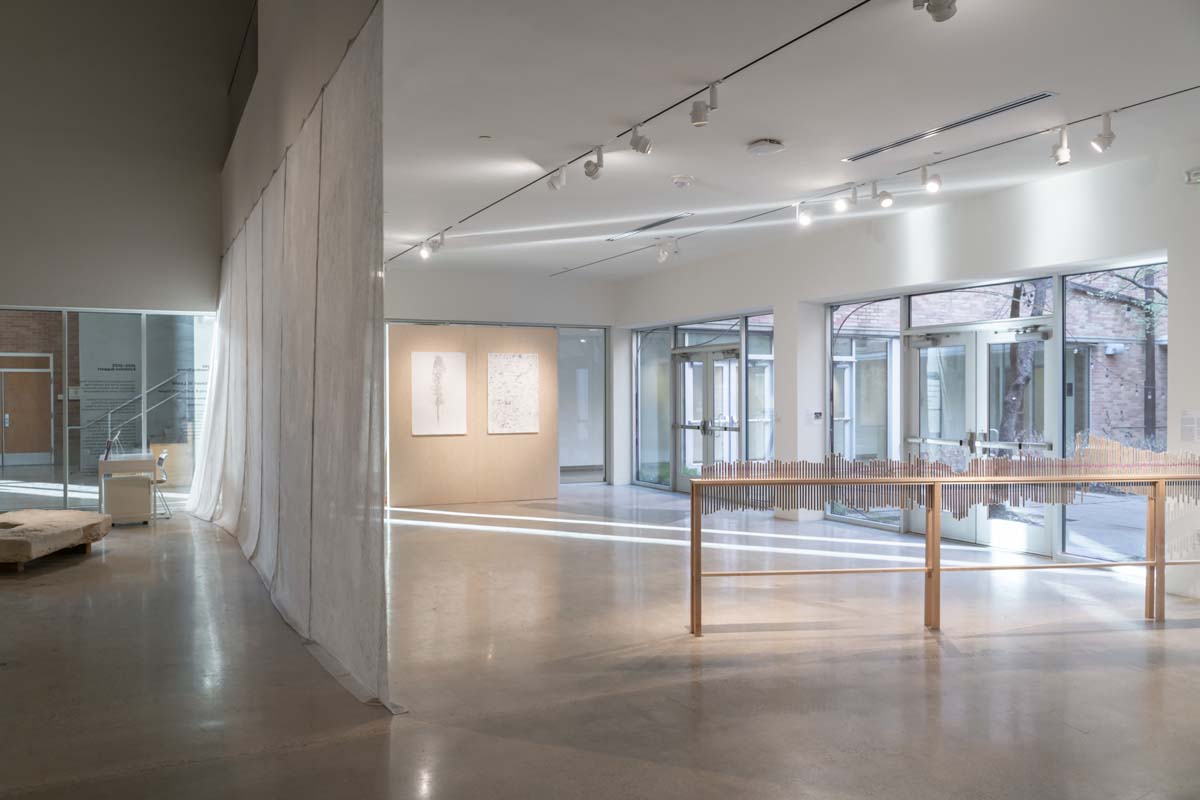
The piece titled rain score (2025), shares this logic. This work is a long, skinny wooden table that holds a single-file row of evenly spaced tubes of sediment. While, according to the wall label, “the height of each tube loosely corresponds to daily water-flow measurements taken at Barton Springs in 2025 and graphed by the United States Geological Survey,” the painstaking effort towards data visualization is not the most interesting part of the work. The table of test-tube-like forms bisects the gallery’s window, spanning inside and outside space at an angle that seems local not to the gallery or even the building itself, but to some other preexisting cardinal direction. Subtly, and for no explicitly described reason, the same table appears to pop out of the wall all the way across the gallery, about thirty feet away, near the entry. As a sculpture, the two sections of table appear to be one table that’s managed to pierce through the exhibition space, prompting the viewer to remember across distances, to remember what came just before.
While Flanagan’s use of earthen materials recalls the landscapes at the heart of her research, it’s really the exhibition design and placement of the works in the space that makes this exhibition truly ecological. To Move Through Stone embodies the Aquifer’s stubborn lack, rather than depicting the Aquifer in full. It calibrates the viewer’s senses to tolerate the inconclusive more than it teaches the viewer a lesson about the environment. One does not need to literally depict plant and animal life to be creating ecological work. Instead, as in Flanagan’s case, exhibitions can attune our senses to the ecological insofar as they work with the existing interconnections between the artwork, the viewer, and the space itself.