Our call for pitches for “The Road” was regurgitated back to us by AI writers around the world. We almost fell for one of them.
Since ChatGPT broke through in 2022, we’d been waiting for this moment. Last fall, we sent out a call for pitches and were stunned not only by the number of responses—over a hundred—but also by the breadth. Somehow our call had circled the globe.
A disconcerting number of responses were from writers we’d never worked with before, and who apparently used AI to write pitches that sounded like something we’d accept. Many of these writers’ voices obviously seemed “off,” but a submitter named Victoria Goldiee was different. She had bylines in prominent publications and one of her pitches referenced real artists and projects we were interested in covering.
At a pitch review meeting, we were getting ready to plot Goldiee’s story onto the editorial calendar. But right before we placed it, Lauren Tresp, our publisher, Googled the writer’s name.
“Oh no,” she said.
Goldiee was a fabulously successful—and recently outed—AI scammer.
Early in the process of reviewing pitches for Southwest Contemporary Volume 13, themed “The Road,” it became apparent that something strange was going on. A few days after the call went out, I got an email from a writer based in Lahore, Pakistan. He had three pitches for me, all road-related but dealing with emerging artists in Asia.
I politely informed him that we only accept pitches that have to do with the Southwest United States and Northern Mexico, and thanked him for his interest.
About a day later, he wrote me back with yet another pitch: “Mirrors of Sand: Desert Art Between the American Southwest and South Asia.” Still too far afield, I replied.
The next day, yet another: “Dust and Grace: The Poetics of Decay in New Mexico’s Art and Landscape.” In this pitch, the Lahore-based writer claimed that: “Through visits to Taos, Santa Fe, and the Chihuahuan Desert, the essay will combine art criticism, environmental reflection, and field observations to pose the question: How does art endure in a place where everything is meant to fade beautifully?”
How else would you come up with language so evocative, and yet so meaningless?
Field observations? Did he think we could offer a stipend for jet setting across the globe?
The pitch also didn’t include any mention of specific artists or artworks, just: “adobe sculptors, desert photographers, and site-specific installations that dissolve under the sun.”
I searched “site-specific installations that dissolve under the sun New Mexico.” No results.
At that point, I just let it go—it was clearly someone using AI to generate pitches. How else would you come up with language so evocative, and yet so meaningless?

The next week, I was traveling and missed one of our pitch review meetings. When I came back, the editorial team brightly informed me they had reviewed a good number of pitches and a few of them looked really promising, but also suspicious. I read through the ones from new freelancers.
“These are all AI,” I announced.
“I knew it!” Lauren said.
Looking closer, they had all the hallmark “tells” of AI writing, em dashes and “not this, but this” sentence construction. There were weird echoes between them, too. The pitches all seemed rather—spectral. The Road was turning out to be downright haunted. Some examples of pitches we received:
Asphalt and Afterimage: Artists Mapping the Ghost Roads of the Southwest explores how contemporary artists in the region are interrogating the legacy of roads, not as romantic open highways, but as palimpsest [sic] of colonization, commerce, and memory.
Ghost Roads: Mapping Disappearance and Memory in the Desert Southwest will explore how contemporary Indigenous and Latinx artists are reimagining forgotten or abandoned highways as living archives—spaces that carry traces of erased communities, migration routes, and vanished histories.
Ghost Roads: Mapping Memory, Loss, and Movement in the Desert Southwest… would examine the ways in which artists in New Mexico and Arizona are redefining the very concept of the road, not as something that gives them freedom, but as a palimpsest of erasure, migration, and resistance.
It seemed that AI is obsessed with “ghost roads.” (And “palimpsests,” apparently.)

AI’s proclivity for ghosts is well documented. The New York Times recently noted their preponderance in AI-generated stories: “In machine-written fiction, everything is spectral. Everything is a shadow, or a memory, or a whisper.”
But the disembodied hand of the AI industry is more than a “whisper woven from the algorithm,” it directly affects the material world. The Guardian recently reported on “ghost workers” in rural India, training AI algorithms to recognize violent and abusive content. There are reports of AI data centers in the U.S. supplanting suburban neighborhoods and driving people out, creating “AI ghost towns.” Data centers that AI relies on to function are disrupting small-town economies and ecologies all over the country. This is particularly concerning in Southwest desert communities where water is scarce, which environmental justice organizers recently called “sacrifice zones” in a “techno-fascist takeover” in the Albuquerque Journal.
Upon further consideration, the network of “ghost roads” running through the editorial inbox seemed suspicious but maybe unsurprising. Large language models are getting better at regurgitating topical information, after all. With 2026 marking the centennial of Route 66—a road famously fragmented in its physical form but looming large in the imagination—perhaps that accounted for the pitches’ supernatural spin.
“In this piece, the road is both muse and scar,” read one, where Route 66 became “cracked asphalt veins through desert scrub.”
Upon further consideration, the network of “ghost roads” running through the editorial inbox seemed suspicious but maybe unsurprising.
Another promised to reflect on “how Route 66 continues to shape identity and memory […] how the same road can carry both loss and hope.” This pitch, from a writer in Lagos, Nigeria, according to her Facebook page, described an aesthetic that seemed entirely drawn from the mid-century affect of generic Route 66 photos: “I’ll weave together visual textures from the landscape, the warm rust of old cars, the neon glow at dusk, and the desert wind with reflections on what it means to belong to a place defined by motion.”
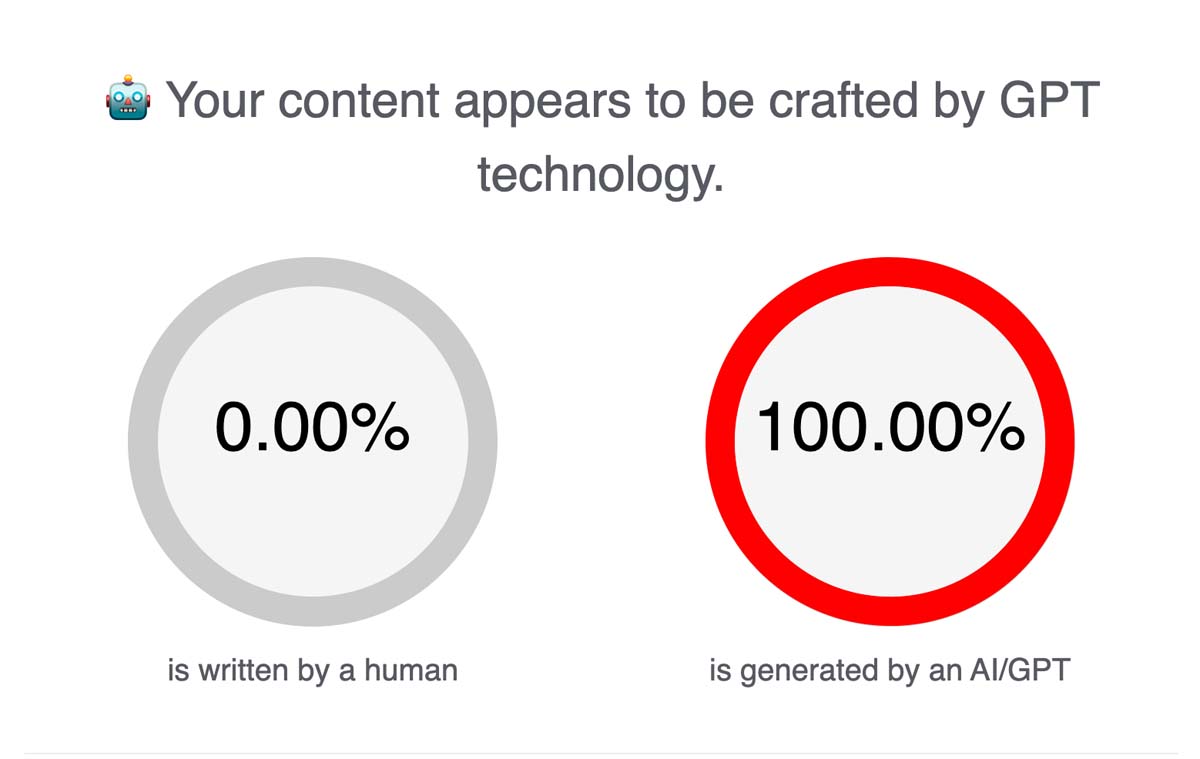
An online AI checker (which uses AI to detect AI) guessed that her pitch was “100% generated by AI.”
I figure that AI-generated pitches accounted for around 20% of the total pitches we received.
It was titled “Borderlines of Desire: The Aesthetic Politics of Movement and Surveillance,” and proposed “a cultural criticism piece that dismantles the myth of the American open road, a cinematic trope of freedom that has collapsed under the weight of racialized surveillance and militarized borders.”
The pitch identified “a vital movement of border artists,” name-checking a bona fide artist, Tanya Aguiñiga, who indeed creates “visceral performances” around the border wall, as well as “the forensic activism of groups like Armadillos Ni Un Migrante Menos,” a genuine humanitarian network.
It declared, “This story is critically urgent now, as the border is increasingly militarized with ‘smart’ technology and billions in contracts for companies like Elbit Systems, creating a less visible but more pervasive ecosystem of control that extends hundreds of miles inland.”
This wasn’t vague gesturing toward the aesthetics of asphalt and the metaphorical potency of roads—it pointed to real information, pegged to a real geopolitical crisis, with the real actors named, not just hinted at.
At the time, we had already commissioned everything for the print issue, but were still looking at pitches for accompanying web content. We were pretty wary after wasting so much time on the AI-generated pitches the previous week, but this one seemed legit.
But right before reaching out, Lauren ran a quick internet search of the writer’s name: Victoria Goldiee.
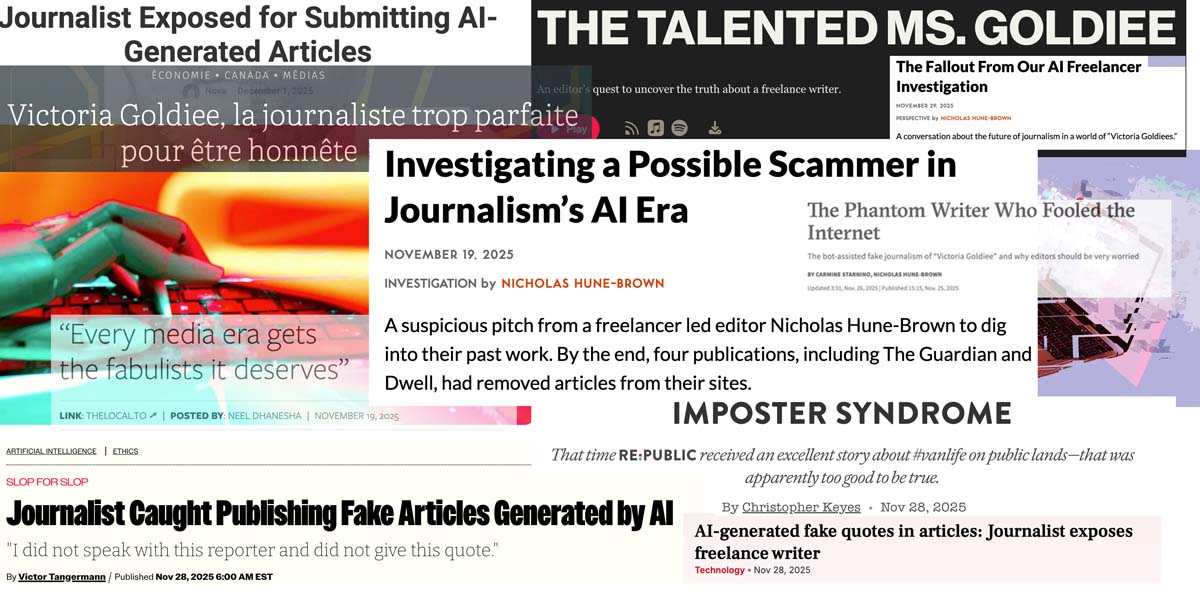
A story titled “Investigating a Possible Scammer in Journalism’s AI Era” popped up. Not only was this another case of AI infiltrating the editorial process, this one was an infamous imposter. In the story, editor Nicholas Hune-Brown, from Toronto’s The Local, related a tale of a writer named Victoria Goldiee with a “suspicious” pitch. Hune-Brown’s story was published in November 2026, about a month after we had received the pitch from Goldiee.
Another article, from Re:Public, detailed their dealings with Goldiee, who had promised an in-depth investigation on the realities of “van life” on public lands. They were already in the middle of editing the feature she had produced, when, getting frustrated with her reporting, they Googled her, found Hune-Brown’s newly published story, and discovered that they, too, were victims of her “journalism malpractice.”
What would Goldiee have written for Southwest Contemporary? Would she have interviewed Tanya Aguiñiga, or just invented quotes that would sound like something the artist would say?
I was curious, so I responded to Goldiee’s email positively, saying we might be interested, just to see what would happen. She never replied. She had already been outed.
Like the majority of the AI freelancers who pitched us, it appears that Goldiee lives in Nigeria. There were also a few from India and Pakistan. They appear to be real people, just working the system—a globalized, dispersed, virtual system propped up by the LLM bubble.
What would Goldiee have written for Southwest Contemporary?
Many of these writers never responded to my follow ups. One email bounced immediately: a true imposter, posing as actual Washington Post journalist Scott Nover, who had absolutely no business pitching Southwest Contemporary a feature “reimagining the road not just as infrastructure, but as memory, sculpture, and cultural archive.”
“What is their end game?” Jordan Eddy, our editorial director, wondered.
Freelancing for independent publications is a tough job, and, considering the time spent reporting, writing, editing, and polishing a well-crafted essay or feature, it doesn’t pay much. But if you could outsource the reporting and writing part to AI, $200 here, $500 there could be cobbled together into a respectable income.
Their end game—whatever would get them to that paycheck—was unlikely to win at Southwest Contemporary, however. Our editorial process and priorities include supporting writers who engage with the wider world but are experts in their own communities. We wouldn’t want a writer in Lagos, or London for that matter, to try to characterize contemporary art and practice in the Southwest to our readers.
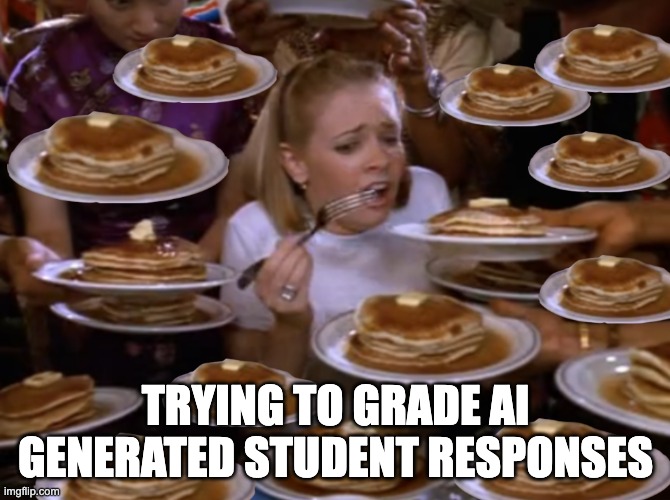
Getting inundated with AI pitches was dispiriting though, to say the least. So much time lost reading through successive pitches that aesthetically glanced across the surface of our subject—the Southwest—never quite piercing it. It felt like driving aimlessly and never reaching a destination. Like drifting along a ghost road, banal and wearisome.
One of Goldiee’s other pitches, in fact, was about “getting lost on purpose—driving without GPS in an age when every route is mapped, optimized, and recorded.” The bizarre construction of the following sentence should have tipped us off to the pretender: “The essay would resonate with the Southwest’s deep history of movement and mirage—a region defined by its vastness and by the artists who continually reinterpret that space.”
In a recent essay in Mousse, “Let’s Talk About Artificial Intelligence Art English,” critic Andrew Berardini observes, “AI doesn’t write from experience, observation, or genuine inquiry. It writes from pattern recognition, producing text that mimics the shape of meaning without ever touching its substance.”
[Reading these AI pitches] felt like driving aimlessly and never reaching a destination. Like drifting along a ghost road, banal and wearisome.
That’s precisely how you end up with nonsense like the “deep history of movement and mirage.” Berardini argues that AI’s imitation of art jargon springs from the material it was largely trained on: the hollow language of press releases.
About ten years ago, I was an independent contractor working for a global art market media company, contracted to write a weekly article covering the global art world. I usually pieced these together using press releases and media kits, combing Flickr to find installation views, and digging through Wikipedia and other databases. I wrote about places like Venice, Sharjah, and São Paulo without ever having been. In other words, I was personally, painstakingly performing the function of what AI does now.
This might be what some media outlets want: someone who can convincingly and cheaply offer coverage of anything, anywhere. The Victoria Goldiees of this new globalized, 100% remote, AI-infused content landscape can do that work. And much of it will be surface-level and vague and ineffectual. But as AI technology advances, more of it will pass muster and go unnoticed. As Berardini notes, the art world is already rife with it.
I’m not completely opposed to AI as a tool. I’m grateful for its usefulness in transcription software, for instance. But more and more of it feels intrusive—the AI assistant hovering over every word I write in emails, the redundant “AI overview” atop simple internet searches, the constant summarizing of documents I’m already familiar with, and the frustrating impossibility of turning those tools off. Rather than a helpful tool, AI is a bothersome and unwelcome presence—like an overbearing ghost hanging over me when I’m on my laptop or phone.
Writing is craft; it is inquiry, joy, flow, insight, and struggle. It feels alienating to have worked so hard crafting the call for “The Road”—in collaboration with our editorial team and advisors, and informed by a deep well of other authors and artists—only to have it reflected back to us in the distorted mirror of AI.
There is an antidote, thankfully. It comes out in print and on the web on Friday, March 20, in Southwest Contemporary Volume 13. I can verify that this issue contains authentic human expressions in writing and art, original reporting, and thoughtful criticism from writers embedded in their local communities. It contains surprising twists and turns, and conjures some of its own ghosts—but not the AI ones.