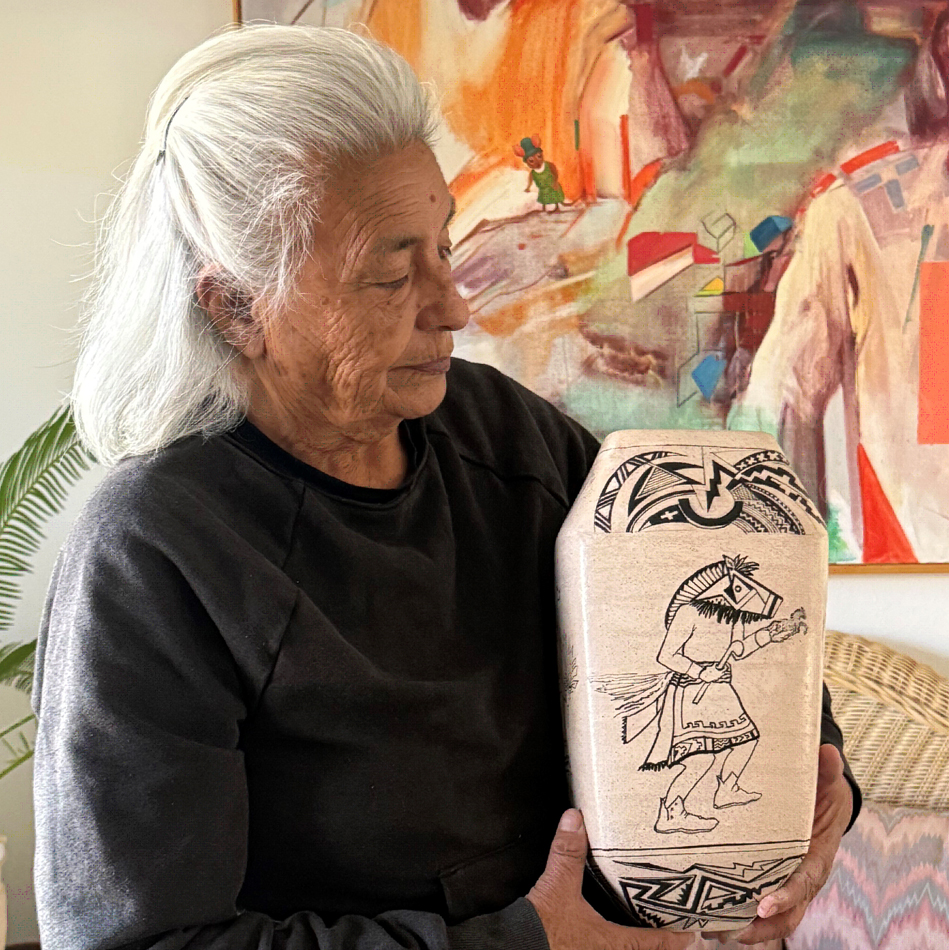
In the 1980s, Pueblo artist Jody Folwell jolted Santa Fe Indian Market with political ceramics. Amid her retrospective, the octogenarian is already pushing toward the next sharp statement.
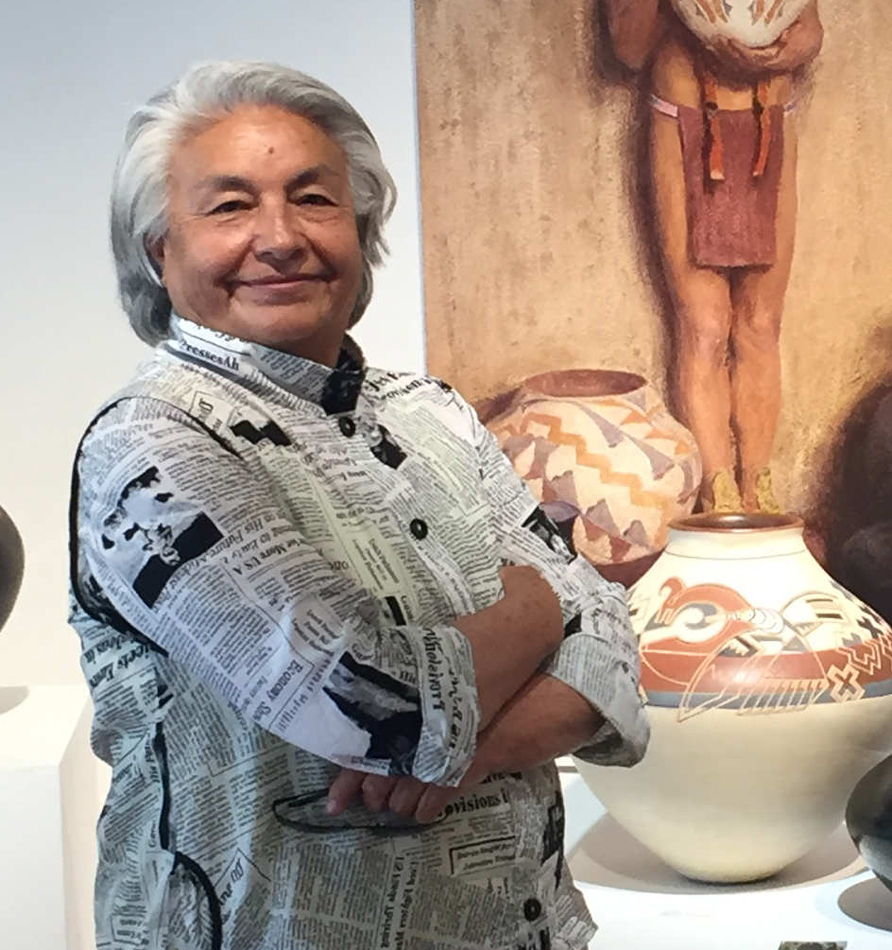
The potentially devastating consequences of a gas leak have Jody Folwell rattled. The celebrated contemporary potter is at home in Kha’p’o Owingeh (“The Place of the Singing Water”), the village where she was born and raised, also known as Santa Clara Pueblo, New Mexico. Thankfully, all is well: The local utility has resolved the issue.
Still, Folwell can’t help but recount her close call during our phone conversation on a March morning. It’s a reminder that life can change on a dime. And that fame doesn’t remove this artist from the daily duties—farm work, fence mending, gardening, yard clean-up, feeding and tending stray animals, picking apples and peaches for her neighbors, three children (two daughters are also potters), calling in gas leaks—that comprise Folwell’s busy life.
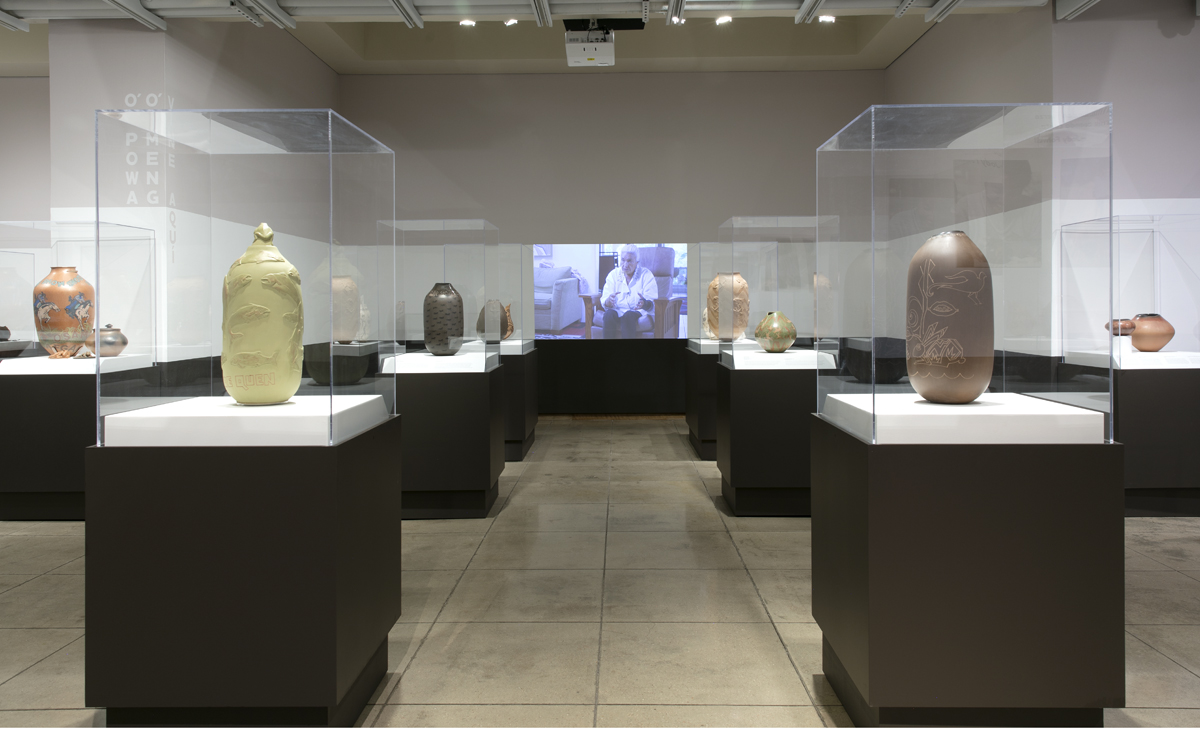
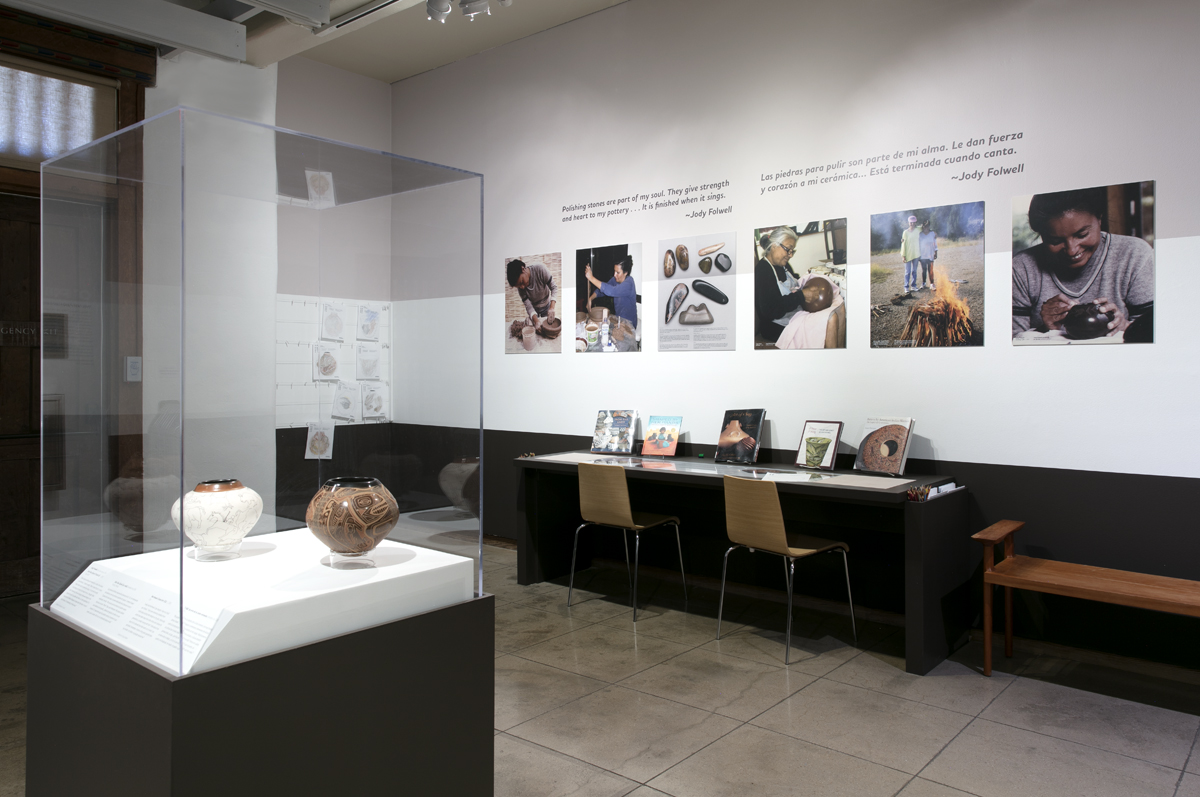
Didactics for the traveling exhibition O’Powa O’Meng: The Art and Legacy of Jody Folwell, now on view at the New Mexico Museum of Art in Santa Fe, state that Folwell has “revolutionized Pueblo pottery, and Native art more broadly, by pushing the boundaries of traditional form, content, and design.” The material doesn’t stop there. Folwell is also “the first Pueblo artist to use pottery for advocacy of social justice and political commentary.” And in her eighty-three years, nearly all of them involving clay work of some sort, the artist has “single-handedly set the trend for employing writing and innovative designs as direct narrative that is now widely used by younger clay artists.”
I was told I can’t do that. It wasn’t appropriate for our people and culture. The clay spirits didn’t want me doing this.
The twenty-plus works in the exhibition, a career retrospective organized by the Minneapolis Institute of Art and the Fralin Museum of Art at the University of Virginia, Charlottesville, attest to these pronouncements. The exhibition features forms and aesthetics not usually associated with traditional Pueblo communities.
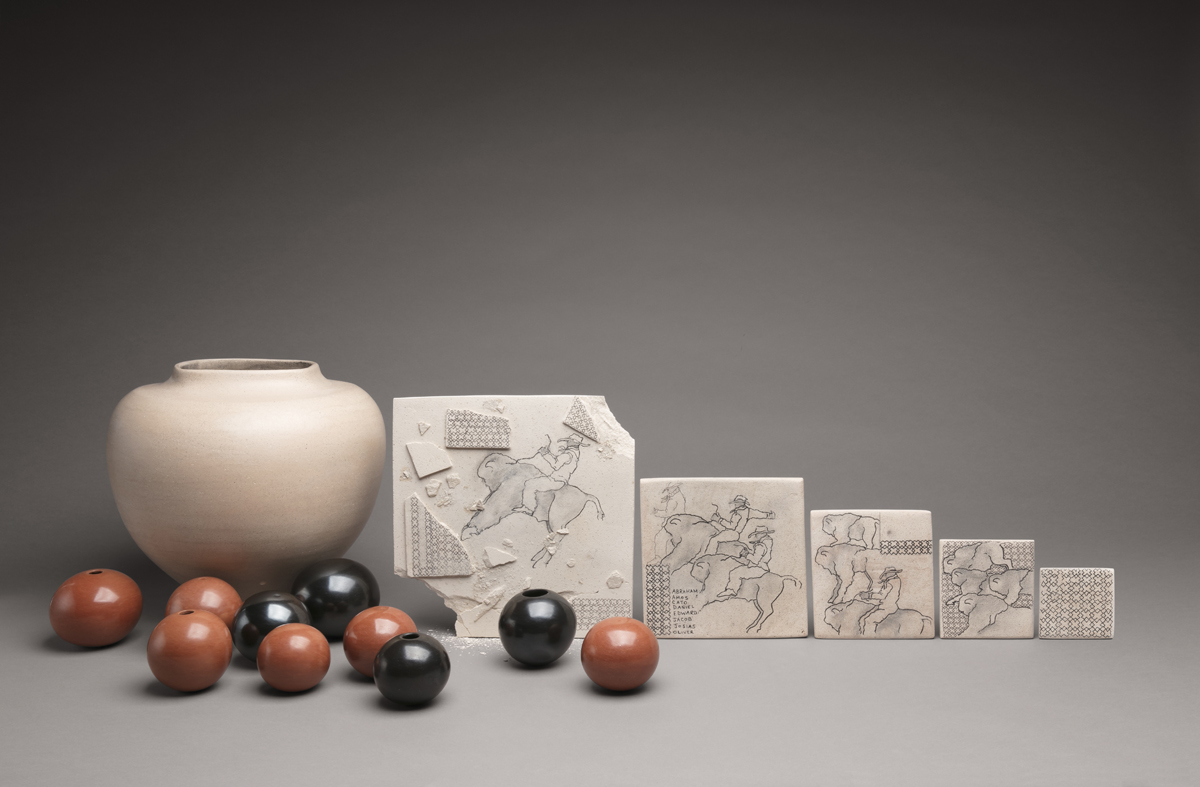
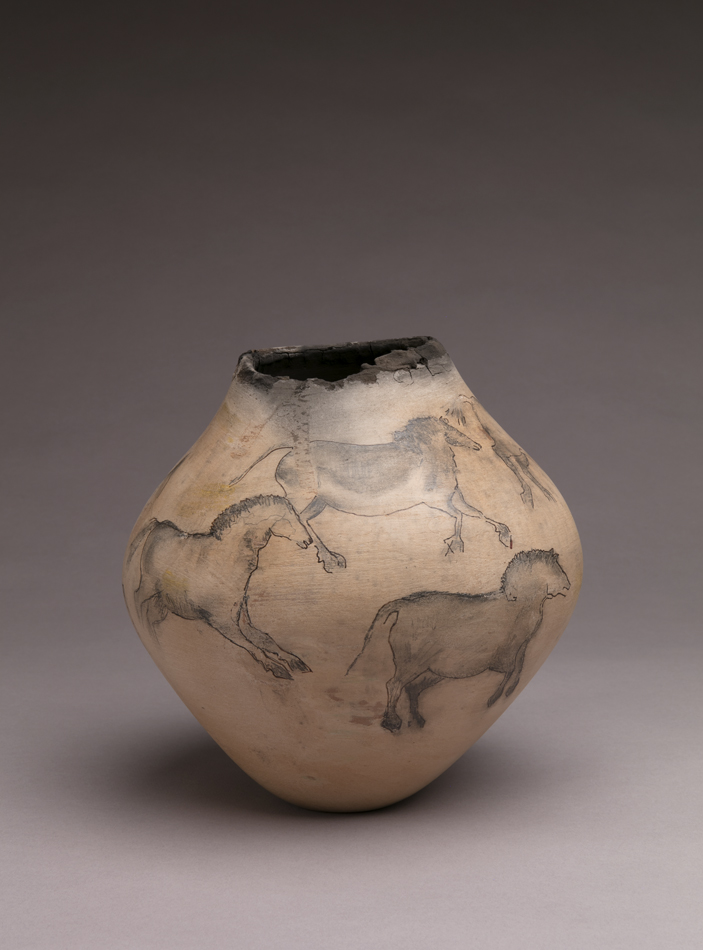
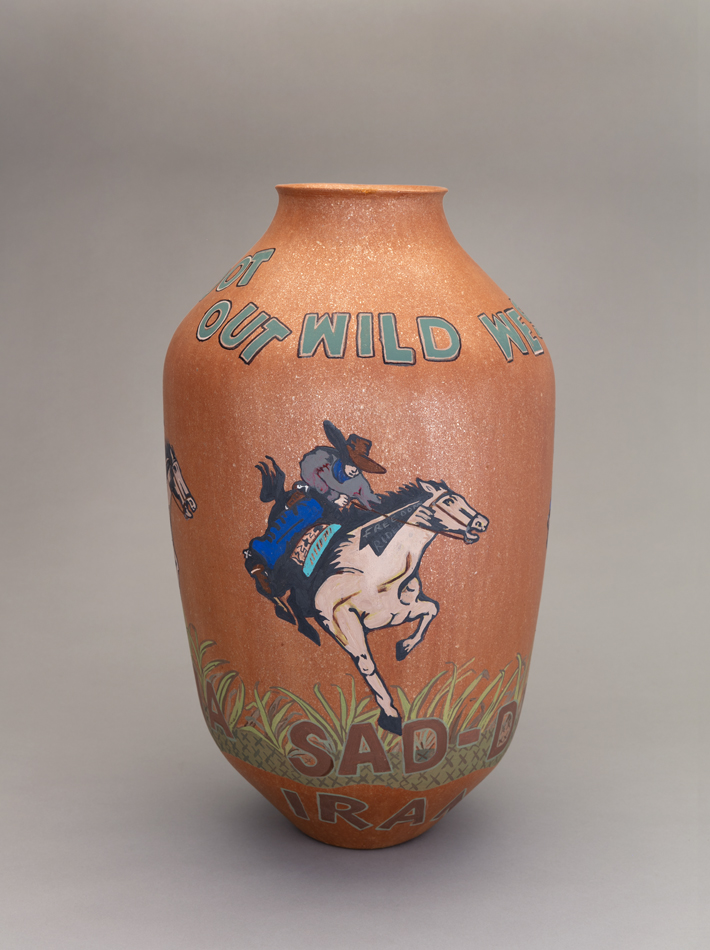
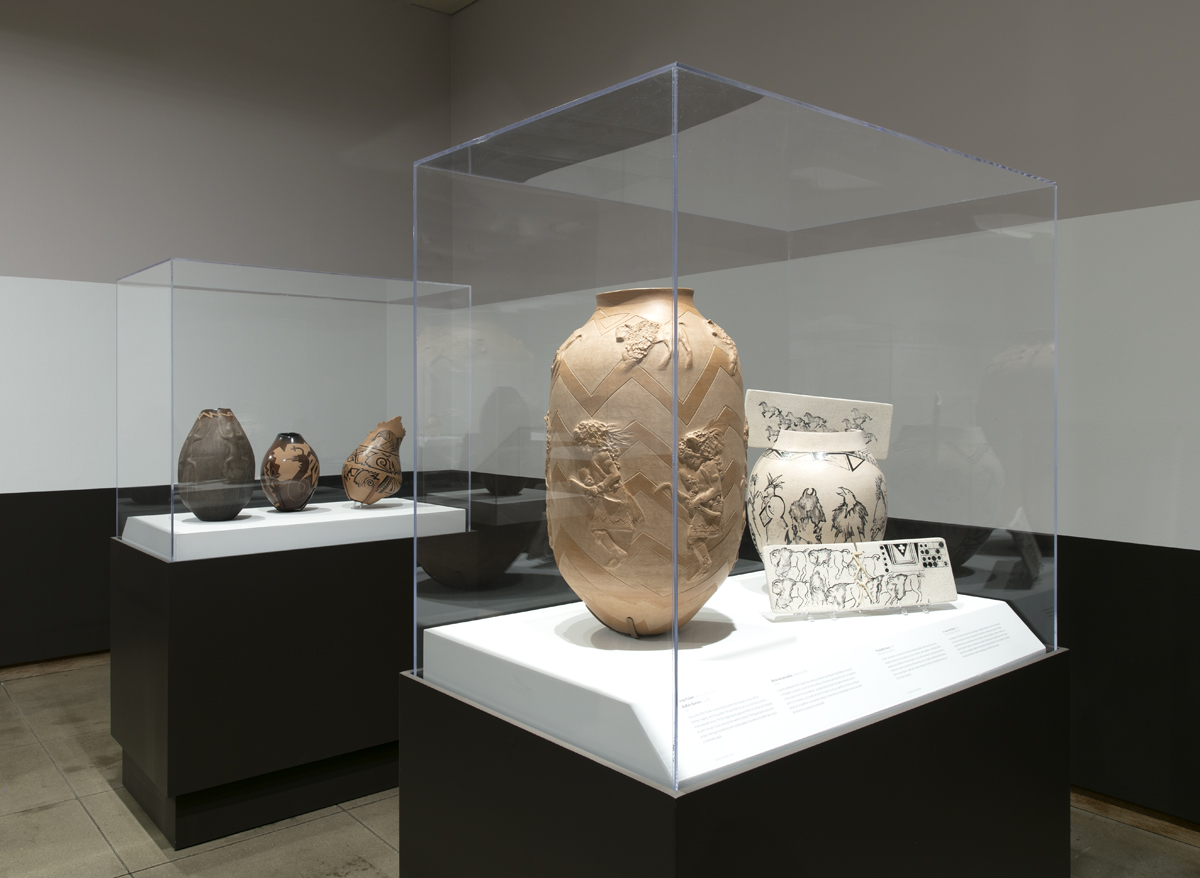
One has a rough, volcano-like opening and sides emblazoned with pop-art graphics and cartoon text (You Don’t Push Bush, 2003, a collaboration with Diego Romero). Another (Ancient, 2018) features a melted lip and Lascaux-style horses gliding along its sides. An homage to President Barack Obama, inspired by a rally Folwell attended (Buffalo Soldier, 2023), includes a white tile she broke, glued together, and painted with fine-line imagery and patterns.
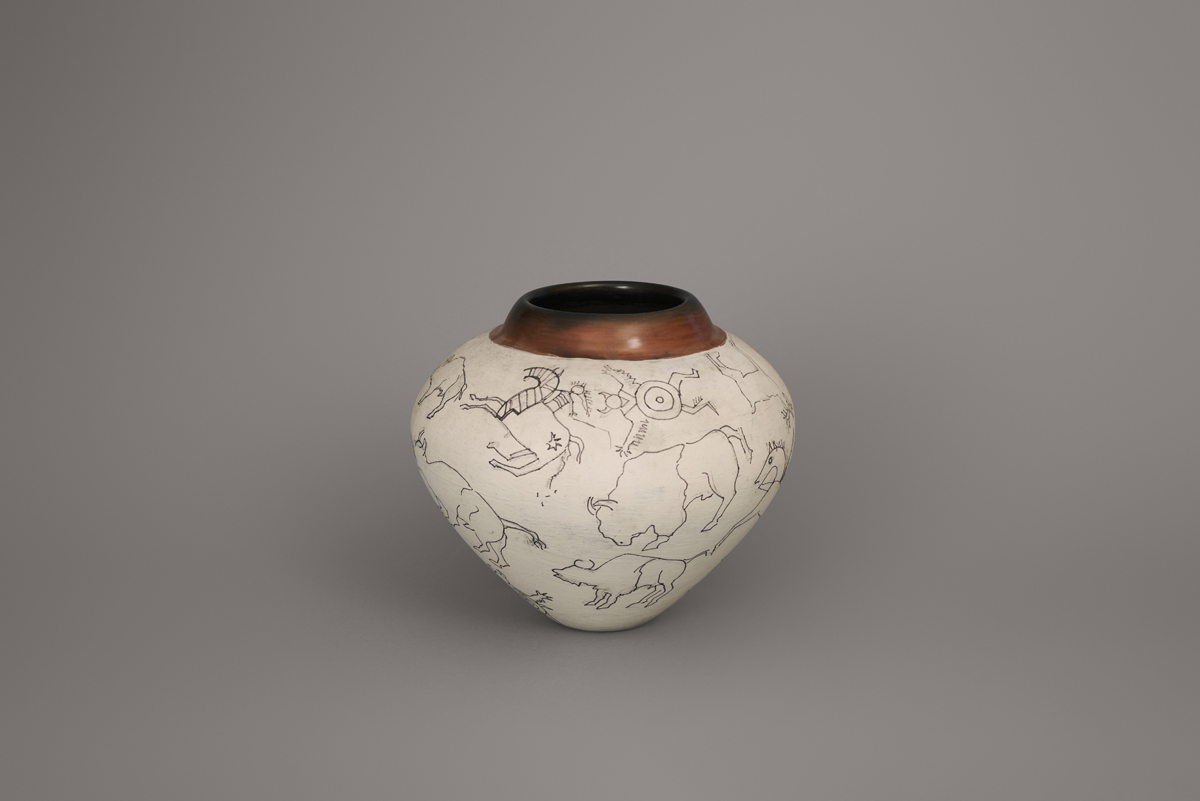
Doh San Quah (I Stole It) (2006) features Folwell’s interpretation of Plains Indian ledger art as painted graphics on a white pot with a smooth, lustrous opening. Her Japanese Inspired Ceramic (2015) is “a Japanese art explosion,” Folwell has said, with a smooth hand-polished bottom and “ring of fire” on top.
Her glistening green The Hero Pot (1984), a collaboration with Bob Haozous (Chiricahua Apache), helped launch her career, winning Best of Show at the 1984 Santa Fe Indian Market, and inspiring other artists to innovate with color and non-traditional slips. That includes her daughters, celebrated potters Susan Folwell and Polly Rose Folwell. Moreover, Diego Romero (Cochiti Pueblo) cites Folwell for establishing new ground for incorporating popular culture and social critique in ceramics, an area in which he also excels.
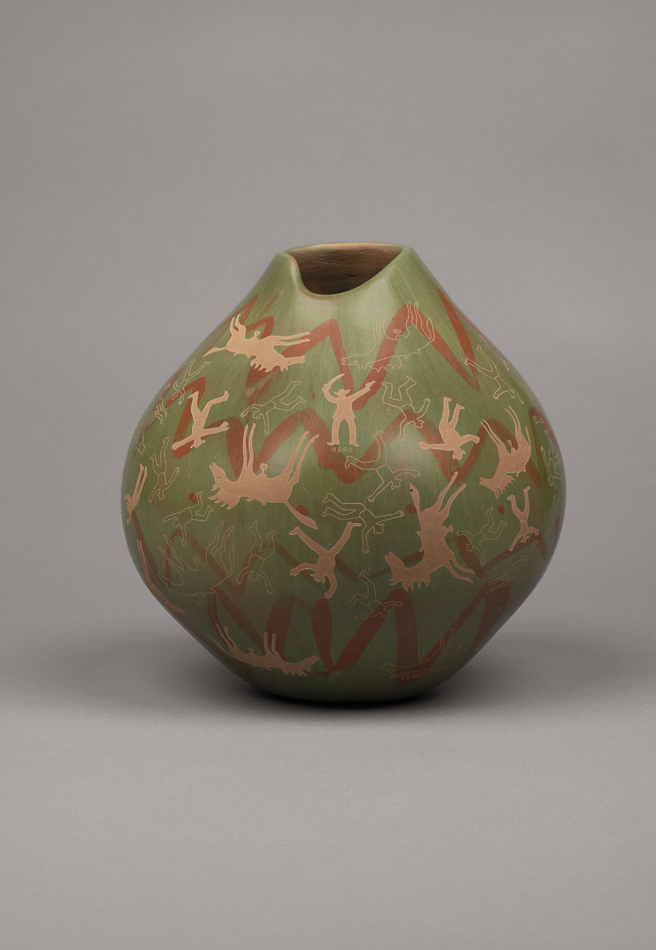
That work, however, also drew criticism from some market judges and viewers. It wasn’t Pueblo enough in color and shape. People at Santa Clara Pueblo, with its tradition of pottery-making extending back 2,000 or more years, also reacted negatively. “I was told I can’t do that,” Folwell recalls. “It wasn’t appropriate for our people and culture. The clay spirits didn’t want me doing this.”
The daughter of Baptist missionaries, Folwell had grown up making storage jars with her great-grandmother. She and her siblings would “help pick out the clay, wood, cow manure, volcanic ash, and mix the clay for her. When all of that was processed, we’d take our shoes off and stomp on the clay to mix it. Clay was part of our life, no different from having lunch or going to school.” Women from the Pueblo, including her mother, would also make baskets and clay pots to sell to white tourists who arrived in buses at Santa Clara. After earning degrees in history, political science, and early childhood education, and teaching for a bit, Folwell started making traditional pottery. It didn’t sell.
“So, I decided to take a step away and do more contemporary work,” she says. A local gallery snapped up The Hero Pot and her other work at the 1984 Indian Market. “I was really excited to find a path, my own way in life,” she recalls. She chose to show and sell her work only in San Francisco, Arizona, and New York. Moreover, “the older I got, the more I realized there are so many ways to do art, and the clay spirits won’t be unhappy,” Folwell says.
I look like a bag woman today. I’m floored by the accolades, but it doesn’t affect me.
O’Powa O’Meng translates as “I came home, I found myself, I’m going forward,” encapsulating Folwell’s approach to art and life. “I’m so grateful to my parents, grandparents, my community,” she says. “There isn’t a single person in the Pueblo [who] hasn’t affected how I deal with my work or offered me a way of knowing my work better.” Even though she lives in an “enclosed environment” in the Pueblo, she says, she continually makes notes on political events. “Right now, with what’s happening, the landscape for art is incredible.”
She’s currently working on pieces addressing the Trump administration and its policies, and Israel’s war. But when asked how she feels wearing the mantle of innovator, of being “the first” and “the best” at her art, she demurs. “I look like a bag woman today,” she says, laughing. “I’m floored by the accolades,” she continues, “but it doesn’t affect me. My life is so busy away from pottery and other people. And with me, it’s always, ‘What’s next?’ I have so much to do every day.” And with that, the eminent potter is off to prune bushes and rake her yard.
On view in Santa Fe through June 21, 2026, O’Powa O’Meng was co-curated by Adriana Greci Green, PhD, curator of Indigenous arts of the Americas at the Fralin; Jill Ahlberg Yohe, PhD, curator at Cafesjian Art Trust Museum in Minnesota; and Bruce Bernstein, senior scholar at the School for Advanced Research in Santa Fe.