Founder of the Office of Collecting and Design Jessica Oreck talks about the museum’s move into a trailer, her collecting origins, and how she meets her community on the road.
This article is part of our The Road series, a continuation of the ideas explored in Southwest Contemporary Vol. 13.
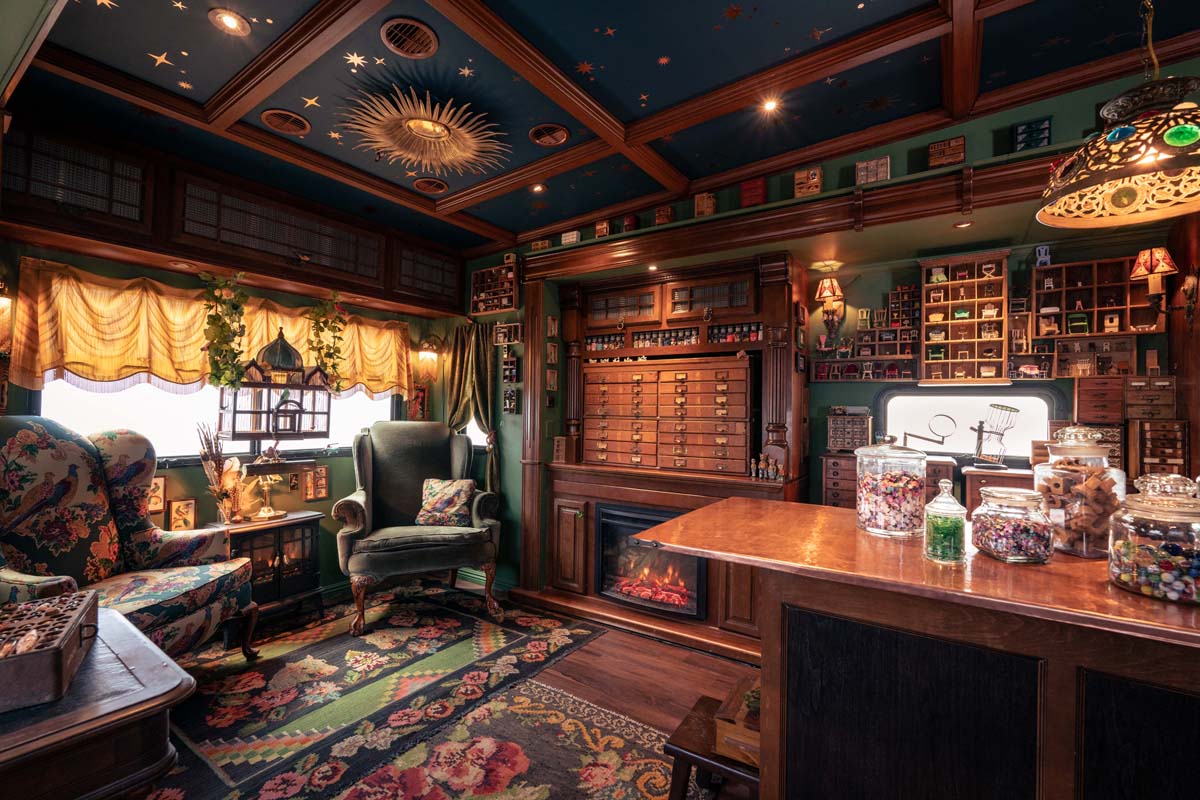
The Office of Collecting and Design, a traveling museum situated in a former mobile home, is a take on a cabinet of curiosities. From the outside, the Office is wrapped in mustard yellow, chocolatey brown, and mossy green. It advertises itself as a “wonderland, museum and nostalgia machine devoted to the diminutive, the misplaced, the unusual, and the forgotten.” Still, it looks very much like an RV, which makes stepping inside even more transformative and breathtaking.
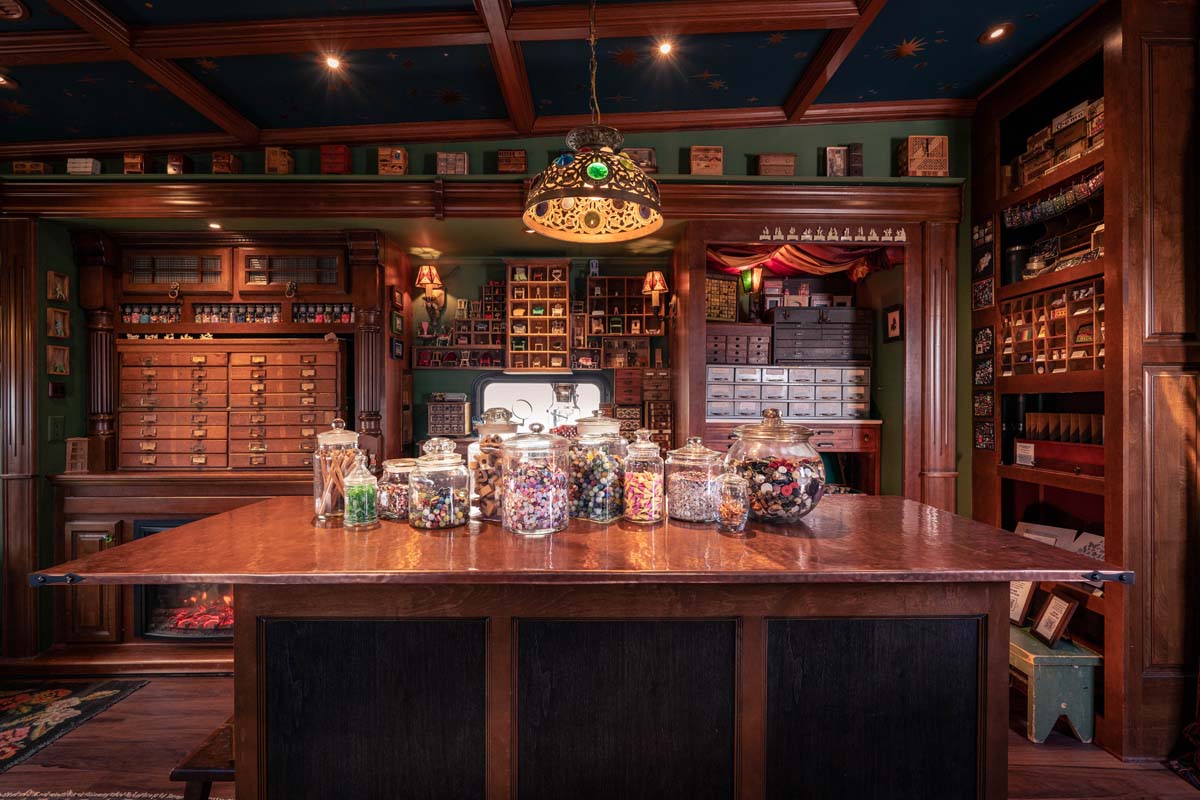
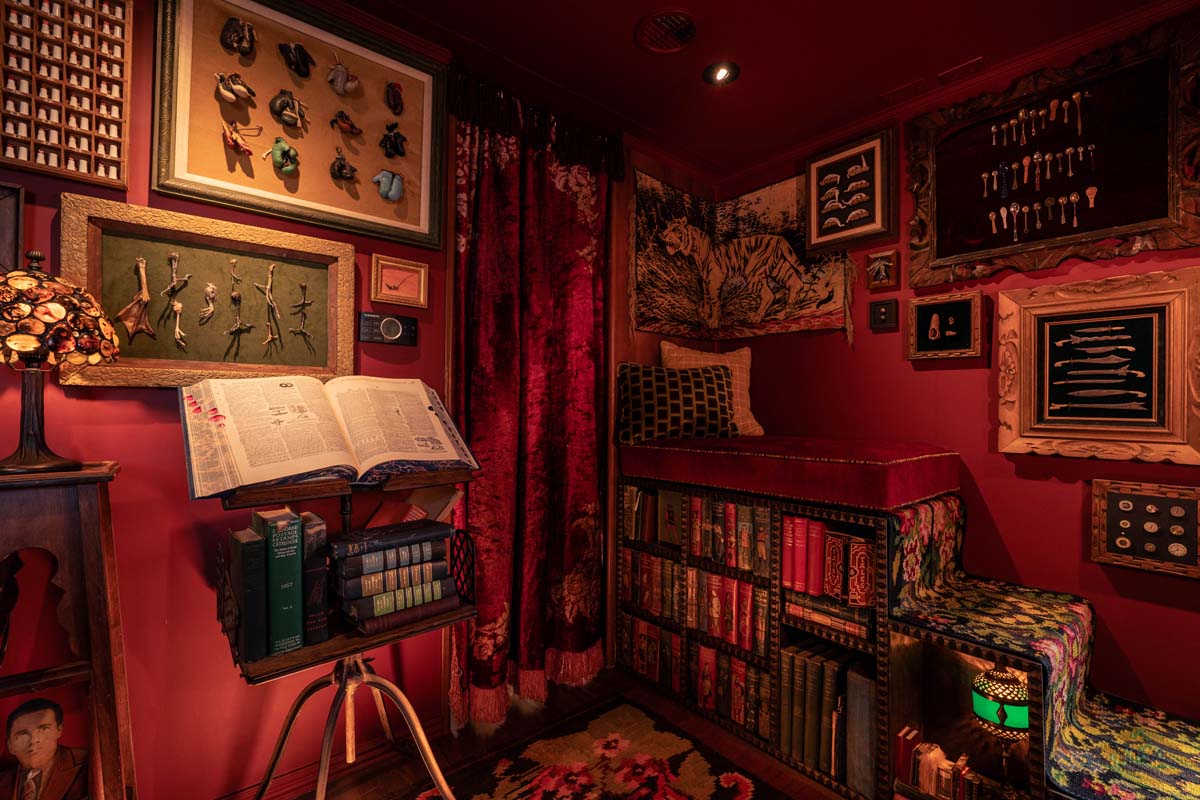
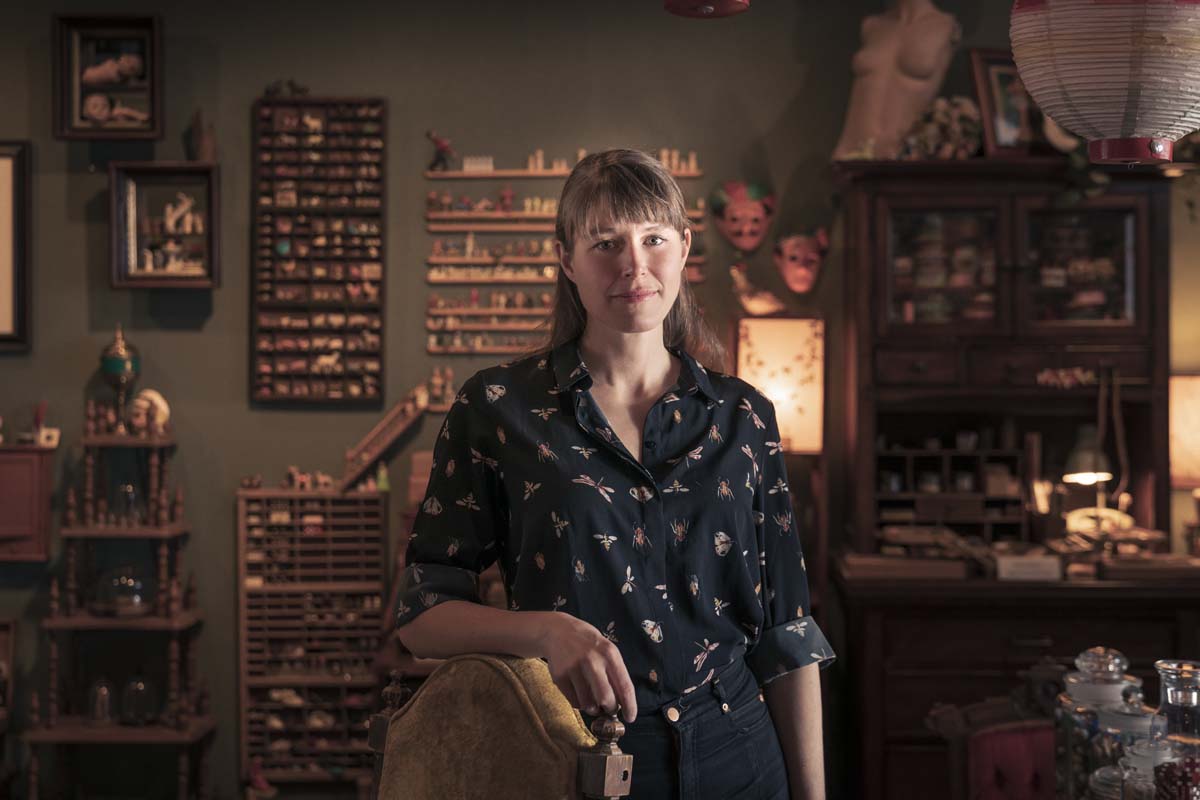
The trailer is surprisingly cozy with its warm green walls, fringed velvet curtains, and vintage armchairs. Light spills through a curtain made of old projector slides, illuminating lost family portraits and sun-faded landmarks embedded in the cardstock frames. The limited square footage is crammed with antique cupboards, flat files, and credenzas. Much of the furniture is stacked atop each other, sometimes towering from the floor to the ceiling, and any empty wall space has been filled with things like a floating shelf full of small telephones, a tapestry with a tiger, or a picture frame displaying mini spoons, with its glass removed so that the utensils invite human touch.
Most drawers are unmarked, but some categorize their contents: foreign chewing gum, plastic animals, teeth. Visitors are allowed to slide out the drawers and peek behind closed doors to discover the small objects nestled inside. I pull open a narrow, wooden drawer and find dozens of miniature food items, neatly separated into a grid with a matching wood separator. Little cakes occupy one cell, and two tiny puffs of cotton candy are in another. Everything in the Office is small, but not necessarily miniature. From another drawer, which I pull on a little too hard, spills full-sized cocktail swizzle sticks in the form of swords, umbrellas, and little men squeezed into pool floaties.
The museum’s founder, artist and filmmaker Jessica Oreck, has always collected small things, beginning in her tween years, when her grandmother gave her a set of vintage dice. Oreck was attracted to the way they had been worn down, and started to gather more chipped, scuffed, and off-weight dice that were no longer suitable for Vegas casinos.
“After that, I was hooked,” Oreck tells me over Zoom. She started scouring estate sales and flea markets for small objects, and says some of the best markets in the world are located in Russia.
“I love digging through the detritus of other people’s lives,” she continues, “and getting to piece together who could have had this and why. I call it ‘the residue of attention,’ the things that people have held on to, the love that they put into them, and how that gets carried on to the next person that holds that object.”
For an artifact to earn a place in the museum, it must be small, vintage, and show evidence of a life well lived.
For an artifact to earn a place in the museum, it must be small, vintage, and show evidence of a life well lived.
“I want stuff that’s human. I want something that’s actually old, that’s actually worn by human hands, and, if possible, made by human hands. But if not, at least, appreciated by human hands,” Oreck says.
Oreck always imagined that she’d open a place to showcase her collections, but envisioned it as something for her retirement years. However, a move to Las Vegas for her husband’s job, plus ample time off brought about by the pandemic, allowed Oreck to realize her vision much earlier. In 2021, she opened a brick and mortar location for the Office in a decaying strip mall, and ran the museum there for four years before taking it on the road.
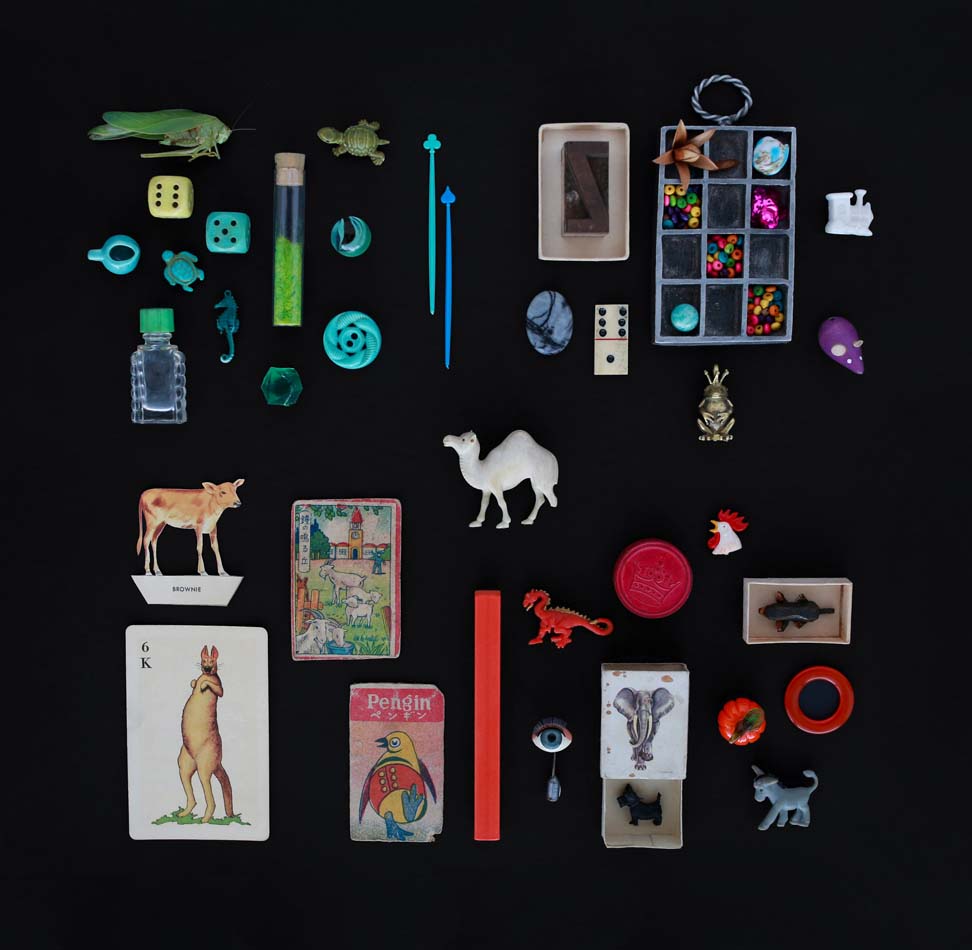
Everything at the Office is touchable, which allows visitors to unlock nostalgic feelings. Oreck says that one of the most popular objects is the jar full of stray buttons, which is prominently displayed on a countertop near the entrance. It seems to be a universal truth that every grandmother has a collection of mismatched buttons. But sometimes, a collection can trigger an unexpected emotional response, and Oreck can never predict which will do it. She recalls a jock-type who was dragged in by his girlfriend and showed little interest in the museum until he opened a drawer full of glass marbles. The man began to cry.
“He said it was like a freight train of his childhood rushing at him,” Oreck says.
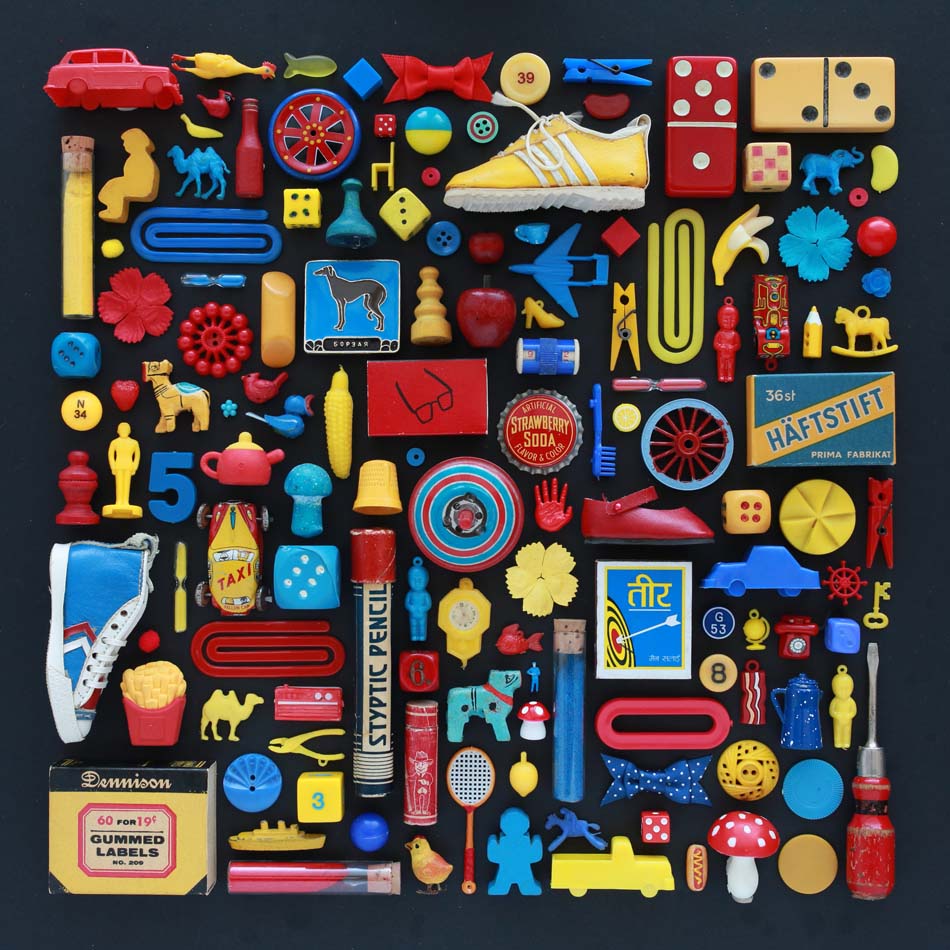
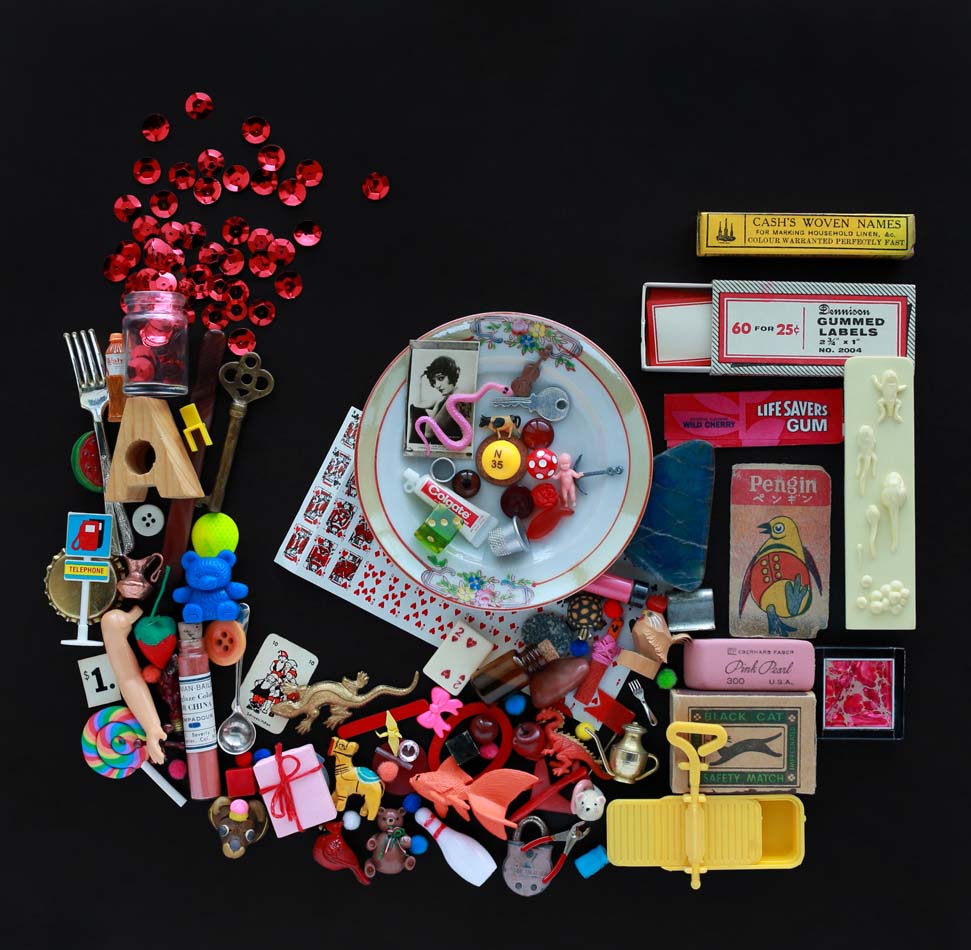
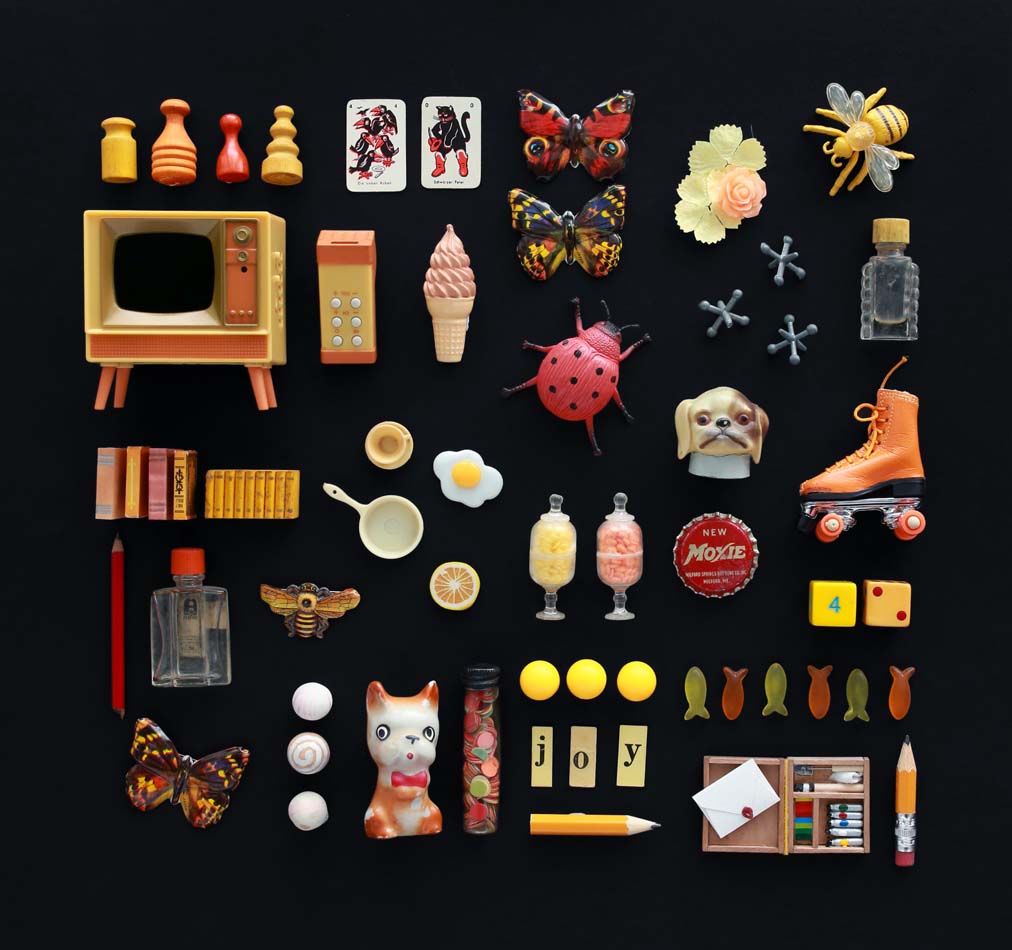
One can spend hours opening up every drawer and door in the museum, but visitors are also given the opportunity to complete a scavenger hunt or take a flatlay photography workshop. The latter activity invites people to curate their own collection, place their tiny camels and big tops in a neat array, then photograph the arrangement from above in a compact, but well-lit studio located at the front of the trailer.
“It ends up somewhere in between play, therapy, and art practice,” Oreck says. “It’s an incredibly intimate way for people to interact with the objects.”
Over time, the Office steadily built up a following around the world and between its various “clubs” has hundreds of subscribers. Many have never even made it out to Las Vegas to see the museum in person.
When the strip mall wouldn’t renew the Office’s lease in 2024, Oreck took the opportunity to fulfill another dream of hers—transform the Office into a travelling museum—which could help her reach her fans.
“Being on the road is my favorite thing on the planet, right in front of collecting,” Oreck says.
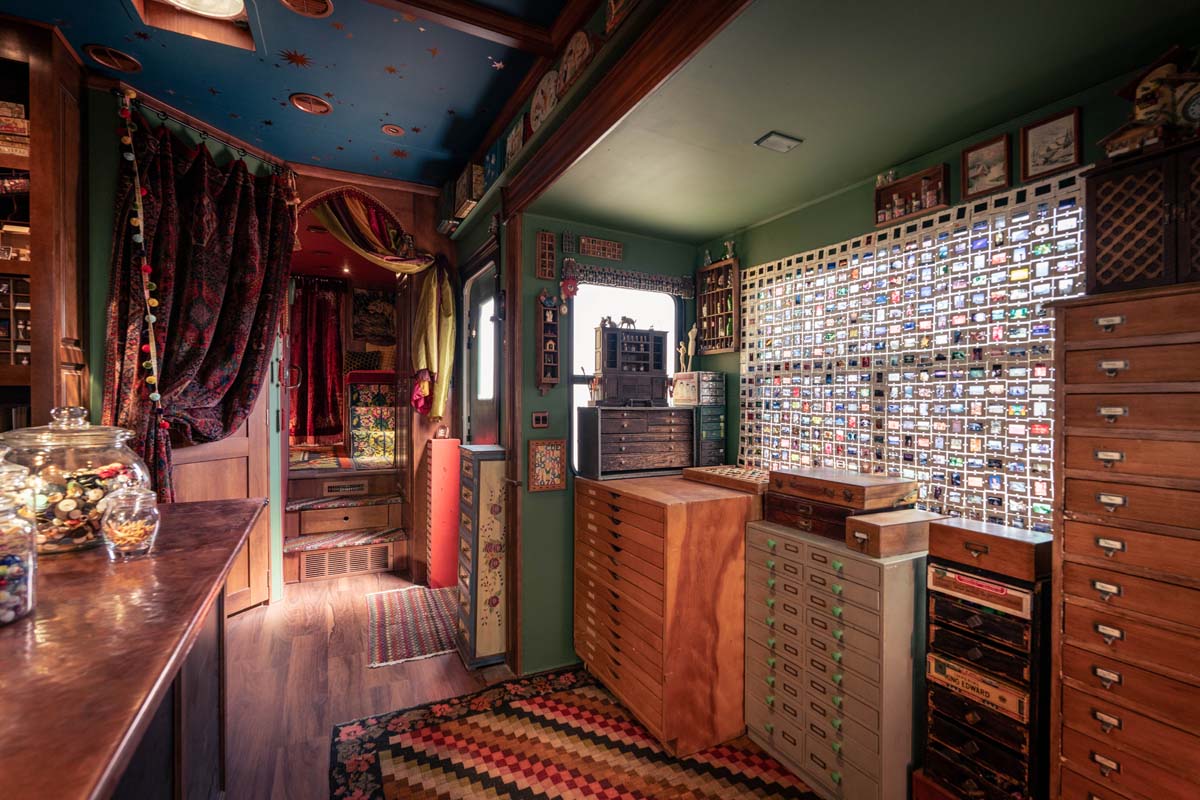
Referencing train cars, traveling caravans, and circus tents from the late 19th and early 20th centuries, Oreck envisions the Office as an unexpected joy that would come to town and take people by surprise. She scoured Craigslist and Facebook for an RV that could be gutted and remodeled into the Office’s warm, wood-trimmed study with gold stars painted across the deep blue ceiling. With funding from a successful Kickstarter campaign and manpower from family and local volunteers, Oreck got the museum into shape in about eight months.
With a fragile, and easily scatterable, collection, Oreck had to think of unconventional ways to keep the museum secure while twisting through narrow mountain ranges and bumping against potholes. There are strategically secured dowel rods that block drawers from spilling open, layers of foam padding and blankets, and thousands of coats of glue. Oreck explains that their biggest trick is rubber cement, which prevents tiny porcelain jars and wooden ducks from jostling around, but is easily loosened when visitors pluck objects off the shelves for their flatlay assemblages.
It takes a full half-day to set up the traveling Office, and another half-day to pack it back up. For that reason, the museum tends to stay put for about five days at a time. Recent tours included stops at the Portland Museum of Art and Material in Salt Lake City. The snug space can only hold six people at a time, and appointments sell out quickly. Oreck estimates that, for an entire six-city tour, they can accommodate 1,000 visitors.
It’s like dangling a giant magnet into a town, and everyone that I would want to hang out with comes to this museum.
Oreck has already taken the museum throughout California and the Pacific Northwest. In the fall, she’ll make her way throughout the Southwest, including Phoenix, Tucson, El Paso, Santa Fe and Taos. Sometimes, Oreck is overwhelmed by taking on a booking manager role, as she would prefer to focus on making art, films, and growing the collection; but Oreck is the museum’s only full-time employee, so she has to wear every hat.
When the tours are in motion, Oreck tows the trailer with a Ram pickup truck. The Office does not have bathrooms, or even running water, so she has to book hotels or tap into the Office’s fanbase to find a place to stay. Luckily, many have an extra bed, and are thrilled to have Oreck in their city.
In the end, the enthusiastic community is what makes the Office roll on.
“I very quickly realized that the objects meant so much less than the people that I was meeting,” Oreck says. “It’s like dangling a giant magnet into a town, and everyone that I would want to hang out with comes to this museum. I just get to meet the most amazing people, and I love to watch people have joy and delight. It’s such an unusual thing for adults to be able to feel.”