In Shifting Topographies, three artists’ varied approaches find common ground in exposing the deadly threat of extractive industries.
Shifting Topographies: Extracting the Landscape
October 18 – December 20, 2025
Coconino Center for the Arts, Flagstaff
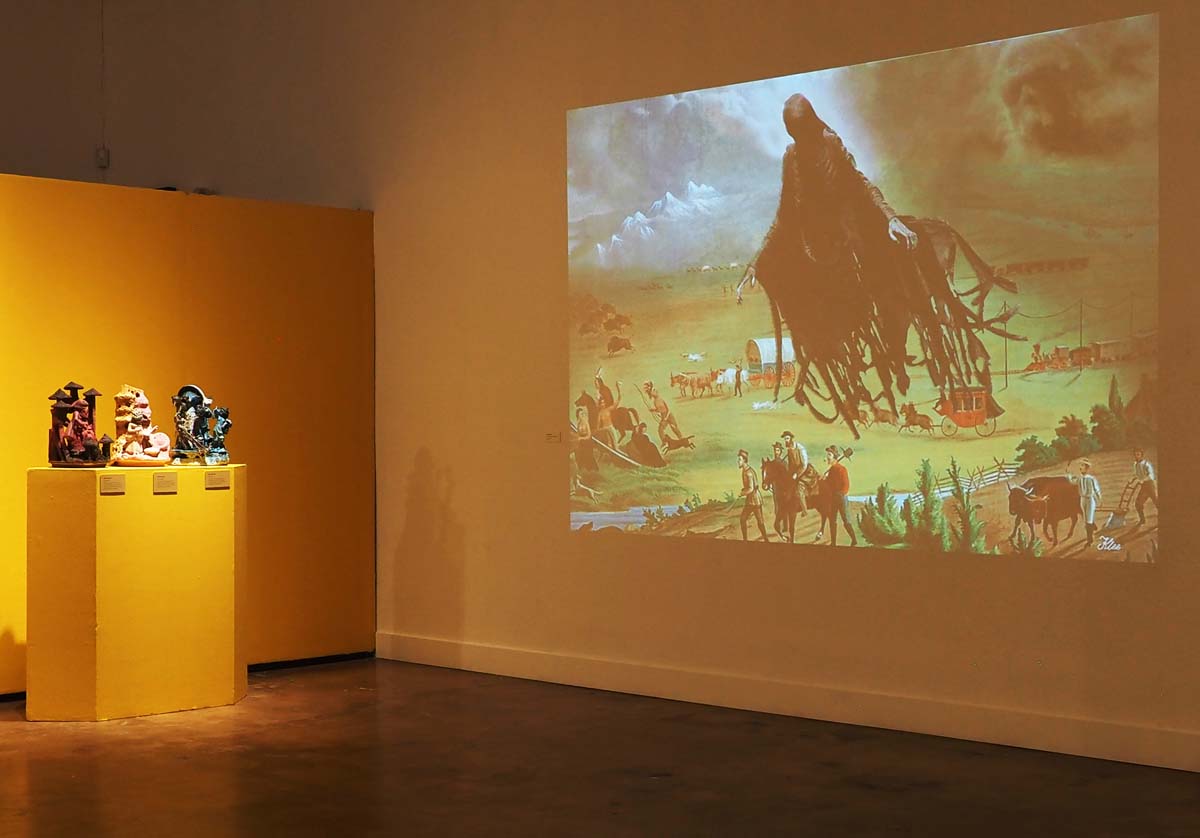
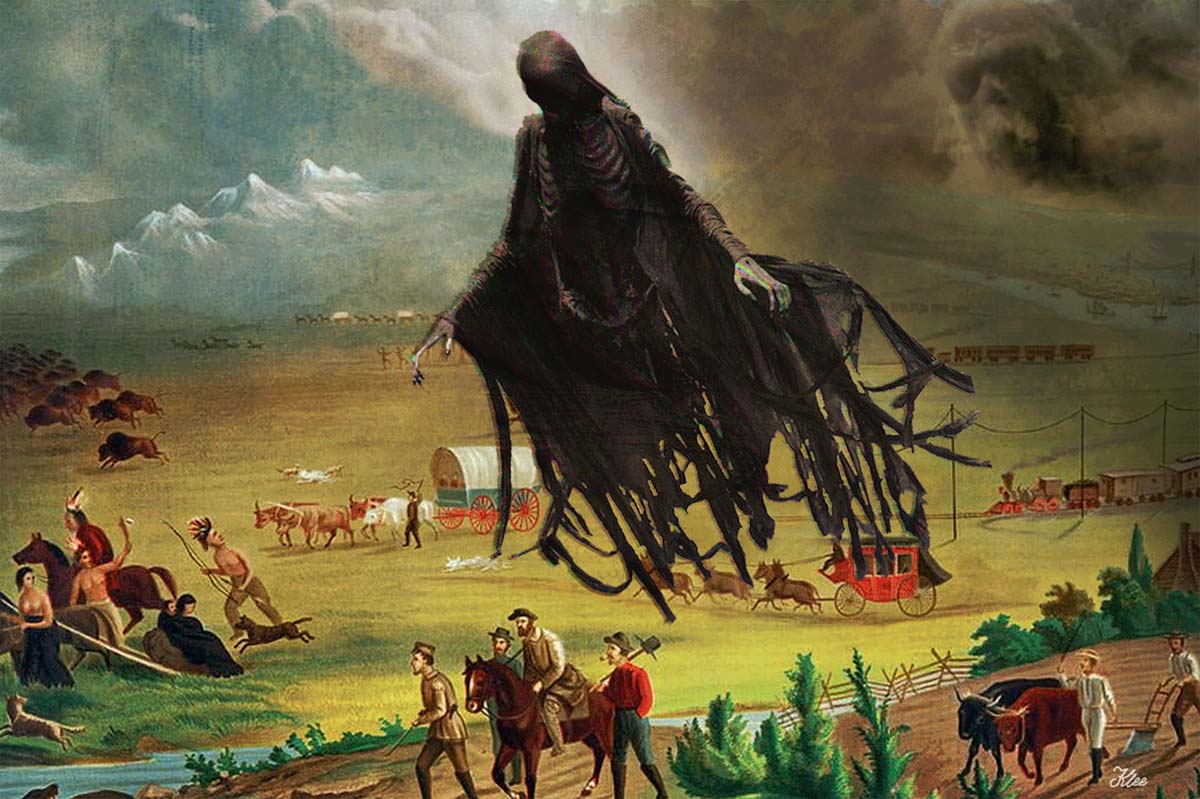
It would be tempting to focus only on the late Klee Benally’s (Diné) The Dark Mark of Manifest Destiny (2021) in the exhibition Shifting Topographies: Extracting the Landscape. Benally’s digital gif, projected on a wall and flickering with seeming technological disruption, magnificently reimagines John Gast’s colonialist manifesto American Progress (1872). Benally replaced Gast’s busty blonde Caucasian woman in scanty, billowing white gown—and who carries a school book (a horrifyingly prescient reminder of American Indian boarding schools) while dragging a telephone wire as she floats above scenes of pioneer “expansion” and fleeing Native people—with a massive, masked skeletal figure in tattered black, fingers outstretched like claws.
Death made manifest, for the millions of Native people slaughtered, forcibly removed, and otherwise denied their heritage, sustenance, and land in the colonialist project of Manifest Destiny. A message reinforced by the skull that is floating—black, gray, and ominous—in the upper right corner of the artwork. It’s a potent reminder of the myriad extractions—from Native people and their cultures to the natural resources embedded in their lands—that have already occurred, and some of which continue to this day.
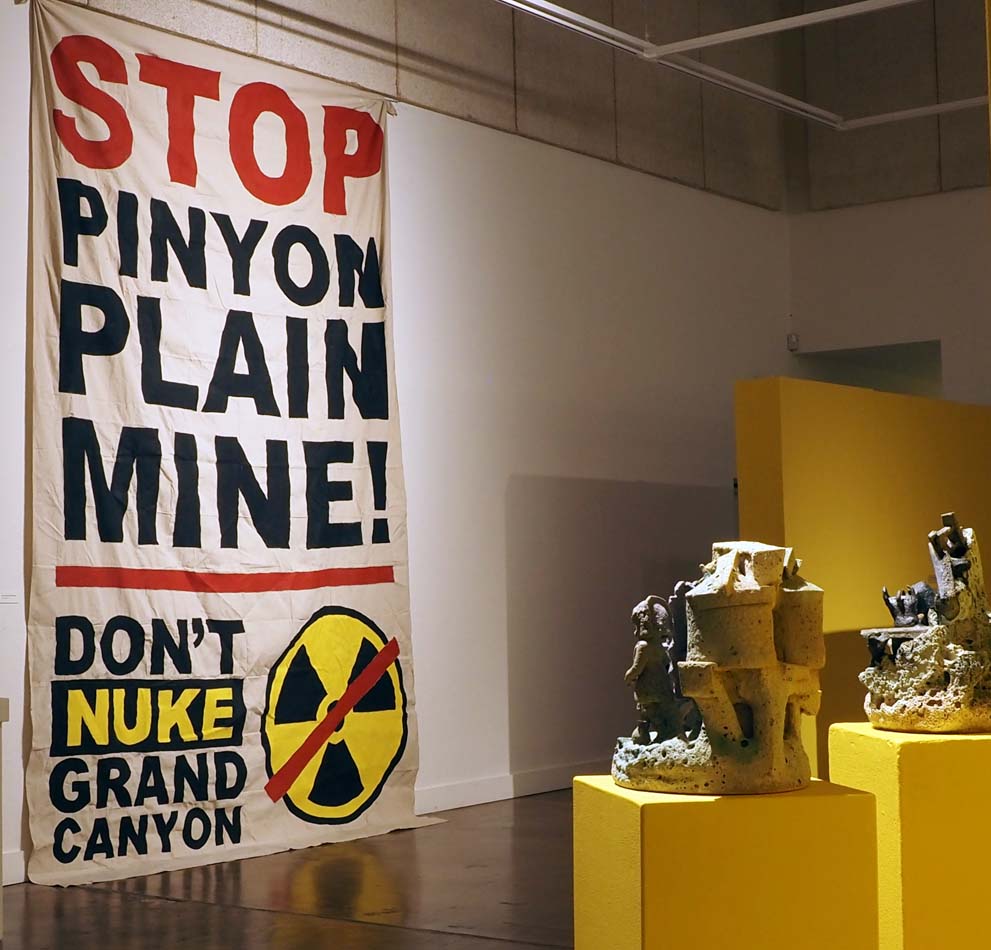
But such attention would overshadow other works by Benally—who lived at Black Mesa on the Navajo Nation, and in Flagstaff—in the exhibition. Such as his drum set made from oil barrels and stickered with radioactivity symbols, album cover posters, and banners from his activist music, performance, and artwork that sought to expose the impact of uranium mining and waste on Indigenous communities throughout the Colorado Plateau. Similarly, Montana-based Carol Hartman’s topographical abstractions of fracking and oil-drilling sites, and Georgia-based Jeff Schmuki’s mutant ceramic sculptures, glazed with mine tailings and lithium oxide, deserve close study.
The exhibition’s “timely and relevant exhibition theme—extraction—takes on a markedly different approach depending on the geographical and cultural perspectives of the represented artists,” states the website description. Indeed, it does. But the three artists’ diverse approaches to artmaking, with reference to the extraction of earth’s natural resources, find common ground in their subversion of the ongoing colonialist project of late capitalism.

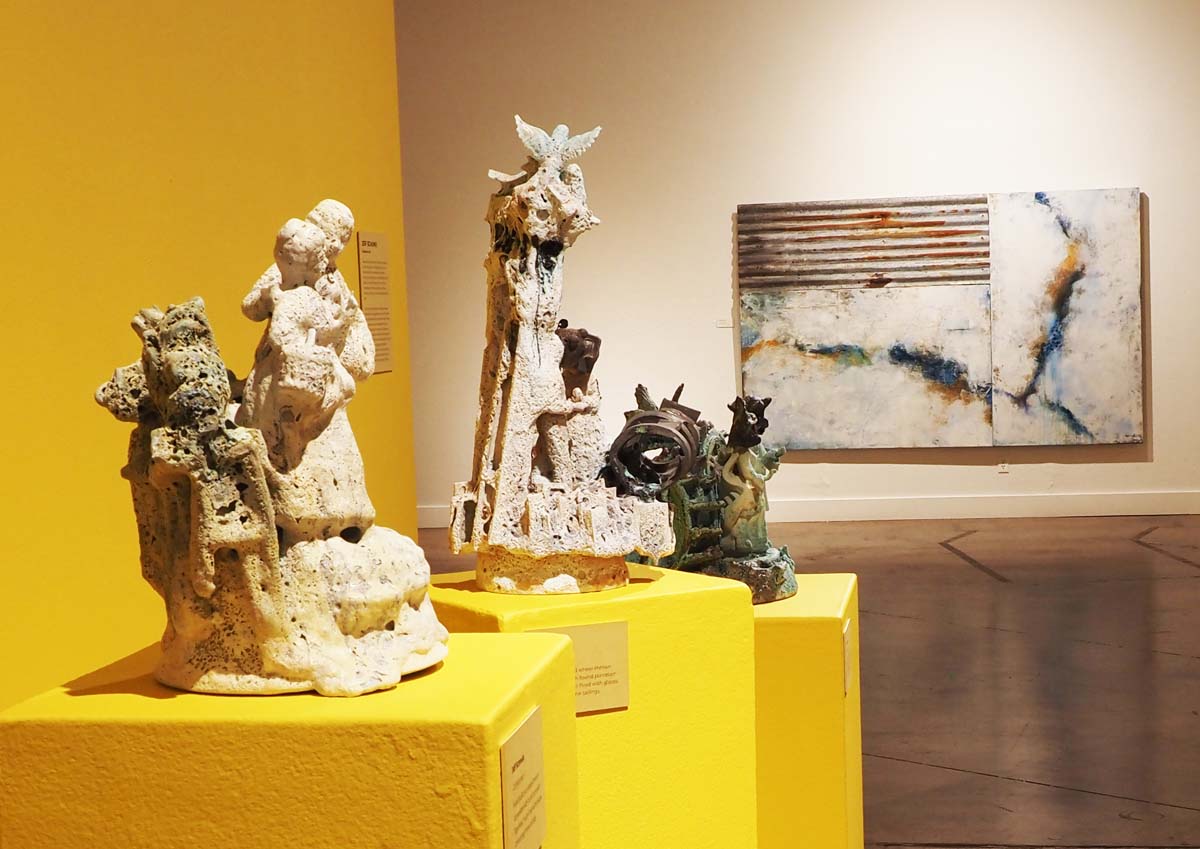
Often buried within Schmuki’s pieces are formerly demure porcelain figurines—think colonists in waistcoats and petticoats, or plantation owners—that are drenched in layers of glaze, given demonic, animalistic, even cordyceps-like heads, and pockmarked. The deranged sculptures appear as if eaten by pollutants, retrieved from a nuclear blast site, or radiated into extinction. The figures, embedded in the rugged terrain of the works’ surfaces, are the ghosts of colonialism: arrested in time and space, but as mutable to the effects of extraction as landscape.
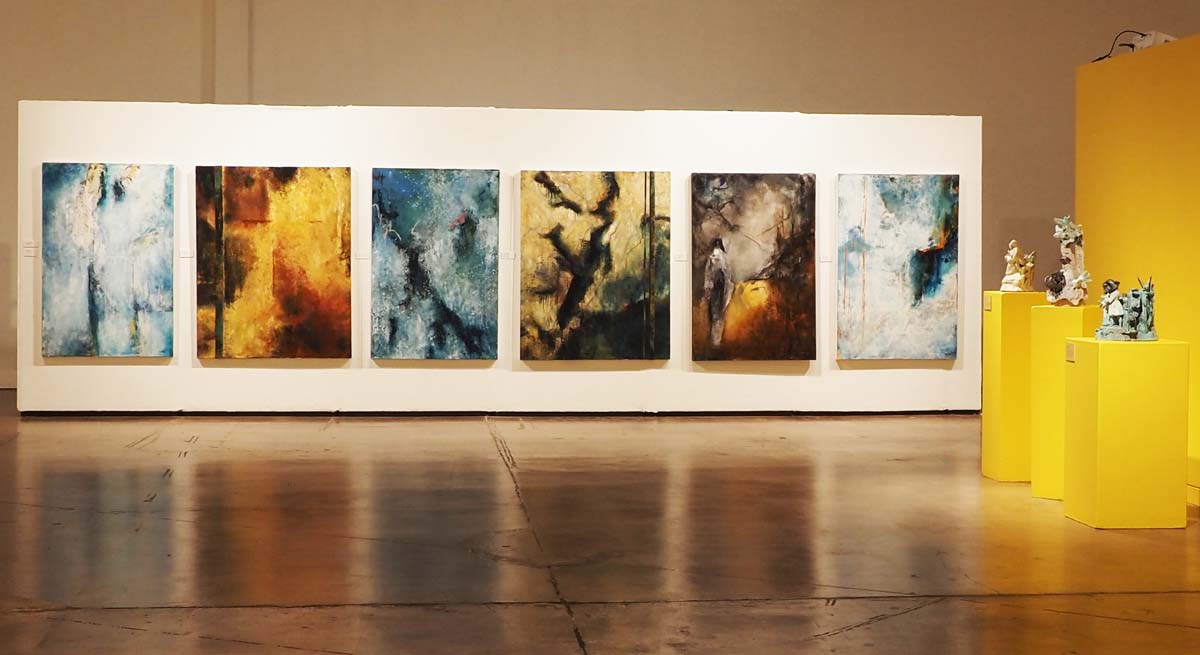
Hartman’s thickly layered paintings, in particular the fracking series occupying one wall, conjure aerial maps or topographies of grief. The large-scale pieces are riven with fracture lines, meandering canyon-like forms, and, in one instance, areas of canvas surging with the reds, yellows, blacks, and orange of fire. Another, however, is awash in cleansing whites and blues—offering a sense of hope for the earth.
It’s a potent reminder of the myriad extractions—from Native people and their cultures to the natural resources embedded in their lands—that have already occurred, and some of which continue to this day.
That relief also surfaces in Benally’s activism and artist statement, and in the efforts of the Tó Nizhóní Ání and Haul No! groups whose messaging, which takes Navajo leadership to task for not protecting the Navajo Nation from uranium transportation, are also included in the exhibition as placards and posters.
Additional bits in the exhibition, including examples of uranium glass and a uranium detector, and clothing with resistance messages designed by Native artists, are curious curatorial choices, but loosely connect largely with Benally’s activist work, and the museum’s mission to connect art, education, and science within its exhibitions.
Hartman’s Into the Light (2024), however, symbolically encapsulates what Benally’s The Dark Mark of Manifest Destiny predicts in landscapes throughout the U.S. in 2025: abstracting the form of the American flag, her piece incorporates the horizontal lines of corrugated metal in place of stars, with what appears as a river—damned, dark, bloodied in places—winding through a depleted, blasted landscape. The strength of exhibition, with its theme of extractive environment threats facing the West, lies within the potency of the artwork itself.